OpenAPI describes APIs. x-openapi-flow turns them into executable workflows — for developers and AI agents.
Define your API workflows in openapi.x.json and execute them without writing custom clients or orchestration logic







🚀 2,100+ downloads in the first 3 weeks!
npx x-openapi-flow init --suggest-transitions
This generates an openapi.x.json file where you can declaratively define how your API should be executed — not just described.
See your API lifecycle come alive from your OpenAPI spec, with one simple command
Validate, document, and generate flow-aware SDKs automatically.
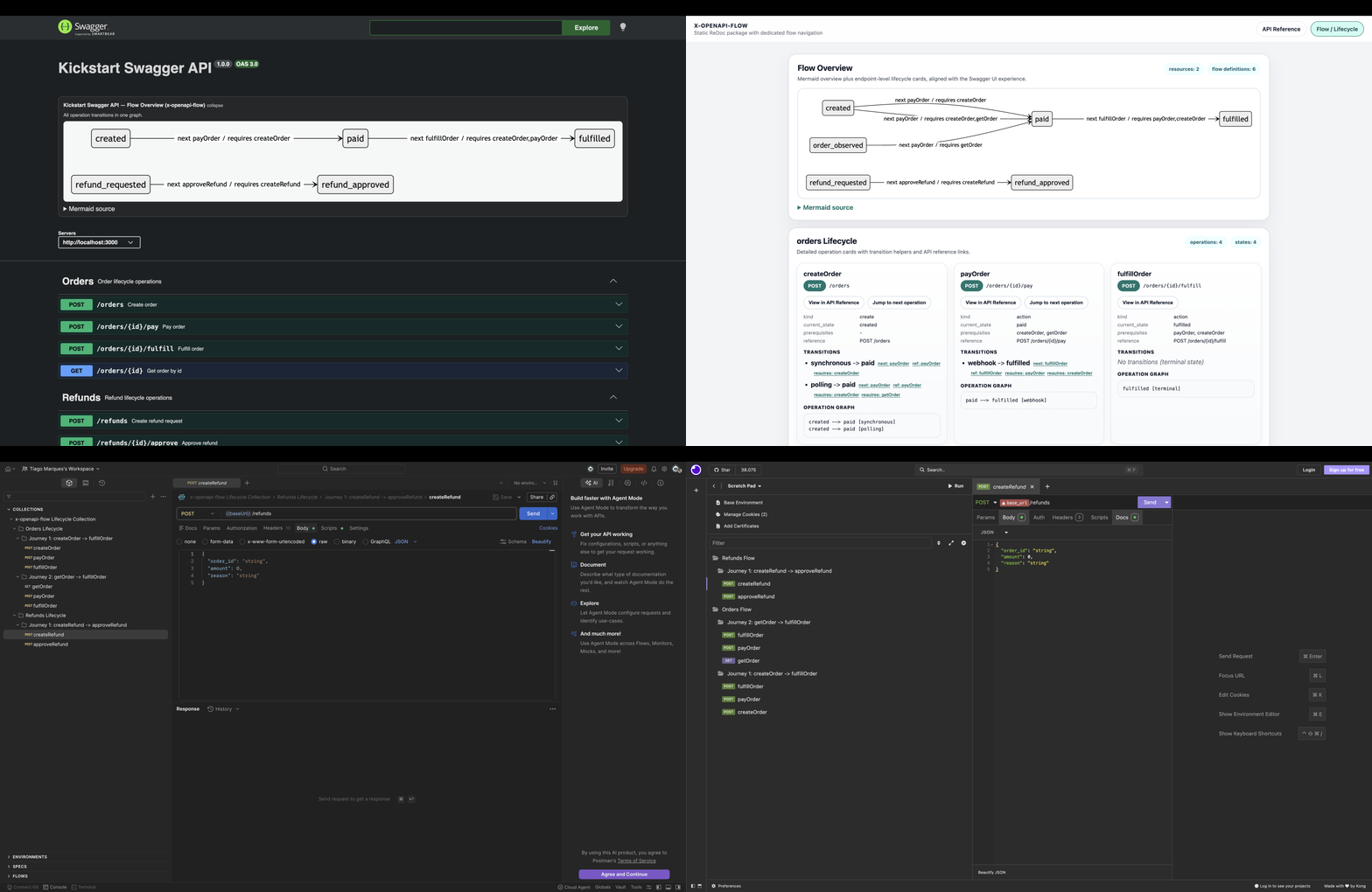
openapi.json → describes your API
openapi.x.json → describes how to use it (flows)
Instead of writing imperative code to orchestrate API calls, you define workflows declaratively and run them anywhere.
x-openapi-flow adds a declarative state machine to your OpenAPI spec.
Model resource lifecycles, enforce valid transitions, and generate flow-aware artifacts for documentation, SDKs, and automation.
Define stateful workflows and lifecycle transitions directly inside your OpenAPI operations:
{
  "operationId": "createOrder",
  "x-openapi-flow": {
    "version": "1.0",
    "id": "create-order",
    "current_state": "created",
    "description": "Creates an order and starts the lifecycle",
    "transitions": [
      {
        "transition_id": "order-created-to-paid",
        "trigger_type": "synchronous",
        "condition": "Payment is confirmed",
        "decision_rule": "payOrder:response.200.body.payment_status == 'approved'",
        "target_state": "paid",
        "next_operation_id": "payOrder",
        "operation_role": "mutate",
        "prerequisite_operation_ids": ["createOrder"],
        "evidence_refs": [
          "payOrder:response.200.body.payment_status"
        ],
        "propagated_field_refs": [
          "createOrder:response.201.body.order_id"
        ],
        "failure_paths": [
          {
            "reason": "Payment denied",
            "target_state": "payment_failed",
            "next_operation_id": "getOrder"
          }
        ]
      }
    ]
  }
}
This flow defines an order lifecycle directly inside your OpenAPI:
- Starts in the
createdstate - Transitions to
paidwhen payment is confirmed - Supports both synchronous and polling-based transitions
- Propagates data between operations automatically
- Can include explicit decision/evidence and failure-path metadata for AI-guided orchestration
Instead of manually orchestrating API calls, the workflow is fully described alongside your API specification.
Building APIs is cheap. Building complex, multi-step APIs that teams actually use correctly is hard.
Teams face recurring problems:
- 📄 Manual documentation is brittle – OpenAPI specs are static, often out of sync with real workflows
- 🤖 AI agents can hallucinate – LLMs and code-generating agents may produce invalid calls if workflows are unclear or undocumented
- 🤯 Workflows are confusing – multi-step operations are hard to track for humans and AI agents
⚠️ Invalid calls slip through – developers make mistakes because lifecycle rules aren’t enforced- ⏱️ Integration slows down – SDKs, Postman collections, and docs need constant manual updates
- 🛡️ Hard to prevent errors in production – without explicit lifecycle rules, invalid operations can reach live systems, causing outages or inconsistencies
x-openapi-flow exists to solve these pains: it makes lifecycles explicit, validates transitions automatically, and generates flow-aware docs and SDKs — so teams move faster, make fewer mistakes, and ship confident integrations.
Turn your OpenAPI spec into a single source of truth for API behavior:
- Visualize API lifecycles directly in Swagger UI and Redoc
- Validate flows and state transitions in CI pipelines
- Generate lifecycle diagrams automatically from your OpenAPI spec
- Build SDKs that understand and respect API workflows
- Export Postman and Insomnia collections organized by lifecycle
- Create AI-ready API contracts for agentic integrations
Fastest way to see value (guided scaffold):
npx x-openapi-flow quickstart
cd x-openapi-flow-quickstart
npm install
npm start
Optional runtime:
npx x-openapi-flow quickstart --runtime fastifyThen run:
curl -s -X POST http://localhost:3110/orders
curl -i -X POST http://localhost:3110/orders/<id>/ship
Expected: 409 INVALID_STATE_TRANSITION.
Initialize flow support in your project:
npx x-openapi-flow init
# optional: infer suggested transitions using naming heuristics
npx x-openapi-flow init --suggest-transitions
After regenerating your OpenAPI file, apply and validate the flow (optional):
npx x-openapi-flow apply openapi.yaml --out openapi.flow.yaml

npx x-openapi-flow validate openapi.flow.yaml --profile strict --strict-quality
This will:
- enrich your OpenAPI spec with flow metadata
- validate lifecycle consistency
- catch invalid transitions early
💡 Tip: run this in CI to enforce API workflow correctness
For larger APIs, you can define flow rules by resource (with shared transitions/defaults) and reduce duplication in sidecar files.
See: Sidecar Contract
Use the official reusable action to validate lifecycle rules in CI with a single step:
- name: Validate OpenAPI flow rules
  uses: tiago-marques/x-openapi-flow/.github/actions/validate@main
  with:
    openapi-file: openapi.flow.yaml
    profile: strict
    strict-quality: "true"
Integration guide: GitHub-Actions-Integration.md
Here’s a real-world payment lifecycle represented in x-openapi-flow:
CREATED -> AUTHORIZED -> CAPTURED -> REFUNDED
Generate a visual graph of the lifecycle:
npx x-openapi-flow graph openapi.flow.yaml --format mermaidResulting diagram:
graph TD
CREATED --> AUTHORIZED
AUTHORIZED --> CAPTURED
CAPTURED --> REFUNDED
This visualization makes your API workflow explicit, easy to communicate, and ready for documentation or demos.
Create a TypeScript SDK that respects your API’s lifecycle and transition rules, following best practices seen in leading companies like Stripe and Adyen:
- Orchestrator by model: each resource exposes methods that enforce valid transitions
- Chainable API calls: perform sequences naturally and safely
npx x-openapi-flow generate-sdk openapi.flow.yaml --lang typescript --output ./sdkExample usage:
const payment = await sdk.payments.create({ amount: 1000 });
await payment.authorize();
await payment.capture();
This SDK guides developers through valid transition paths, following patterns used by market leaders to ensure safe and intuitive integrations.
CI validation is important, but production safety needs request-time enforcement.
x-openapi-flow now includes an official runtime guard for Node.js that can block invalid state transitions during request handling.
- Works with Express and Fastify
- Resolves operations by
operationId(when available) or by method + route - Reads current resource state using your own persistence callback
- Blocks invalid transitions with explicit
409error payloads
Install and use directly in your API server:
const {
  createExpressFlowGuard,
  createFastifyFlowGuard,
} = require("x-openapi-flow/lib/runtime-guard");
Express example:
const express = require("express");
const { createExpressFlowGuard } = require("x-openapi-flow/lib/runtime-guard");
const openapi = require("./openapi.flow.json");

const app = express();

app.use(
  createExpressFlowGuard({
    openapi,
    async getCurrentState({ resourceId }) {
      if (!resourceId) return null;
      return paymentStore.getState(resourceId); // your DB/service lookup
    },
    resolveResourceId: ({ params }) => params.id || null,
  })
);
Fastify example:
const fastify = require("fastify")();
const { createFastifyFlowGuard } = require("x-openapi-flow/lib/runtime-guard");
const openapi = require("./openapi.flow.json");

fastify.addHook(
  "preHandler",
  createFastifyFlowGuard({
    openapi,
    async getCurrentState({ resourceId }) {
      if (!resourceId) return null;
      return paymentStore.getState(resourceId);
    },
    resolveResourceId: ({ params }) => params.id || null,
  })
);
Error payload for blocked transition:
{
  "error": {
    "code": "INVALID_STATE_TRANSITION",
    "message": "Blocked invalid transition for operation 'capturePayment'. Current state 'CREATED' cannot transition to this operation.",
    "operation_id": "capturePayment",
    "current_state": "CREATED",
    "allowed_from_states": ["AUTHORIZED"],
    "resource_id": "pay_123"
  }
}
More details: Runtime Guard
Want to see the value immediately? Use the official minimal demo:
Run in under 5 minutes:
cd example/runtime-guard/minimal-order
npm install
npm start
Create an order, then try to ship before payment (must return 409 INVALID_STATE_TRANSITION):
curl -s -X POST http://localhost:3110/orders
curl -i -X POST http://localhost:3110/orders/<id>/ship
HTTPie equivalent:
http POST :3110/orders
http -v POST :3110/orders/<id>/shipUse a reusable deterministic engine independently of CLI and OpenAPI parsing:
const { createStateMachineEngine } = require("x-openapi-flow/lib/state-machine-engine");

const engine = createStateMachineEngine({
  transitions: [
    { from: "CREATED", action: "confirm", to: "CONFIRMED" },
    { from: "CONFIRMED", action: "ship", to: "SHIPPED" },
  ],
});

engine.canTransition("CREATED", "confirm");
engine.getNextState("CREATED", "confirm");
engine.validateFlow({ startState: "CREATED", actions: ["confirm", "ship"] });
More details: State Machine Engine
Convert x-openapi-flow metadata to a pure engine definition:
const { createStateMachineAdapterModel } = require("x-openapi-flow/lib/openapi-state-machine-adapter");
const { createStateMachineEngine } = require("x-openapi-flow/lib/state-machine-engine");

const model = createStateMachineAdapterModel({ openapiPath: "./openapi.flow.yaml" });
const engine = createStateMachineEngine(model.definition);
More details: OpenAPI State Machine Adapter
x-openapi-flow is ideal for teams and organizations that want clear, enforceable API workflows:
- API-first organizations – maintain a single source of truth for API behavior
- Teams building AI agents – provide AI-friendly contracts and enforce correct API usage, so agents can safely call endpoints in the right order without guessing or violating workflow rules
- API platform teams – ensure consistent lifecycle rules across endpoints
- Companies with complex API workflows – reduce errors and ambiguity in multi-step processes
- SDK teams – generate flow-aware SDKs that guide developers
See how x-openapi-flow extends OpenAPI to make your API workflows explicit, enforceable, and actionable:
| Capability | OpenAPI | x-openapi-flow |
|---|---|---|
| Endpoint contracts | ✅ Yes | ✅ Yes (fully compatible, extended) |
| Lifecycle states | ❌ No | ✅ Yes – define states for each resource |
| Transition validation | ❌ No | ✅ Yes – catch invalid calls before runtime |
| Flow diagrams | ❌ No | ✅ Yes – generate visual lifecycle graphs |
| Usage guidance (next valid actions) | Limited/manual | ✅ Built-in via lifecycle metadata – guides developers and AI agents |
Explore how x-openapi-flow integrates with popular API tools, making lifecycles and flows explicit for documentation and testing.
cd example/swagger-ui
npm install
npm run apply
npm start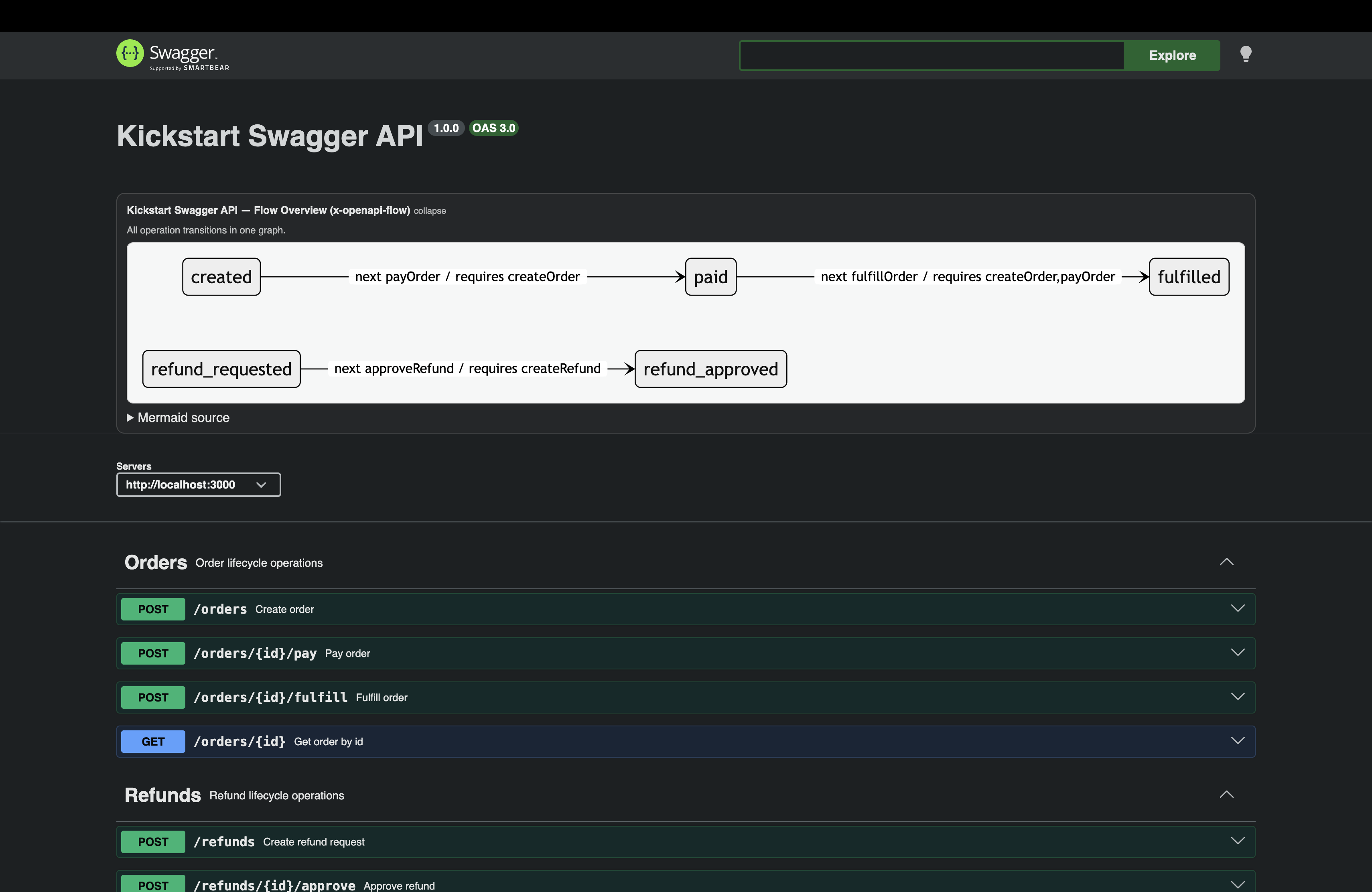
Lifecycle panel shows valid states and transitions
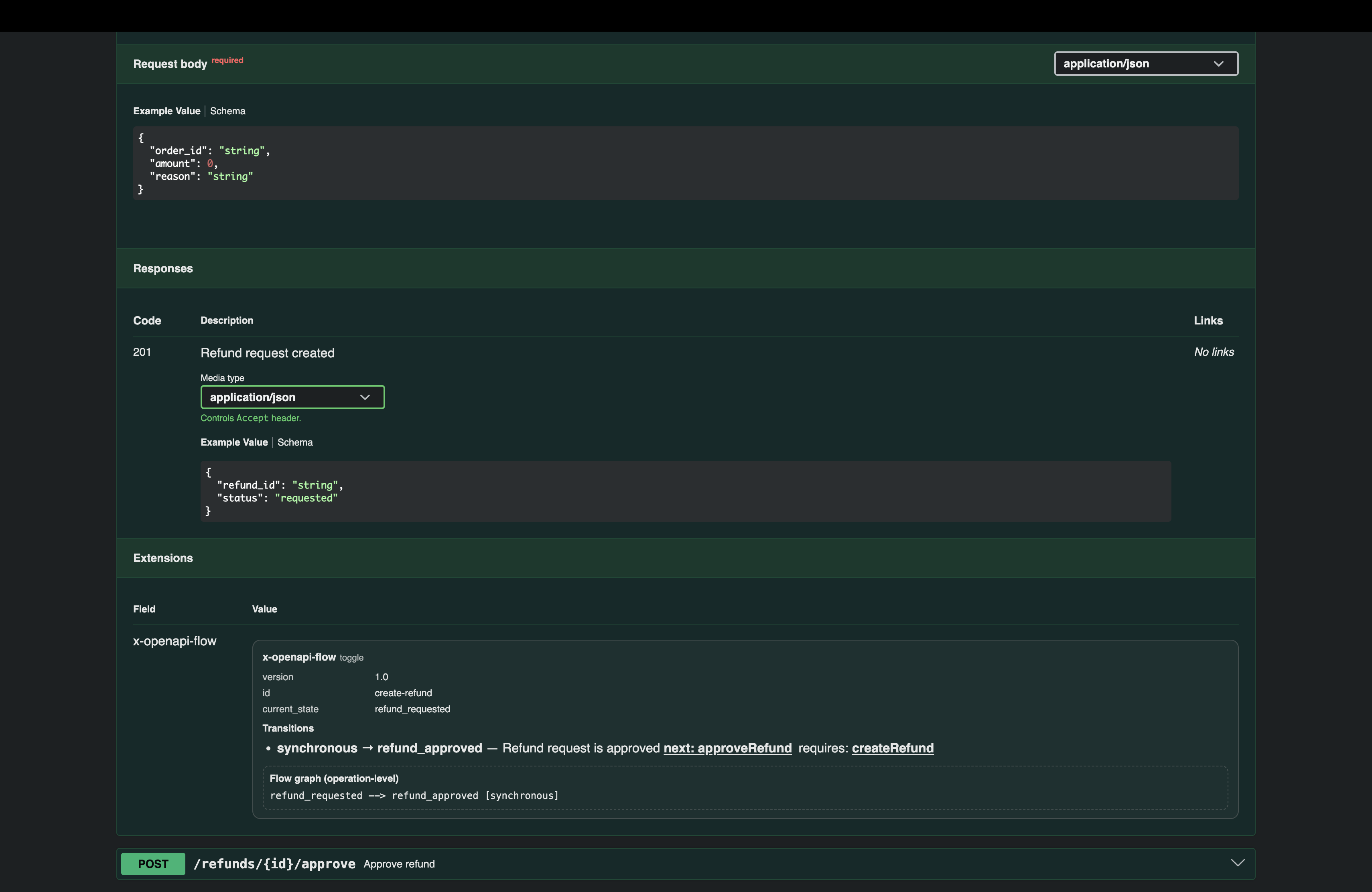
Detailed view of transitions per operation
cd example/redoc
npm install
npm run apply
npm run generate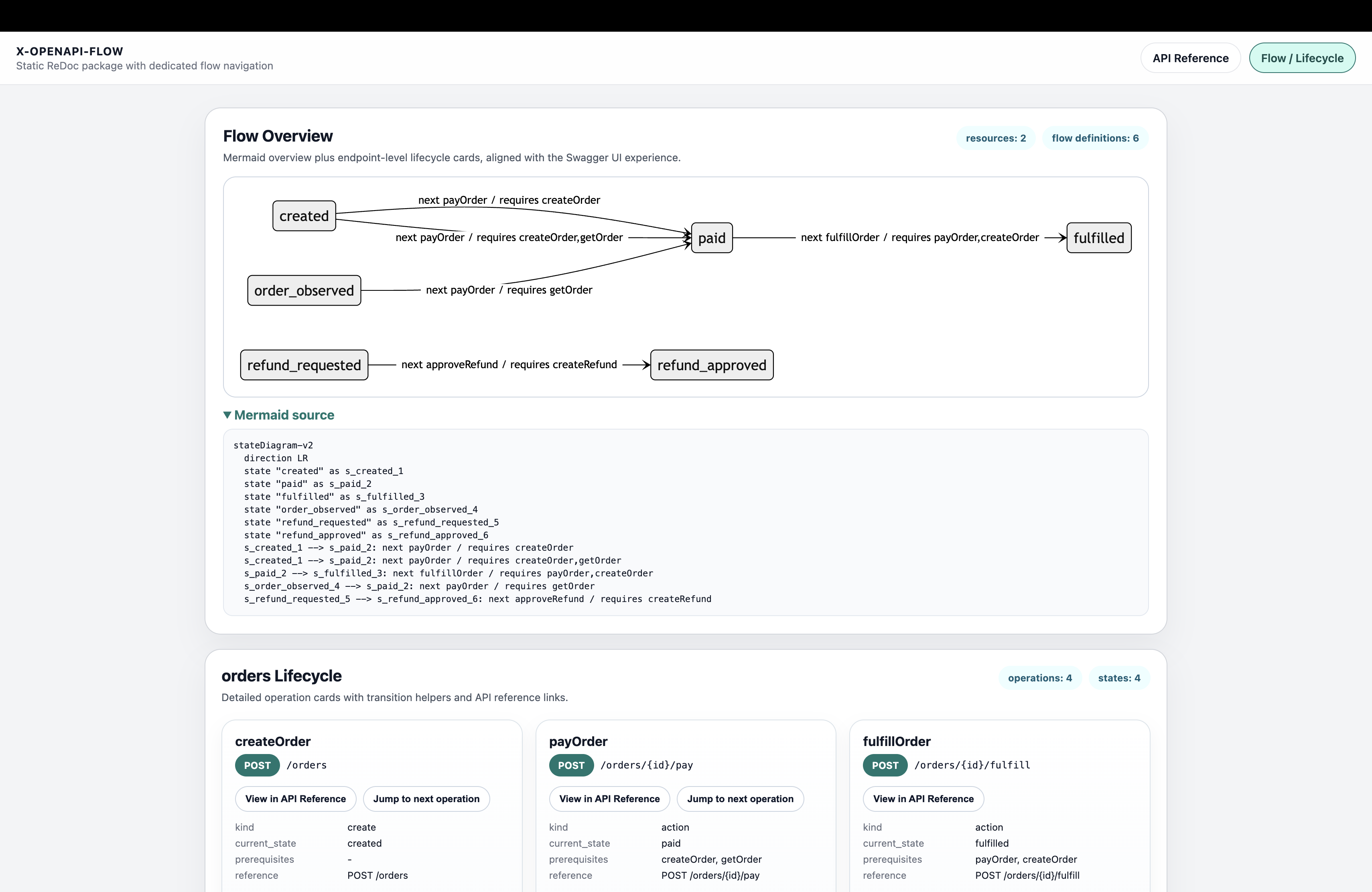
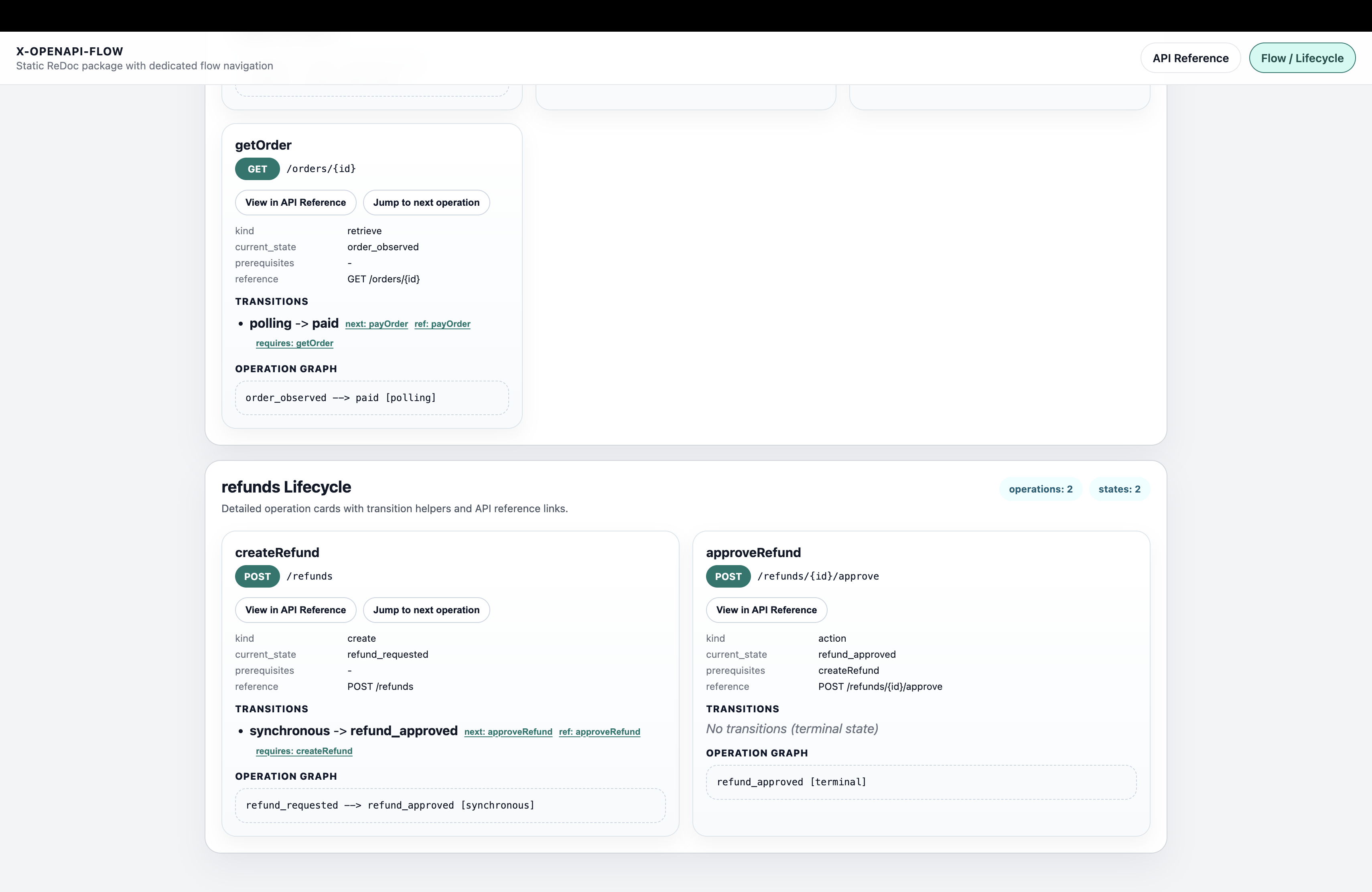
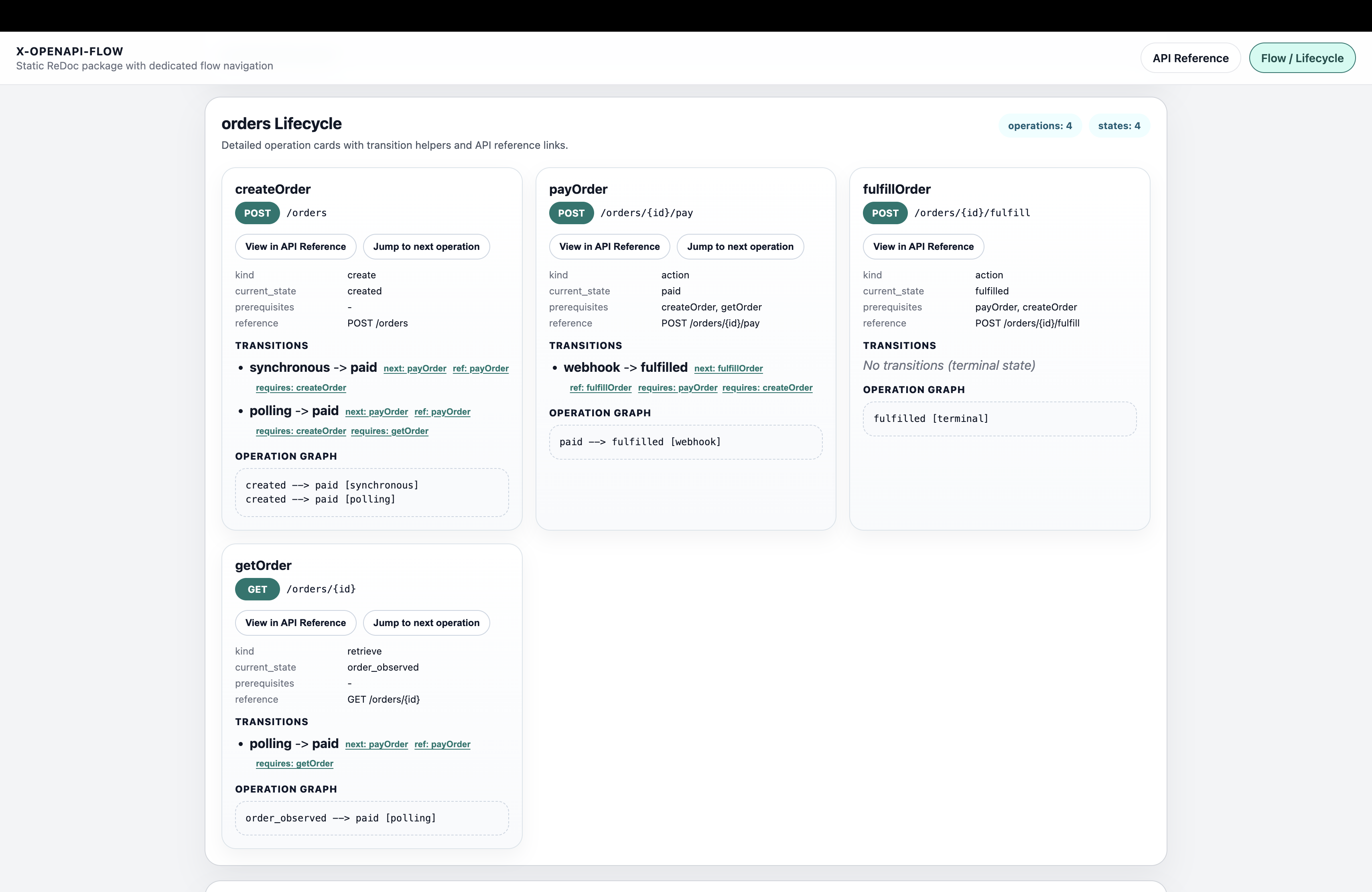
Auto-generated lifecycle diagrams make documentation clear and consistent
cd example/postman
npm install
npm run apply
npm run generate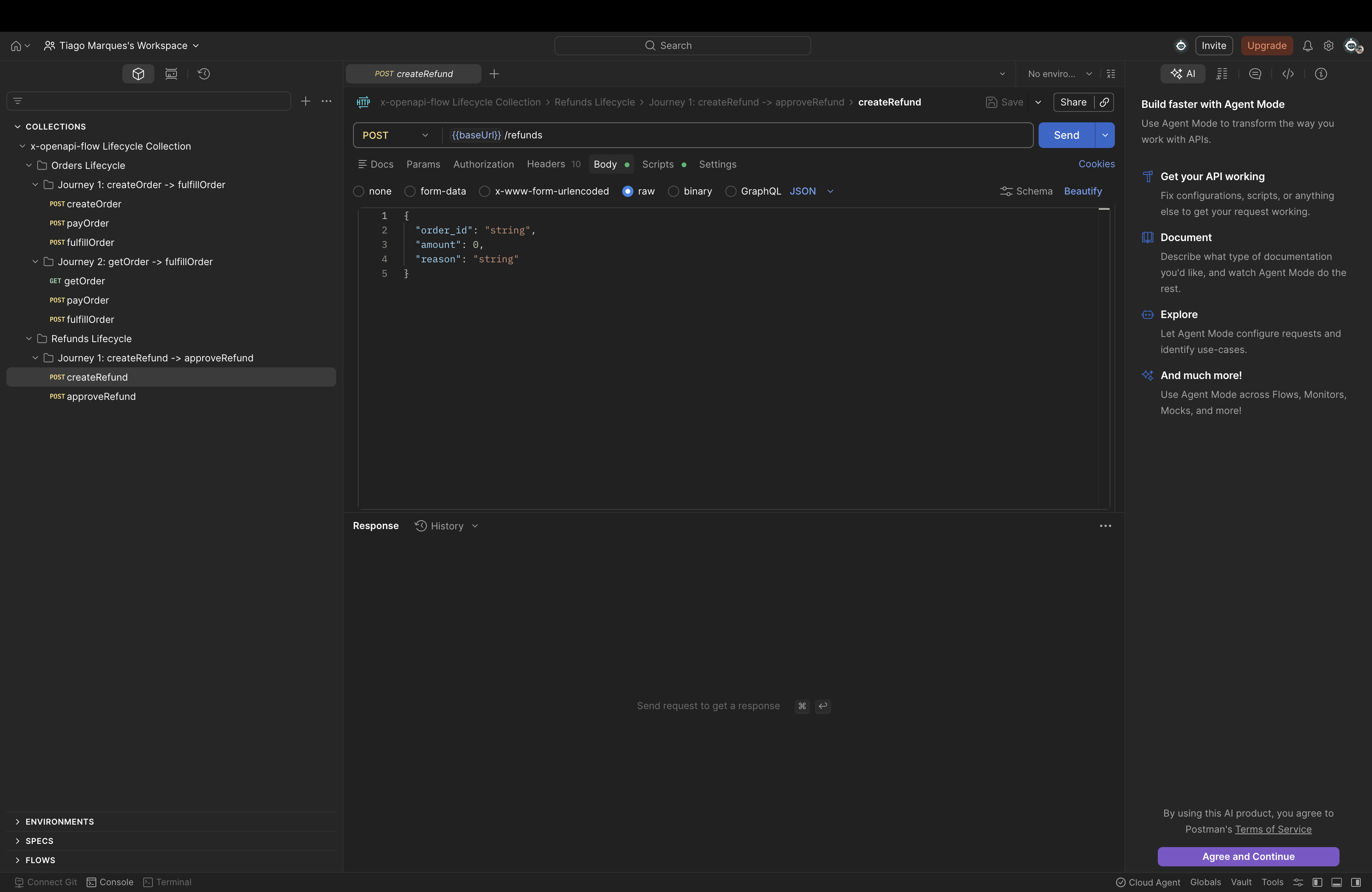
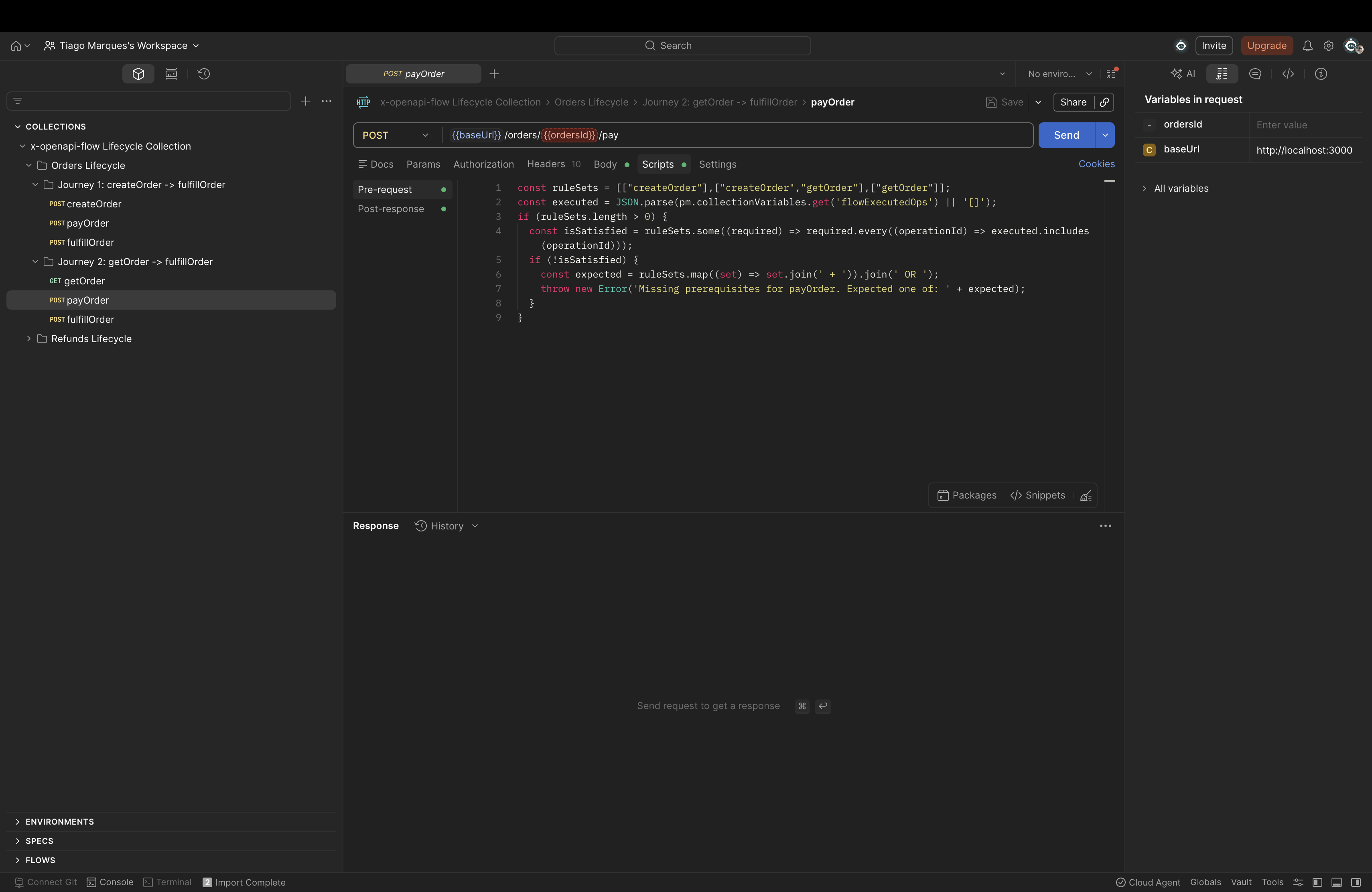
Collections reflect lifecycle order, reducing integration errors
cd example/insomnia
npm install
npm run apply
npm run generate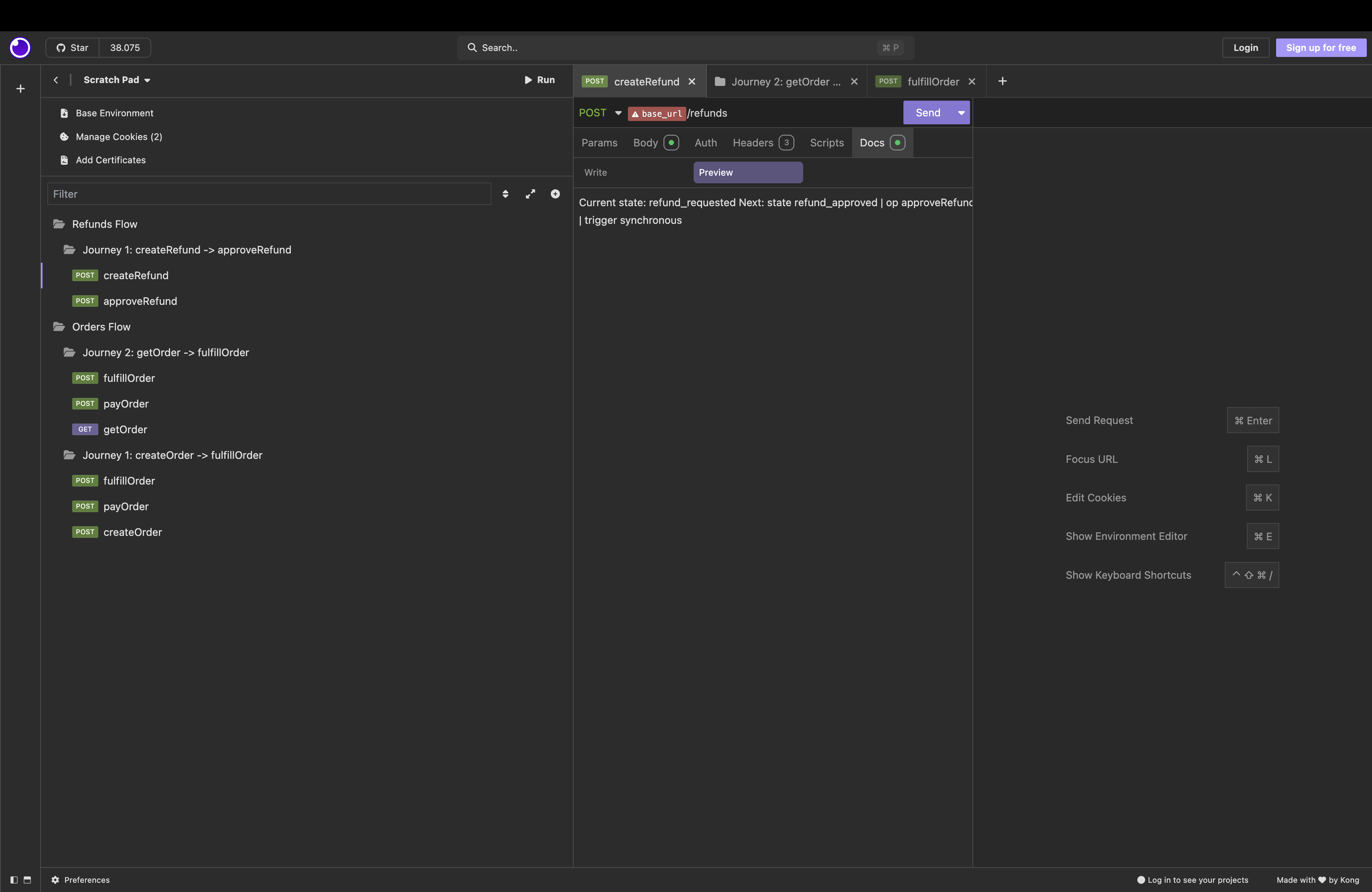
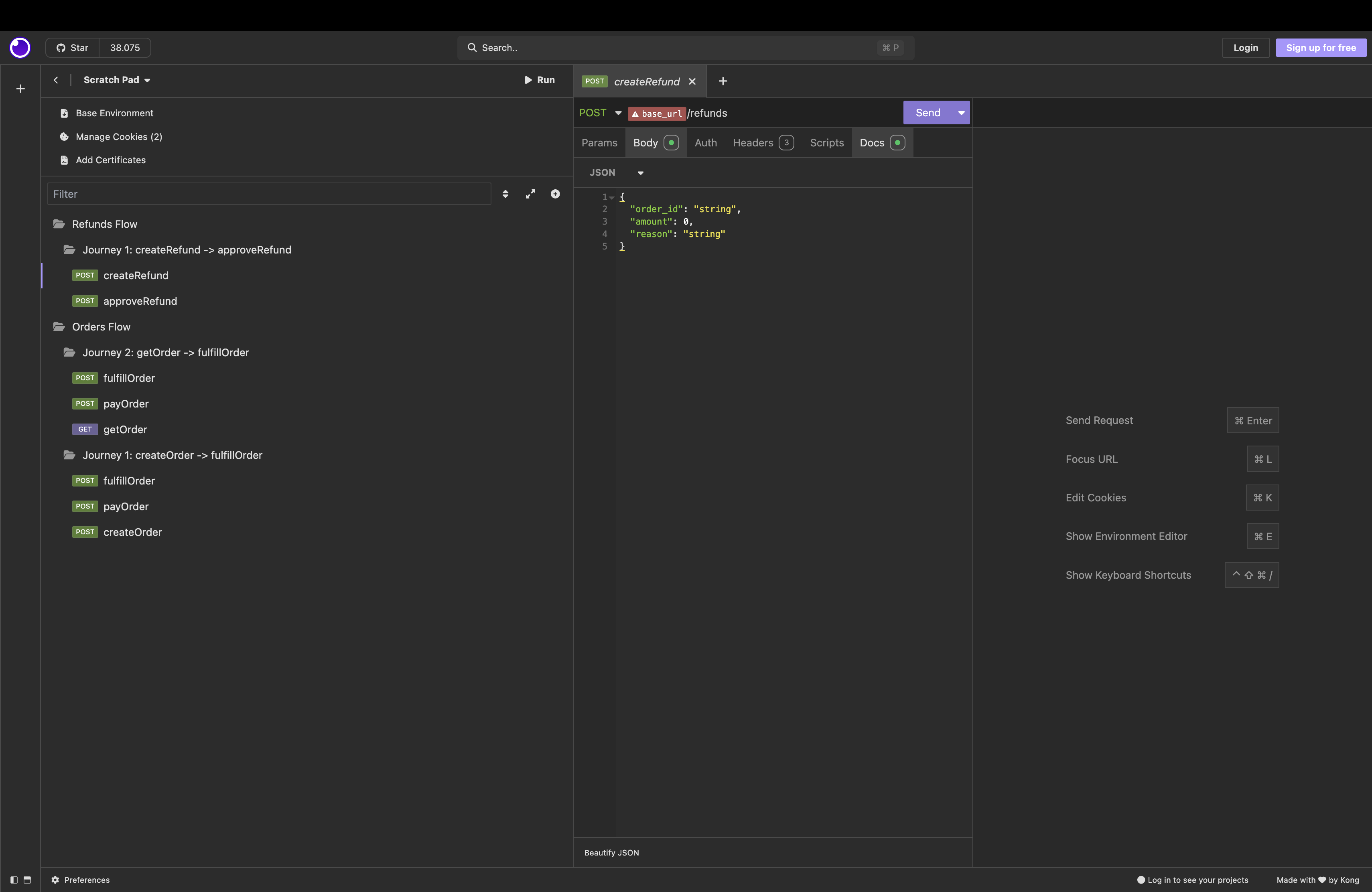
Requests are pre-organized according to lifecycle transitions
Use x-openapi-flow from the command line to manage, validate, visualize, and generate SDKs/docs for your API workflows.
npx x-openapi-flow help [command]         # show help for a specific command

npx x-openapi-flow --help                 # general help

npx x-openapi-flow version                # show version

npx x-openapi-flow doctor [--config path] # check setup and config

npx x-openapi-flow completion [bash|zsh]  # enable shell autocompletion

npx x-openapi-flow quickstart [--dir path] [--runtime express|fastify] [--force] # scaffold runnable onboarding project# initialize flow support
npx x-openapi-flow init [--flows path] [--force] [--dry-run]
# apply flows to OpenAPI
npx x-openapi-flow apply [openapi-file] [--flows path] [--out path]
# validate transitions
npx x-openapi-flow validate <openapi-file> [--profile core|relaxed|strict] [--strict-quality] [--semantic] # generate lifecycle diagrams
npx x-openapi-flow graph [openapi-file] [--format mermaid|json]
# generate Redoc docs
npx x-openapi-flow generate-redoc [openapi-file] [--output path]
# export flows
npx x-openapi-flow export-doc-flows [openapi-file] [--output path] [--format markdown|json] # generate flow-aware SDK
npx x-openapi-flow generate-sdk [openapi-file] --lang typescript [--output path] # generate executable flow tests (happy path + invalid transitions)
npx x-openapi-flow generate-flow-tests [openapi-file] [--format jest|vitest|postman] [--output path]
# postman/newman-oriented collection with flow scripts
npx x-openapi-flow generate-flow-tests [openapi-file] --format postman [--output path] [--with-scripts]Full details:
Get the most out of x-openapi-flow with detailed guides, examples, and integration instructions:
-
Adoption Guide – docs/wiki/getting-started/Adoption-Playbook.md
Learn how to introduce x-openapi-flow into your API workflow efficiently -
Troubleshooting – docs/wiki/reference/Troubleshooting.md
Quick solutions to common issues and validation errors -
Real Examples – docs/wiki/engineering/Real-Examples.md
Explore real OpenAPI specs enhanced with lifecycle metadata -
Integrations:
- GitHub Actions – docs/wiki/integrations/GitHub-Actions-Integration.md
Validate flow rules in CI in one reusable workflow step - Swagger UI – docs/wiki/integrations/Swagger-UI-Integration.md
See flow-aware panels in Swagger UI - Redoc – docs/wiki/integrations/Redoc-Integration.md
Generate lifecycle diagrams in Redoc documentation - Postman – docs/wiki/integrations/Postman-Integration.md
Organize collections according to valid transitions - Insomnia – docs/wiki/integrations/Insomnia-Integration.md
Pre-configure requests according to lifecycle flows
- GitHub Actions – docs/wiki/integrations/GitHub-Actions-Integration.md
We’re actively expanding x-openapi-flow to support multiple platforms and SDKs. Check our progress:
-
🗂 Roadmap Overview – #2
See planned features and high-level goals -
🐍 Python SDK MVP – #3
Enable Python developers to use flow-aware SDKs -
🏎 Go SDK MVP – #4
Bring lifecycle-aware SDKs to Go projects -
☕ Kotlin SDK MVP – #5
Support Android and JVM developers with flow-aware SDKs
Keep track of updates and improvements in x-openapi-flow:
-
Latest Version (v1.7.0) – CHANGELOG.md#170---2026-04-02
See what shipped in the current release -
Version History – CHANGELOG.md
Review the full version history and past updates -
Release Notes – GitHub Release v1.7.0
See detailed notes for the latest release, including new features and fixes
To ensure clarity and accessibility for the global developer community, all project documentation should be written in English. This helps contributors, users, and AI agents understand and use x-openapi-flow consistently.