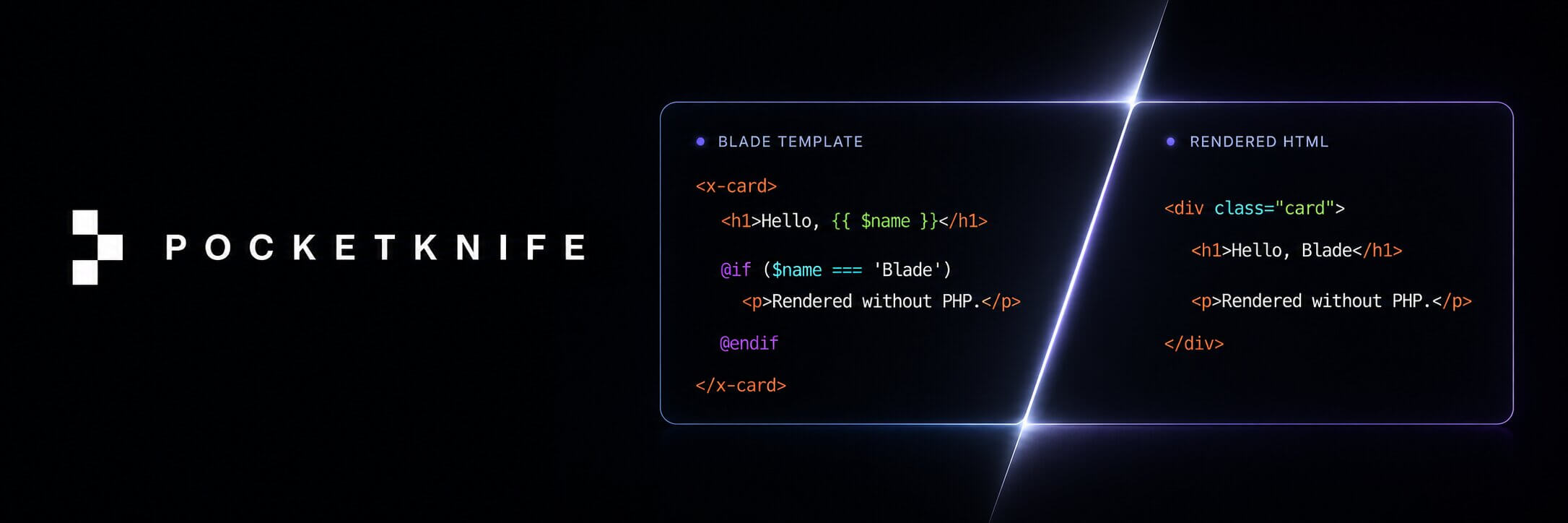
The portable Blade. A Go engine that renders Laravel Blade templates — no PHP, no eval, no runtime. Write real Blade, get static HTML. Need a full application, move the files into a Laravel app and you're good to go.
<h1>{{ $site->name }}</h1>

@foreach ($plans as $plan)
    <li>{{ $loop->iteration }}. {{ $plan->name }} — {{ $plan->price }}</li>
@endforeach<h1>Pocketknife</h1>
<li>1. Starter — Free</li>
<li>2. Pro — $12/mo</li>Blade is a great templating language, but running it requires PHP executing arbitrary code. If you wanted to give your users the option to edit templates, there is not safe way to gaurantee that they will not run any malicious code, until now. Pocketknife renders a subset of Blade and the output is nearly identical to what a real Laravel app produces from the same files.
So a Pocketknife site is literally a slice of a Laravel app. Toggle it into a real app and zero files move.
Components work like real Blade components — @props defaults, attributes, slots:
{{-- resources/views/components/sections/hero.blade.php --}}
@props(['heading' => 'Hello', 'cta' => 'Learn more'])
<section class="hero">
    <h1>{{ $heading }}</h1>
    <a href="/signup">{{ $cta }}</a>
</section>
{{-- resources/views/pages/index.blade.php --}}
<x-sections.hero heading="Build sites with Blade" cta="Get started"/><section class="hero">
<h1>Build sites with Blade</h1>
<a href="/signup">Get started</a>
</section>Data comes from JSON and markdown files, bound the way Laravel would bind them: resources/data/site.json → $site, resources/data/collections/plans.json → $plans, resources/data/content/post/*.md → $post.
Output {{ }} / {!! !!} / {{-- --}} · @if / @elseif / @else · @foreach with the full $loop object, @break / @continue · components with @props, bound attributes (:items="$plans"), $attributes, default and named slots · expressions with -> / [] access, ??, comparisons, booleans — all with PHP semantics (truthiness, loose equality, stringification) · @vite rendered as its static projection (Tailwind Play CDN + inlined CSS).
No function calls, no assignments, no @php. Undefined variables are compile-time errors with file/line/col — ?? is the sanctioned default ({{ $tagline ?? 'Welcome' }}).
go build -o /usr/local/bin/pocketknife ./cmd/pocketknifeLint a site directory — silence means everything is inside the static subset:
pocketknife lint exampleCompile speaks one JSON document on stdin, one on stdout — files in, files + deps + diagnostics out. No disk, no eval:
echo '{"files": {"resources/views/pages/index.blade.php": "<h1>{{ $title }}</h1>", "resources/data/site.json": "{}"}, "data": {"title": "Hi"}}' \
  | pocketknife compile | jq -r '.files["index.html"]'
# <h1>Hi</h1>
Or embed the engine directly from Go:
result := pocketknife.Compile(vfs.Dir("my-site"), []string{"resources/views/pages/index.blade.php"}, pocketknife.Options{})The example/ directory is the smallest useful site — a page, a layout, a component fed by collection data — with a render.sh that runs the whole pipeline.
| Path | What it is |
|---|---|
blade/ |
The Go engine: scanner, parser, renderer, expression evaluator. Stdlib-only, never panics on user input. |
laravel/ |
The devdojo/pocketknife Composer package that makes the same files render in a real Laravel app. |
fixtures/ |
The contract — conformance cases rendered by both engines. |
oracle/ |
A minimal Laravel app that runs the fixtures through genuine Blade in CI. |
cmd/pocketknife/ |
The CLI: compile, lint, version. |
Full design specs live in docs/specs/.