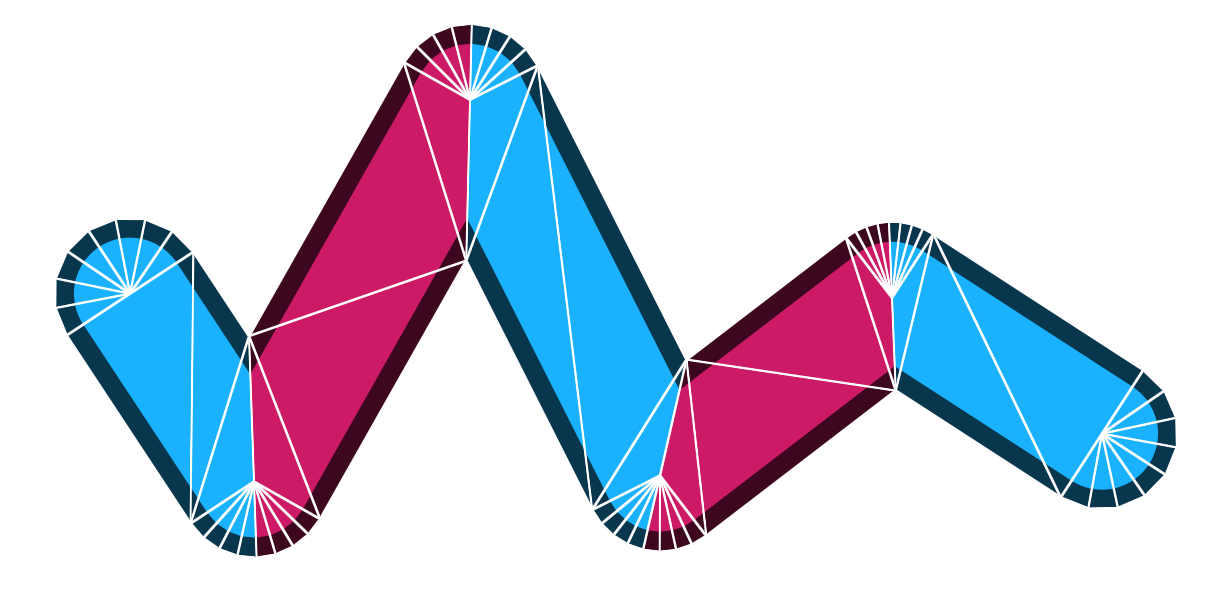
High-performance, flexible GPU-accelerated line rendering for WebGPU. A direct port of regl-gpu-lines to WebGPU.
For background on GPU line rendering, see Matt DesLauriers' Drawing Lines is Hard and Rye Terrell's Instanced Line Rendering.
npm install webgpu-instanced-linesimport { createGPULines } from "webgpu-instanced-lines";
const gpuLines = createGPULines(device, {
format: canvasFormat,
join: "round",
cap: "round",
vertexShaderBody: /* wgsl */ `
@group(1) @binding(0) var<storage, read> positions: array<vec4f>;
struct Vertex {
position: vec4f,
width: f32,
}
fn getVertex(index: u32) -> Vertex {
return Vertex(positions[index], 20.0 * ${devicePixelRatio.toFixed(1)});
}
`,
fragmentShaderBody: /* wgsl */ `
fn getColor(lineCoord: vec2f) -> vec4f {
return vec4f(0.2, 0.5, 0.9, 1.0);
}
`,
});
// In render loop:
gpuLines.draw(
pass,
{
vertexCount: numPoints,
resolution: [canvas.width, canvas.height],
},
[dataBindGroup],
);See docs/API.md for full API documentation.
The renderer uses instanced rendering with triangle strips. For a line with N points, it draws N-1 instances, where each instance renders one line segment plus half of the join geometry on each end. End caps are simply joins stretched around to form a cap.
The geometry is carefully generated to optimize for high-performance rendering without the full rigor of stroke expansion algorithms, which handle self-intersection more carefully. The lineCoord varying is constructed so that length(lineCoord) gives consistent radial distance from the line center across both segments and caps, permitting uniform stroke widths.
- Instanced rendering with triangle strips
- Screen-projected lines using a custom vertex function that can read geometry from buffers, textures, or procedural computation
- Bevel, miter, and round joins
- Round, square, and butt end caps
- Line breaks via
w = 0sentinel value - A
lineCoordvarying that can be used to construct SDF stroke outlines with anti-aliasing
- Does not apply special handling for self-intersecting lines.
- Does not implement dashed lines (though you can compute a line distance attribute and implement dashes)
- Does not implement stroke borders (though it exposes
lineCoordto make it straightforward) - World-space line widths require custom computation in the vertex shader function.
- Does not implement
arcsend cap type. - Rapidly varying line widths render incorrectly.
See the examples directory for working examples. Each demonstrates a different feature:
- basic - Simple sine wave with round joins and caps
- closed-loop - Seven-sided star (closed path)
- variable-width - Per-vertex width with cosine function
- border - SDF border effect with mouse interaction
- dash - Dashing with cumulative distance tracking
- multiple - Multiple separate lines with line breaks
- depth - Blended closed loop with transparency
- msaa - 4x multi-sample anti-aliasing
- lorenz - A strange attractor, iterated in a compute shader, with vertex positions computed from buffer lookups and rendered in a single draw call
© 2026 Ricky Reusser. MIT License.