WARNING - this project is obsolete and this repository serves as a historical artifact. This project is not in a usable state. See
availfor newest progress on the phantom constraint pattern.
availability is an unconventional effects library. It lets user provide a fixed concrete monad for all effectful functions in an application, and attach effects to the monads in an easy way.
- It is very lightweight (~70 sloc core), easy to understand and fast.
- It works with existing ecosystem, like
mtlandlens. - You can use the expressive
ReaderTpattern conveniently. - You can derive effects from each other via predefined interpretation strategies, i.e. newtypes that extends a monad with a few instances. For example, it takes one line to derive
Getter a, Setter afromGetter (IORef a).
Current effects libraries has one principle of effect restriction: an effect can be used in a monad if it can be interpreted in terms of the monad. This works well with a polymorphic monad type, but a polymorphic type is unfriendly to compiler optimization. In contrast, a concrete monad can be easily optimized, but if fix a monad that supplies all effects we need, we can no longer restrict what effects each function can use.
availability solves this problem with the phantom constraint pattern. We use a newtype wrapper M to screen out the user from directly manipulating the underlying monad, and let user to implement interpretations of effects in terms of other more primitive effects. In any function, the user can use an effect only if:
- The effect is implemented for the monad, and
- The effect constraint
Eff eis available in the context.
The second requirement decouples the availability of effects from the monad implementation. At last, we use a function runM to clear the constraints and restore the underlying monad. A typical example looks like this:
data Ctx = Ctx { foo :: Int, bar :: IORef Bool } deriving (Generic)

newtype App a = App { runApp :: ReaderT Ctx IO a }
  deriving (Functor, Applicative, Monad, MonadIO, MonadReader Ctx)
  deriving (Interpret (Embed IO))
    via ViaMonadIO App
  deriving (Interpret (Getter "foo" Int))
    via FromHas "foo" () Ctx (ViaMonadReader App)
  deriving (Interpret (Putter "bar" Bool))
    via StateByIORef () (FromHas "bar" () Ctx (ViaMonadReader App))

testParity :: (Effs '[Getter "foo" Int, Putter "bar" Bool]) => M App ()
testParity = do
  num <- get @"foo" @Int
  put @"bar" (even num)

example :: IO ()
example = do
    rEven <- newIORef False
    runM @'[Getter "foo" Int, Putter "bar" Bool] testParity
      & runApp & (`runReaderT` Ctx 2 rEven)
    readIORef rEven >>= print
    runM @'[Getter "foo" Int, Putter "bar" Bool] testParity
      & runApp & (`runReaderT` Ctx 3 rEven)
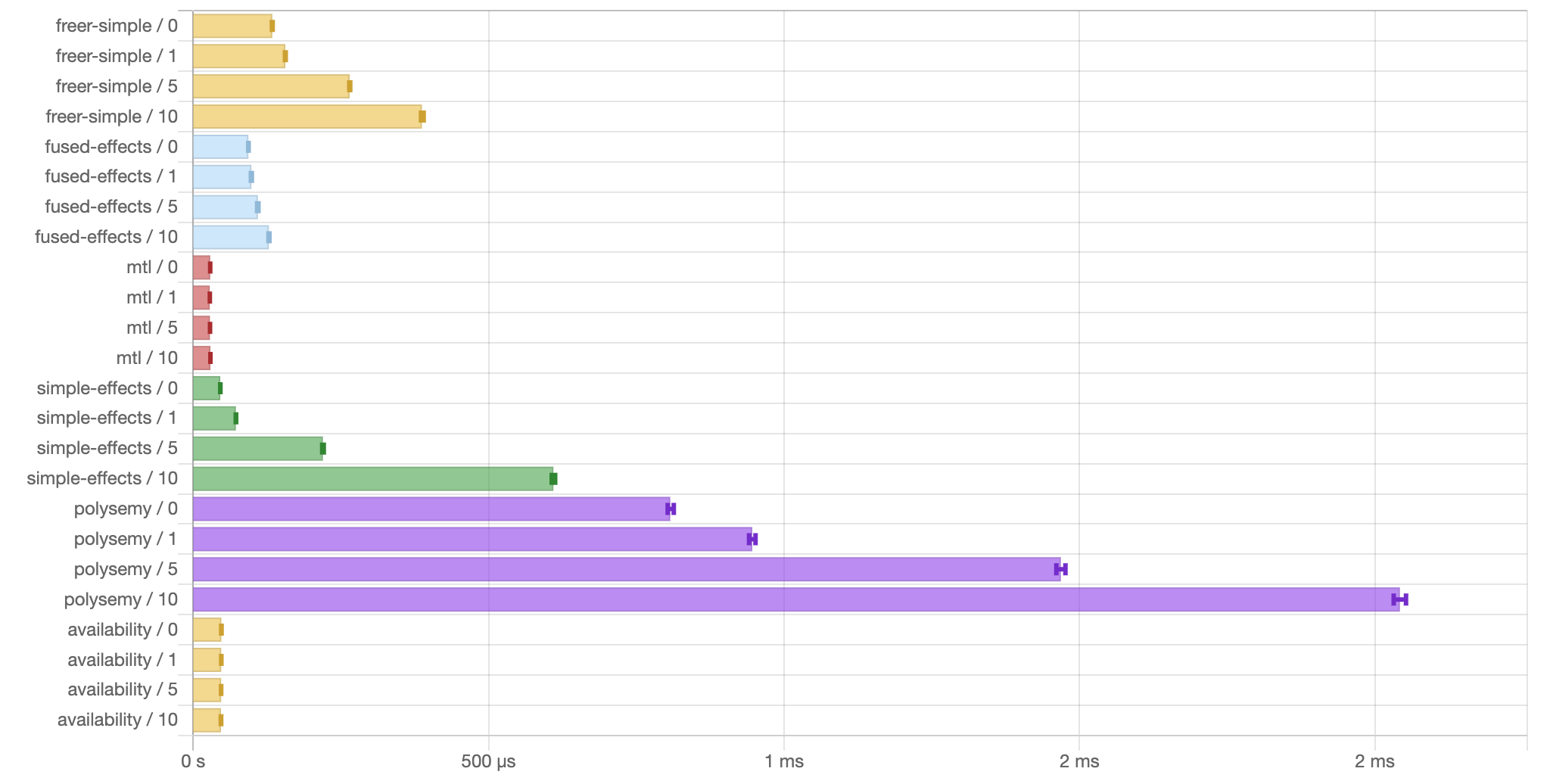
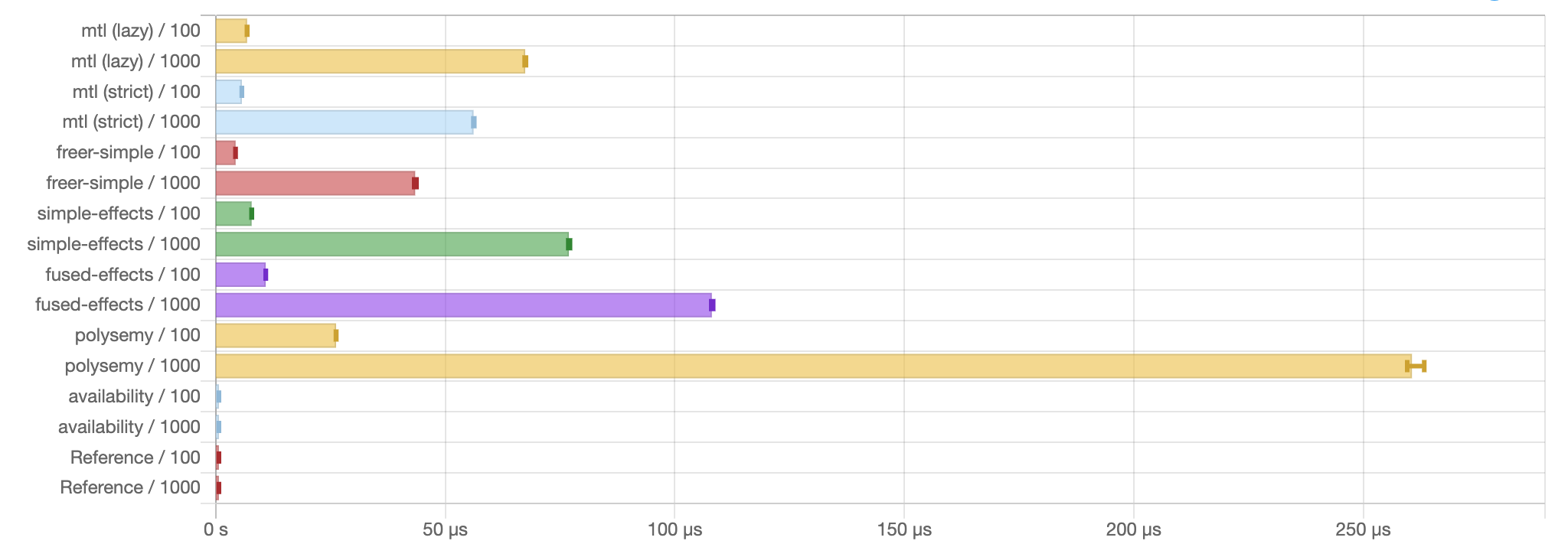
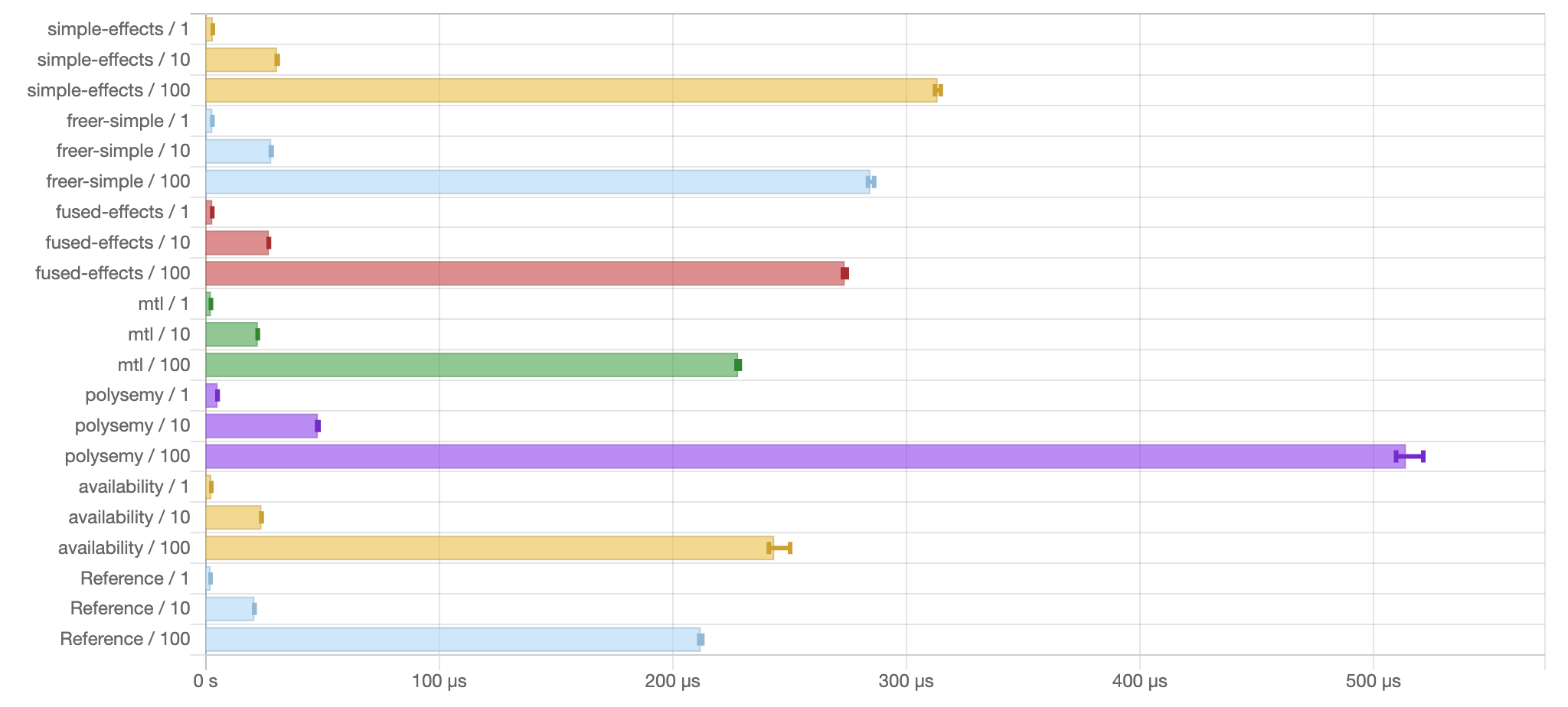
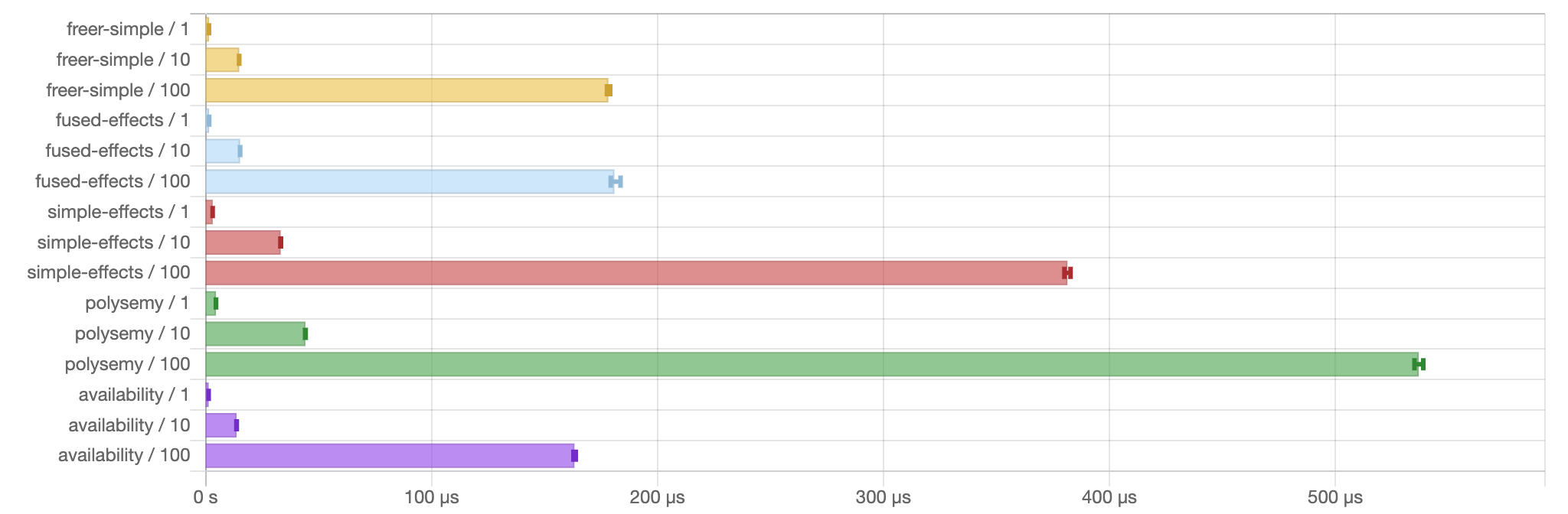
readIORef rEven >>= printavailability has good performance and performed better than fused-effects, freer-simple, polysemy and sometimes mtl in effect-zoo microbenchmarks.
This benchmark interprets multiple layers of no-op effects. availability performed almost identical to mtl. This is because I used mtl to build the underlying monad.
This benchmark decrements a counter till 0. availability performed identical to reference implementation due to GHC optimization, even after separating effect implementations and the program.
This benchmark tests a typical practical scenario of reading files and logging. availability has slightly worse performance than mtl and slightly better than fused-effects.
This benchmark involves reinterpreting higher level effects to more primitive ones. availability performed better than other libraries.
This is the definition of the classic Teletype effect in availability.
import Availability

data Teletype :: Effect where
  ReadTTY :: Teletype m String
  WriteTTY :: String -> Teletype m ()

readTTY :: Sendable Teletype m => M m String
readTTY = send ReadTTY

writeTTY :: Sendable Teletype m => String -> M m ()
writeTTY s = send (WriteTTY s)
One can implement a pure echoing program via mtl:
import           Availability
import           Availability.State
import           Availability.Writer
import qualified Control.Monad.State                  as MTL
import qualified Control.Monad.Writer                 as MTL
import           Data.Function                        ((&))

newtype PureProgram a = PureProgram
  { runPureProgram :: MTL.WriterT [String] (MTL.State [String]) a }
  deriving (Functor, Applicative, Monad)
  deriving (MTL.MonadWriter [String], MTL.MonadState [String])
  deriving (Interpret (Teller "out" [String]))
    via ViaMonadWriter PureProgram
  deriving (Interpret (Getter "in" [String]), Interpret (Putter "in" [String]))
    via ViaMonadState PureProgram

instance Interpret Teletype PureProgram where
  type InTermsOf _ _ = '[Getter "in" [String], Putter "in" [String], Teller "out" [String]]
  interpret = \case
    ReadTTY -> get @"in" >>= \case
      []     -> pure ""
      x : xs -> x <$ put @"in" xs
    WriteTTY msg -> tell @"out" [msg]

echoPure :: Eff Teletype => M PureProgram ()
echoPure = do
  i <- readTTY
  case i of
    "" -> pure ()
    _  -> writeTTY i >> echoPure

runEchoPure :: [String] -> [String]
runEchoPure s = runM @'[Teletype] echoPure
  & runPureProgram & MTL.execWriterT & (`MTL.evalState` s)
or an impure interpretation directly through IO.
import           Availability.Embed
import           Availability

newtype ImpureProgram a = ImpureProgram { runImpureProgram :: IO a }
  deriving (Functor, Applicative, Monad, MonadIO)
  deriving (Interpret (Embed IO))
    via ViaMonadIO ImpureProgram

instance Interpret Teletype ImpureProgram where
  type InTermsOf _ _ = '[Embed IO]
  interpret = \case
    ReadTTY      -> embed getLine
    WriteTTY msg -> embed $ putStrLn msg

echoIO :: Eff Teletype => M ImpureProgram ()
echoIO = do
  i <- readTTY
  case i of
    "" -> pure ()
    _  -> writeTTY i >> echoIO

main :: IO ()
main = runM @'[Teletype] echoIO & runImpureProgram-
Running effects: Because effects in
availabilityare detached from the monad structure, they cannot be run on a one-by-one basis. Practically, one can only run all effects and obtain the underlying concrete monad at once viarunM. This means there is no exact equivalent torunReaderT,runExceptTetc on theMmonad.If your application can entirely run on a single transformer stack (in particular,
ReaderT IO), this is a non-issue because there will be no need to run effects one-by-one. For some other scenarios, there are some solutions that may be used solve this issue:localis an almost identical substitute torunReaderTwithout destructing the monad.- Similarly,
tryErroris a substitute torunExceptT. - To simulate
runStateT, simply set the value before the action and get the value after it. listenis a very close analog torunWriterT.
The same problem is present in Tweag's
capability, whose implementation is in many aspects similar to this library.