Secure coding tutorial - based on MVC procedural PHP web app
As security professional I was involved with website security testing, reporting vulnerabilities to web developers and verifying if these were properly fixed. Because of this I got interested in how vulnerabilities can get into web applications and how to prevent them. I thought the best way to find out is making (secure) websites myself, because if I better understand how developers introduce security vulnerabilities into applications I can better support them in improving code quality and security.
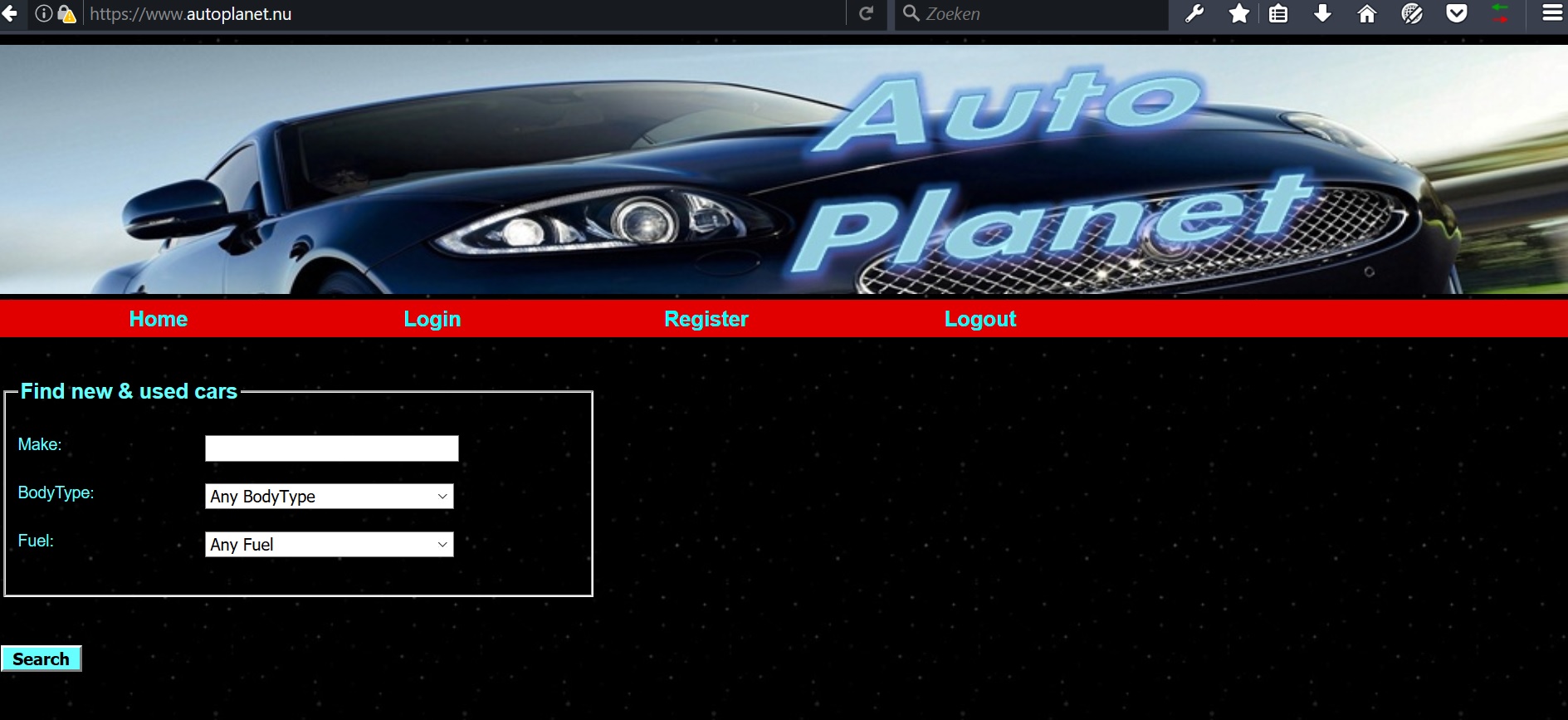
Therefore I started two projects: autoworld and autoplanet. Both are car trading websites, based on PHP and MySQL: Users can sell cars (after signing in) and can search and buy cars. Autoworld was written from scratch with no plan, little knowledge of programming and therefore full of vulnerabilities. Autoplanet is the second project and an attempt to do a better job by using MVC architecture, code design priciples (dry, kiss, yagni, name conventions, etc.) and secure coding practices. As I had little experience with OOP both sites were programmed in procedural PHP, to my opinion this shouldn't be an issue as you can write good code and secure code also in procedural programming.
Note that this is work in progress and that the code will be regularly updated but hopefully it may still be helpful.
\webroot
    \public
        \carimages
        \css
        \images
        index.php
        .htaccess
     \application
        \controllers
        \models
        \helpers
        \views

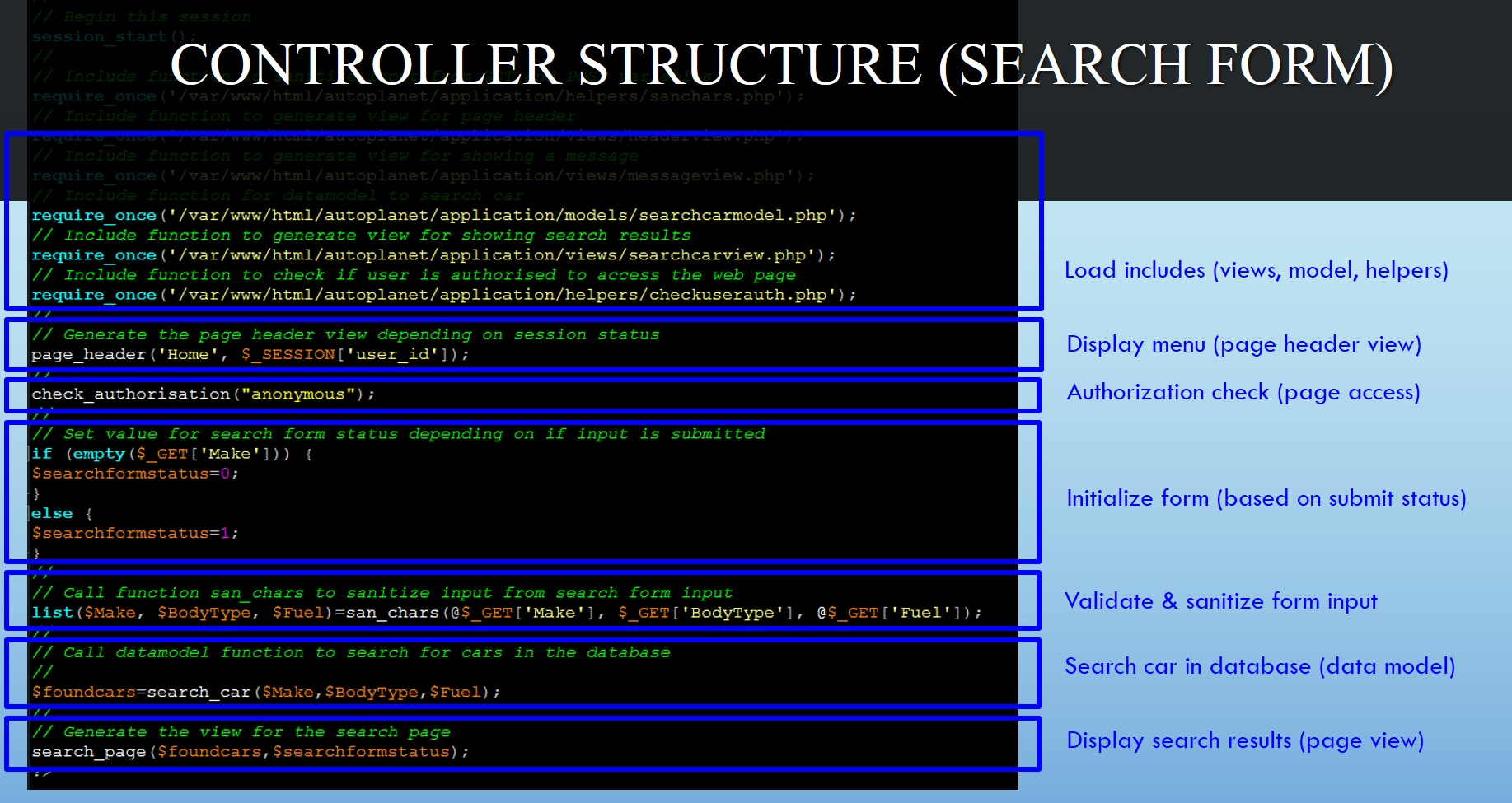
- Input sanitization: Remove/replace/escape/encode unwanted input
- Input validation: Reject unwanted input
- Prepared Statements: Prevent that user data can alter your SQL queries
- File upload security: Don’t allow users to upload and execute whatever they want
- Output encoding: Convert data into a safe format before sending it to the user
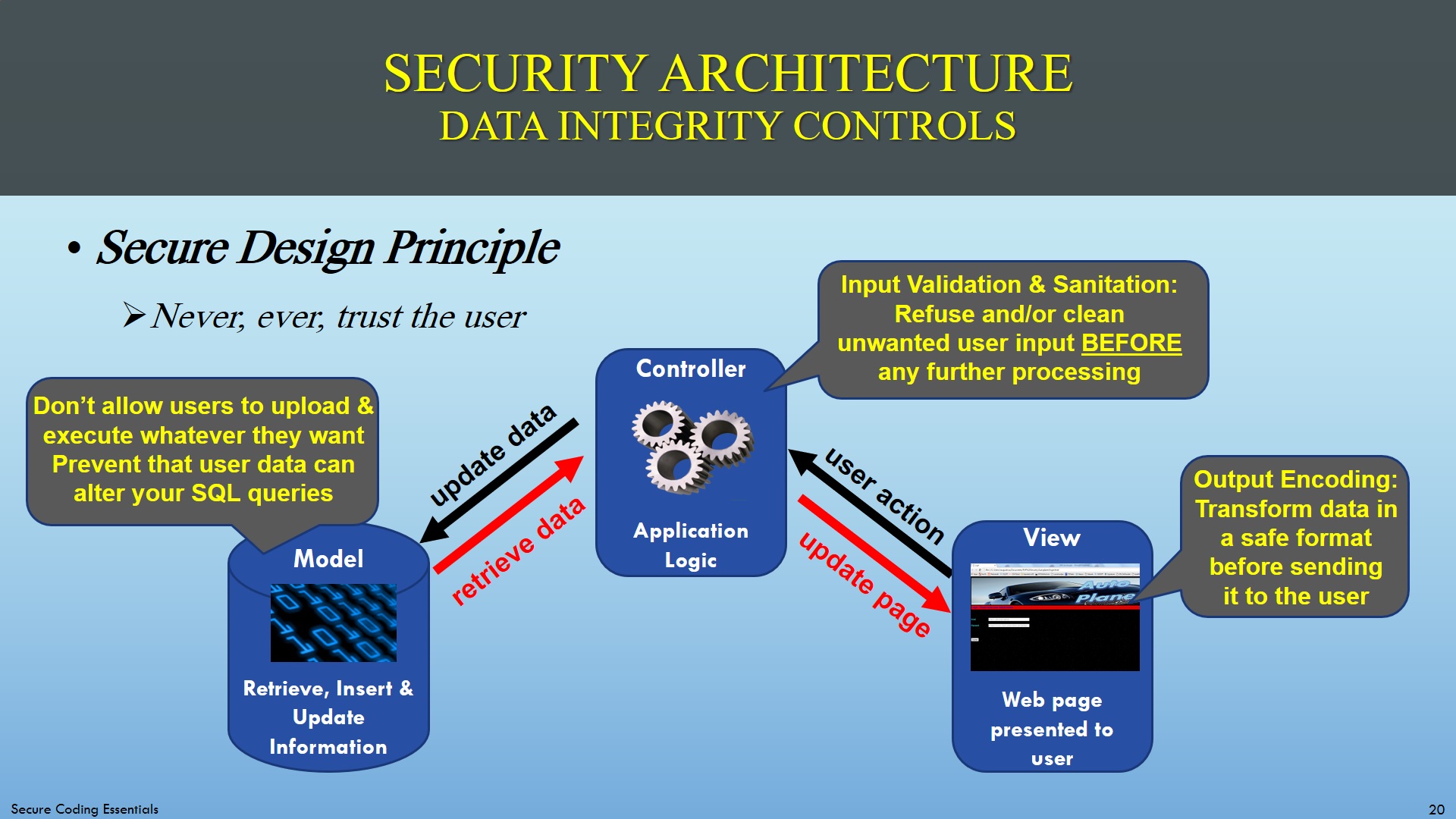 Where to put the data integrity controls in the MVC
- Web page access: Check authorization upon every page request - has the user the right role to access this web page ?
- Data object access: Make sure that only authorized users can execute actions on data objects (e.g. delete records)
- Centralize access control: Use a centralized authorization routine - copying the same authorization code on every page is error prone
- Session data access: Prevent unauthorized access to session ID's and cookies
- Database access: Use database accounts for each user role with corresponding authorizations based on least privilege principle
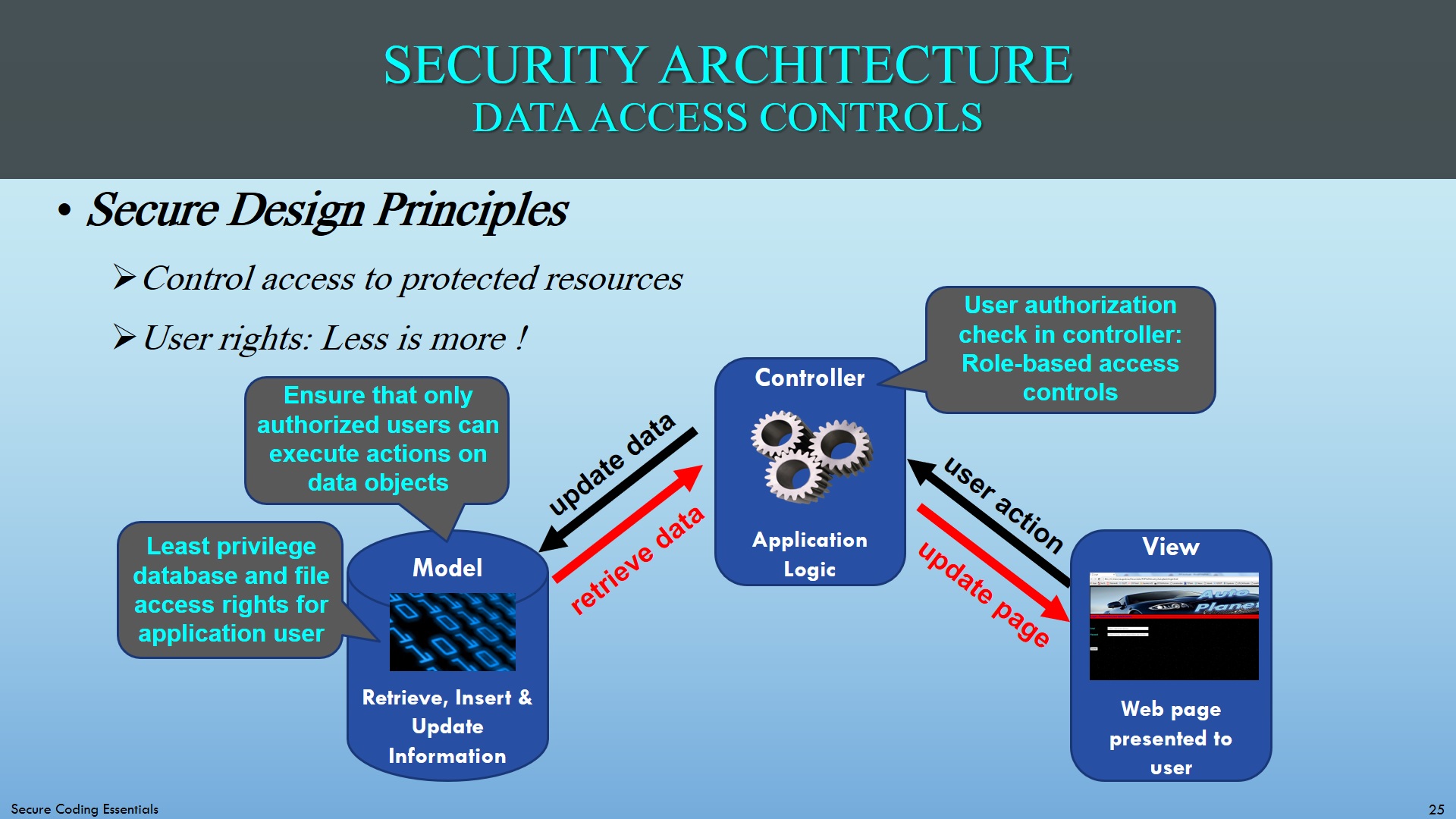 Where to put the data access controls in the MVC
- Protect sensitive user data: Use site-wide TLS encryption to ensure that all data is sent via HTTPS
- Protect data on web forms: Use POST for sending information via web forms and turn off autocompletion on browsers
- Protect session data: Enforce that only cookies are used for transmitting session data and that they only can be sent via HTTPS
- Protect credentials: Use a recent salted password hashing algorithm and keep database connection strings out of your source code
- Protect sensitive data on your server: Use URL rewriting and routing to hide physical files/paths and disable directory listings
- Don't reveal your source code: Prevent displaying stacktraces, show only generic error messages
 Where to put the data access controls in the MVC
- Design robust application logic: Prevent that application logic steps can be bypassed or executed in the wrong way
- Prevent abuse of functionality: Add safeguards to prevent abuse of your application (e.g. captchas to counter automated attacks)
- Minimize attack surface: Unnecessary features may be exploited by attackers
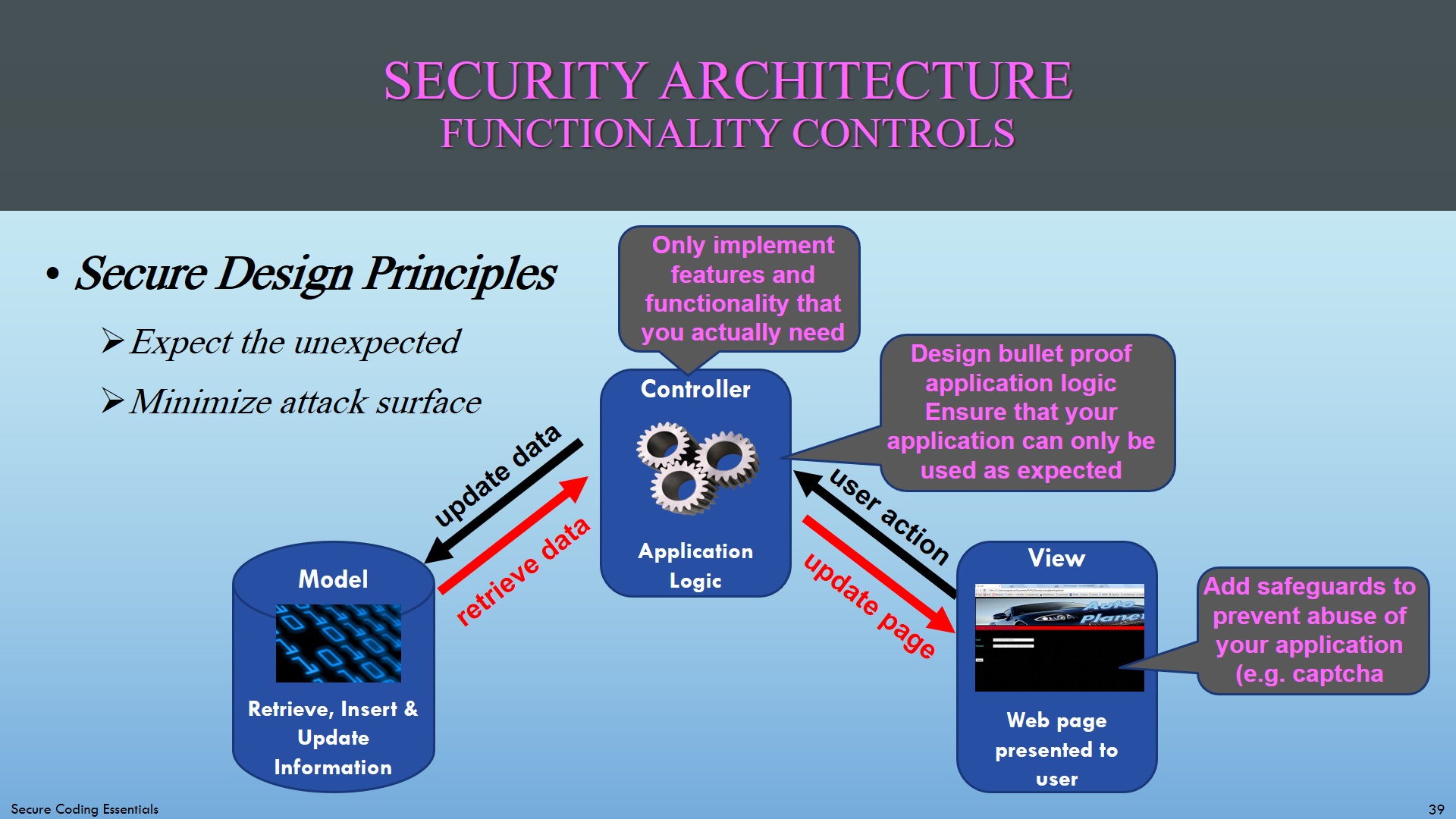 Where to put the functionality controls in the MVC
More to follow...