Exact mesh booleans, intersection curves, self-intersection repair,
isocontours and isobands, and N-ary CSG on PyVista
meshes. PyVista in, PyVista out, through one .trueform accessor on
pyvista.PolyData.
pip install pyvista-trueformThe accessor registers itself on import and answers through
.trueform on any pyvista.PolyData:
import pyvista as pv
import pyvista_trueform  # registers the accessor

pv.Cube().trueform.volume()
The cache is whole-value, keyed by the dataset's VTK modification time — the held instance is what lets trueform's spatial tree, face membership, and edge link build lazily once:
import numpy as np

a = pv.Cube()
mesh = a.trueform.to_mesh()
assert a.trueform.to_mesh() is mesh  # same cached instance, MTime unchanged

np.asarray(a.points)[0] += 1.0       # raw mutation: MTime NOT bumped
a.Modified()                         # tell VTK, so the cache rebuilds
assert a.trueform.to_mesh() is not mesh
A worked example — a boolean carves the shape, domains reads the
pieces the arrangement made, and pick names the one a ray struck:
import numpy as np
import pyvista as pv
import pyvista_trueform as tfpv
import trueform as tf

a = pv.Cube()
b = pv.Cube(center=(0.5, 0.5, 0.5))

carved = a.trueform.difference(b)
carved.cell_data["trueform_labels"]  # per-face source: 0 (a) or 1 (b)
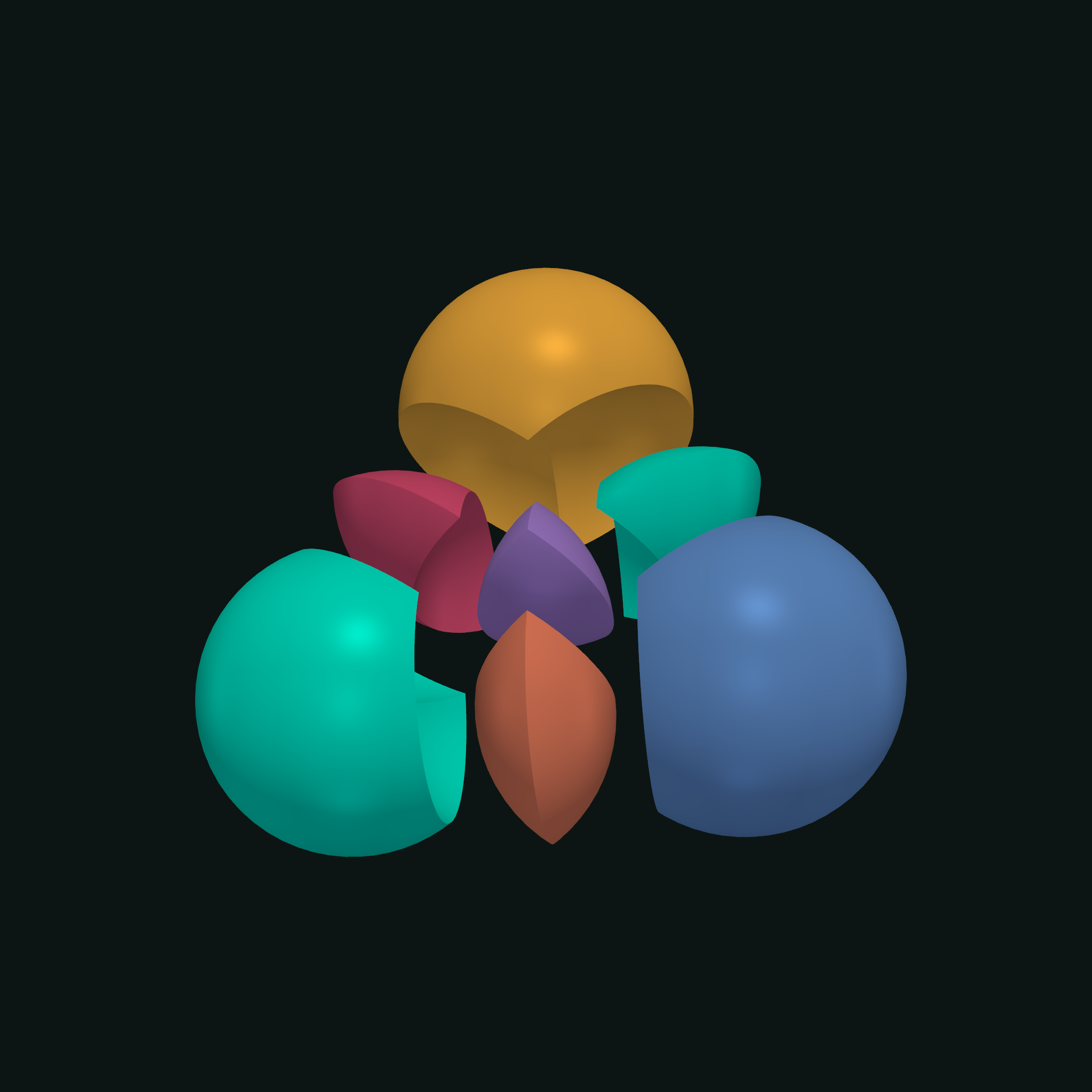
blocks = tfpv.domains([a, b])        # every overlap pocket, its own block
ray = tf.Ray(origin=np.array([-2, 0, 0], dtype=np.float32),
            direction=np.array([1, 0, 0], dtype=np.float32))
hit = tfpv.pick(blocks, ray)
hit.block_index                      # which block the ray struck
The contract the package holds itself to — dialect laws, the full surface, the gotchas — is one call away:
print(tfpv.agents()) # the package contract, for agents and humans alikeThe sections below cover the rest of the surface these three lean on.
Build one arrangement of N operands and answer arbitrarily many boolean expressions against it:
from pyvista_trueform import csg_graph

c = pv.Cube(center=(0.25, 0.5, 0.0))  # quads, mixed ngons: normalized losslessly
graph = csg_graph([a, b, c])
graph.mesh(tf.op(0) - (tf.op(1) | tf.op(2)))

graph.domains()                       # every watertight piece, as a MultiBlock
graph.intersection_curves()           # the seams, as line PolyData
graph.outer_shell()                   # boundary of everything the operands enclose
graph.native                          # escape hatch: the raw trueform.CsgGraph

csg_graph([a]) # one operand is legal: its own self arrangementto_trueform and to_pyvista cross the boundary; only to_trueform
copies:
from pyvista_trueform import to_trueform, to_pyvista, curves_to_pyvista

mesh = to_trueform(a)                        # detached trueform.Mesh, copies the geometry
to_pyvista(mesh)                             # zero-copy: shares mesh's own NumPy buffers
curves_to_pyvista(tf.boundary_curves(mesh)) # any (paths, points) pair, zero-copyfrom pyvista_trueform import read, write
write("cube.obj", a) # dispatched on suffix; .obj keeps a's own quad faces
read("cube.obj") # zero-copy conversion back to PolyData
write("cube.stl", a.trueform.triangulated()) # STL: triangles only
read("cube.stl") # STL welds duplicate vertices on the way infrom pyvista_trueform import domains, mesh_arrangements, split_into_domains
domains([a, b, c]) # every watertight domain, named by id, as a MultiBlock
mesh_arrangements([a, b, c]) # the whole arrangement instead, as one labeled PolyData
a.trueform.domains() # one mesh's own overlap pockets, from its self arrangement
arranged = mesh_arrangements([a, b, c])
split_into_domains(arranged, exclude_outer_shell=True) # already cut: labeled and
# split, no second arrangementpick and closest answer over any MultiBlock (nested ones flatten; a
plain PolyData works too, as block 0):
from pyvista_trueform import pick, closest

blocks = domains(csg_graph([a, b]))
ray = tf.Ray(origin=np.array([-2, 0, 0], dtype=np.float32),
            direction=np.array([1, 0, 0], dtype=np.float32))
pick(blocks, ray)                 # hit.block_index, hit.point: first block struck
closest(blocks, [0.0, 0.0, 0.0]) # same shape, by proximity instead of a raytri = a.trueform.triangulated()
tri.trueform.remeshed(0.1) # isotropic, target edge length
tri.trueform.decimated(0.5) # quadric-error, target face proportion
tri.trueform.simplified() # quadric-error, to an error budget instead
labels = np.zeros(tri.n_cells, dtype=np.int32)
remeshed = tri.trueform.remeshed(0.1, preserve_regions=labels)
remeshed.cell_data["trueform_labels"] # preserve_regions rides back as cell dataa.trueform.volume() # .area(), .signed_volume(), .mean_edge_length() too
a.trueform.is_closed() # .is_open(), .is_manifold(), .is_non_manifold(),
# .euler_characteristic() too
a.trueform.distance(b) # euclidean; .intersects(b) too
a.trueform.signed_distance(b) # negative inside b; batched over a's own points
a.plot(scalars=a.trueform.signed_distance(b), cmap="polydera_div") # packaged map, registered on import
a.trueform.closest_point([0, 0, 0]) # (face_id, distance, point)
a.trueform.closest_points([2, 0, 0], k=3) # the k nearest, closest first
a.trueform.closest_point_pair(b) # witness pair between a and b
a.trueform.principal_curvatures() # (k0, k1); .shape_index() too
seg = tf.Segment(np.array([[2, 0, 0], [3, 0, 0]], dtype=np.float32))
a.trueform.distance(seg) # queries take trueform primitives; .closest_point(seg) too
n, labels = a.trueform.connected_components() # (n, per-face component labels)
a.trueform.split_components() # one block per component, as a MultiBlock
a.trueform.boundary_curves() # open edges, as line PolyData
a.trueform.boundary_edges() # the dataset's own point ids instead; .boundary_paths(),
# .non_manifold_edges(), .non_manifold_paths() too
ray = tf.Ray(origin=np.array([-2, 0, 0], dtype=np.float32),
direction=np.array([1, 0, 0], dtype=np.float32))
a.trueform.ray_cast(ray) # (face_id, t); config=(min_t, max_t) bounds itAll of these answer against the cached mesh, so the spatial tree amortizes across calls.
from pyvista_trueform import (align_rigid, align_similarity, align_icp,
                             align_obb, align_knn, chamfer_distance)

align_rigid(a, b)       # Kabsch: rotation + translation, correspondence required
align_similarity(a, b)  # + uniform scale, same correspondence requirement
align_icp(a, b)         # iterative closest point, no correspondence needed
align_obb(a, b)         # oriented-bounding-box alignment, no correspondence
align_knn(a, b)         # one soft-correspondence step
chamfer_distance(a, b)  # one-way chamfer measure

matrix = align_rigid(a, b)                    # 4x4 delta: maps a's current points onto b
aligned = a.transform(matrix, inplace=False) # apply to a itself to align it with bfrom pyvista_trueform import connect_lines, tube
line = pv.Line((0, 0, 0), (1, 0, 0))
tube(line, radius=0.1) # triangle tube; unordered 2-point segments connect first
connect_lines(line) # just the assembly: segments in, polylines out, same point idstfpv.box(2.0, 1.0, 3.0) # ticks subdivide each axis
tfpv.sphere(1.0, stacks=20, segments=20)
tfpv.cylinder(1.0, 2.0, segments=20)
tfpv.plane(10.0, 5.0) # ticks subdivide each axis
tfpv.sphere(1.0, dtype=np.float64, index_dtype=np.int64) # trueform's defaults apply when omitted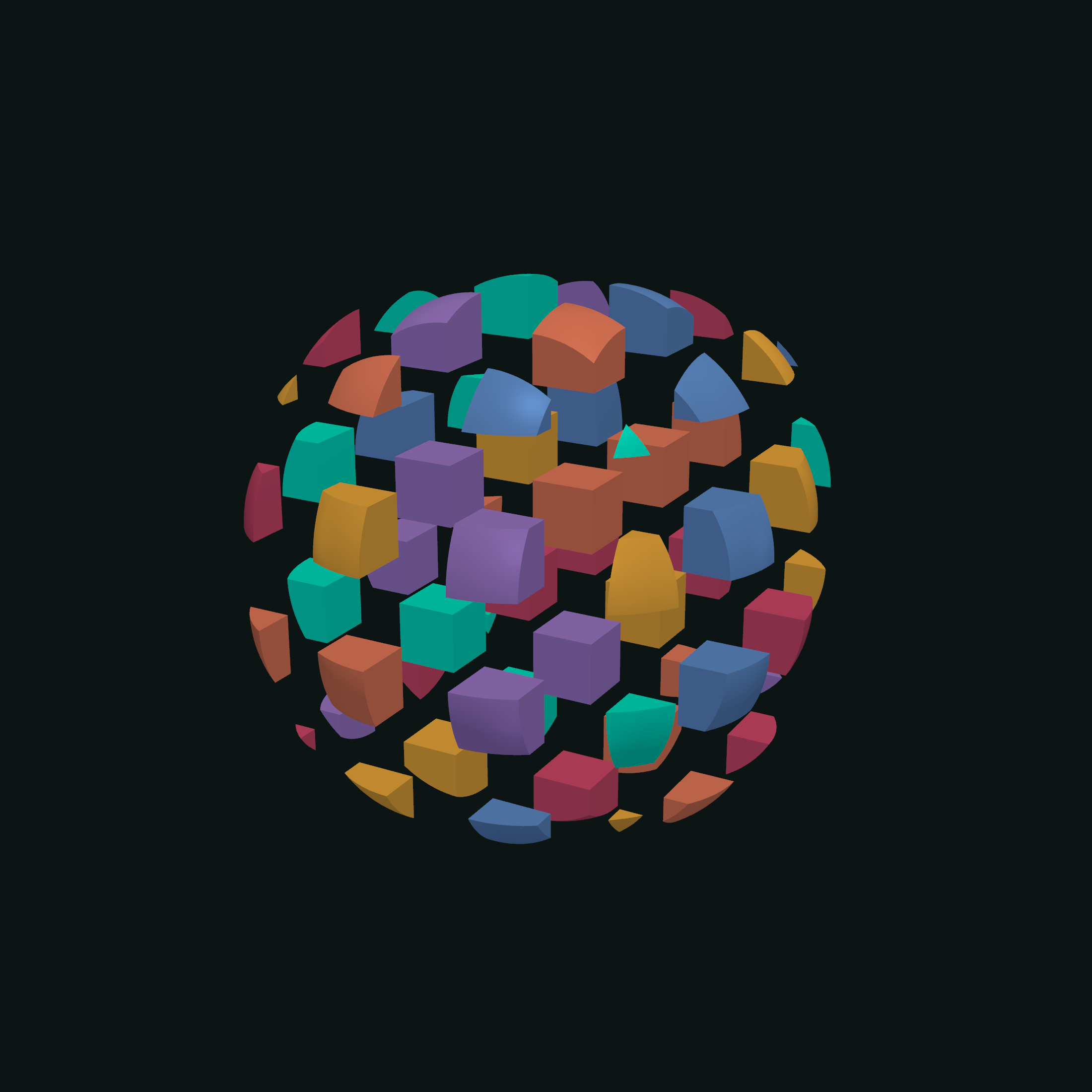
Seven standalone scripts in examples/, each with an importable
compute() and a plotting main() (python examples/<name>.py); the
gallery ships in the Polydera color scheme through the shared
examples/_theme.py:
boolean.py— a boolean difference recut live under a dragged sphere widget, the result labeled by source.csg_fracture.py— a sphere minus a grid of cutters through one csg_graph expression, read back as volumetric chunks; clicking a chunk names it throughclosest.isobands.py— height isobands and isocontours overlaid on a surface, recut live from a band-count slider.signed_distance.py— a hills surface recolored live by signed distance to a dragged torus probe, diverging about the zero seam.curvature.py— Gaussian curvature across a torus and mean curvature across a hills surface, from oneprincipal_curvaturescall each.remesh_and_simplify.py— remeshed, decimated, and simplified side by side.raycast_depth.py— an orthographic depth image from one batchedtf.Raycast.
Orientation verdicts (orient_faces_consistently,
ensure_positive_orientation) — the Python binding still returns only the
repaired faces array, no verdict yet.
Dual-licensed:
- Noncommercial: PolyForm Noncommercial License 1.0.0
- Commercial: Contact info@polydera.com