A Node.js + TypeScript CLI tool for generating comprehensive project specifications using AI. Creates structured markdown documentation for architecture, UI/UX, API, deployment, roadmap, and actionable task lists.
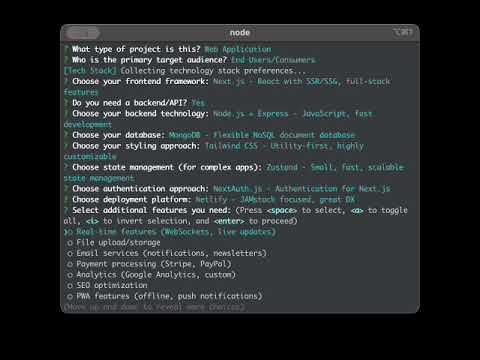
- 🤖 AI-Powered Generation - Uses OpenAI GPT-4 (with support for other providers)
- 📋 Comprehensive Specs - Architecture, UI/UX, API, Deployment, and Roadmap documentation
- ⚡ Two Modes - Quick (minimal questions) or Detailed (comprehensive questionnaire)
- 📝 Structured Output - Clean markdown with Summary, Main Content, and Assumptions sections
- ✅ Task Generation - Automatic task list creation with actionable checkboxes
- 🔧 Configurable - Support for multiple AI providers and custom settings
- 🛡️ Safe Operations - Smart file handling with overwrite protection
npm install -g nspecgengit clone https://github.com/nuvo-code/nspecgen.git
cd nspecgen
npm install
npm run build
npm linknspecgen --version-
Initialize configuration:
nspecgen init
-
Generate specifications:
nspecgen run --mode quick
-
View generated files:
ls specs/
# architecture.md  ui-ux.md  api.md  deployment.md  roadmap.md  tasks.md
# Initialize configuration
nspecgen init [--force]

# Generate all specifications
nspecgen run [options]

# Add specific specification
nspecgen add <step> [options]

# Update existing specifications
nspecgen update [step] [options]--mode <mode>- Generation mode:quickordetailed(default: quick)--steps <steps>- Comma-separated list of steps:architecture,ui,api,deployment,roadmap--output <dir>- Output directory (default: ./specs)--force- Overwrite existing files without prompting--provider <provider>- AI provider:openai,anthropic,gemini,local--model <model>- AI model to use
# Quick generation with minimal questions
nspecgen run --mode quick

# Detailed generation with comprehensive questionnaire
nspecgen run --mode detailed --output ./documentation

# Generate only architecture and API specs
nspecgen run --steps architecture,api

# Update all existing specifications
nspecgen update --all

# Use specific AI provider and model
nspecgen run --provider openai --model gpt-4-turboRun nspecgen init to create a specgen.config.json file in your project root:
{
  "provider": "openai",
  "model": "gpt-4",
  "outputDir": "./specs",
  "defaultMode": "quick",
  "steps": {
    "architecture": true,
    "ui": true,
    "api": true,
    "deployment": true,
    "roadmap": true
  }
}Set your API key using environment variables:
# OpenAI
export OPENAI_API_KEY="your-api-key"

# Anthropic
export ANTHROPIC_API_KEY="your-api-key"

# Google Gemini
export GEMINI_API_KEY="your-api-key"

# Or set in config
export NSPECGEN_API_KEY="your-api-key"
export NSPECGEN_PROVIDER="openai"
export NSPECGEN_MODEL="gpt-4"After running nspecgen run, you'll find structured documentation:
specs/
├── architecture.md    # System architecture and technology stack
├── ui-ux.md          # User interface and experience design
├── api.md            # API specification and endpoints
├── deployment.md     # Infrastructure and deployment strategy
├── roadmap.md        # Project timeline and milestones
└── tasks.md          # Actionable task checklist
Each file follows a consistent structure:
- Summary - Key points and decisions (5-7 bullets)
- Main Content - Detailed specifications and guidelines
- Assumptions & Open Questions - Areas needing clarification
git clone https://github.com/nuvo-code/nspecgen.git
cd nspecgen
npm install
npm run buildnpm test
npm run test:watchnpm run dev # Watch mode compilation
npm run link # Link for global usage
npm run unlink # Remove global link- Fork the repository
- Create a feature branch
- Make your changes
- Add tests for new functionality
- Submit a pull request
- Additional AI provider implementations (Local)
- CI/CD integration for automatic spec updates
- Plugin system for custom specification steps
- Web UI interface
- Template system for different project types
- Export to different formats (PDF, Word, etc.)
MIT License - see LICENSE file for details.