HealthyRemote is a comprehensive wellness platform designed for remote workers. It helps users track their health metrics, participate in challenges, access educational content, and receive AI-powered wellness assistance to maintain a healthy lifestyle while working remotely.
Try the live application: https://apphealthyremote.mmdlab.tech/
Test credentials:
- Username: paco | Email: paco@example.com
- Username: paca | Email: paca@example.com
Watch the 2min demo:
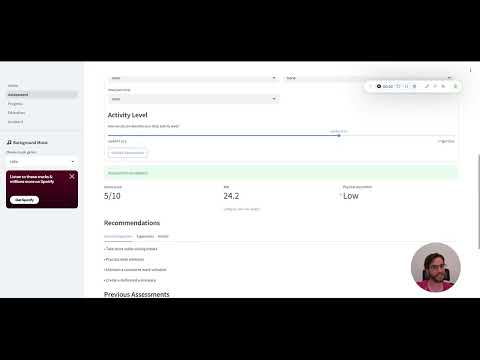
- Track daily activities with duration and type
- Monitor stress levels over time
- Record weight measurements for BMI calculation
- Conduct mobility self-assessments
- AI Wellness Assistant for personalized guidance
- Participate in structured wellness challenges
- Educational content on ergonomics and stretching
- Background music integration via Spotify
- Interactive dashboards showing health trends
- Comprehensive progress reports
- Downloadable PDF wellness reports
- BMI interpretation and recommendations
- Personalized user profiles
- Multi-page interface with intuitive navigation
- Authentication system (login and registration)
- Mobile-responsive design
- Python: Core programming language
- Streamlit: Web application framework
- PostgreSQL/Neon: Database for user data storage
- OpenAI API: Powers the AI wellness assistant
- ReportLab: Generates PDF wellness reports
- Plotly: Interactive data visualizations
- Pandas/NumPy: Data processing and analysis
- Spotify Web Embed: Background music player
- Home.py: Main dashboard and entry point
- pages/
- 1_Assessment.py: Health assessments and tracking
- 2_Progress.py: Health metrics visualization and reports
- 3_Education.py: Ergonomics and wellness education
- 4_Assistant.py: AI wellness assistant interface
- utils/
- components.py: Core functionality including AI assistant, BMI interpreter, and Spotify player
- database.py: Database operations, schema definition, and data access
- pdf_generator.py: PDF wellness report generation
- recommendations.py: Dynamic health recommendations and tips
- visualization.py: Data visualization helpers
- wellness_tips.py: Wellness tips and advice
- data/
- db_samples/: Sample database records for testing and demos
- images/: Images for self-assessment tests
- .env: Environment variables for configuration
- requirements.txt: Python dependencies
- Python 3.8 or higher
- PostgreSQL database (Neon)
- OpenAI API key
-
Clone the repository:
git clone https://github.com/yourusername/HealthyRemote.git cd HealthyRemote -
Create and activate a virtual environment:
python -m venv venv
source venv/bin/activate  # On Windows use `venv\Scripts\activate`
-
Install the required packages:
pip install -r requirements.txt
-
Create a .env file in the root directory and add your credentials:
DATABASE_URL=''
OPENAI_API_KEY=''
-
Initialize the database:
python -c "from utils.database import init_db; init_db()"
-
Start the Streamlit application:
streamlit run Home.py
-
Open your web browser and go to
http://localhost:8501to access the application.
HealthyRemote can be easily run in a Docker container for local development or deployment.
- Docker installed on your machine
- (Optional) Docker Compose for multi-service setups
-
Build the Docker image:
docker build -t healthyremote . -
Make sure you have a
.envfile in the project root with your environment variables (e.g.DATABASE_URL,OPENAI_API_KEY). -
Run the container:
docker run -p 8501:8501 --env-file .env healthyremote
-
Open your browser and go to
http://localhost:8501to access the application.
If you have a docker-compose.yml file, you can start the application with:
docker-compose upThen access the app at http://localhost:8501.
To deploy the application to Streamlit Cloud:
- Push your code to GitHub
- Go to the Streamlit Cloud dashboard
- Connect your GitHub repository
- Add the required environment variables (DATABASE_URL, OPENAI_API_KEY)
- Deploy the application
The data directory contains important resources that are necessary for the full functionality of the application:
These files contain sample data for testing and demonstration:
- Sample activities, weights, and stress logs
- Pre-defined challenges and their requirements
- Test user profiles with realistic health data
Contains all visual assets for the application:
- Mobility test illustrations used in the self-assessment section
- Exercise demonstration images for the education section
- UI elements and icons
To properly run the application, ensure the data directory structure is maintained after cloning the repository.
The application requires several Python packages, which are listed in the requirements.txt file. Please install the dependencies using:
pip install -r requirements.txtReady to enhance your wellness journey? Access the HealthyRemote application live at HealthyRemote.
Explore the features and see how it can support your health and wellness goals!
If you have any questions, feedback, or contributions, feel free to contact.
Happy remote work, and stay healthy!
-
ScanSource. (2023). Healthcare Industry Trends and Growth Forecast Infographic. Retrieved from https://www.scansource.com/~/media/Project/scansource/scansourceweb/Enablement/Programs/2023-vertical-marketing-program/2023-healthcare-infographic.pdf
-
Oakman, J., Kinsman, N., Stuckey, R., Graham, M., & Weale, V. (2024). Working from home—understanding the impacts on health. Journal of Occupational Health, 66(1), uiae005. https://academic.oup.com/joh/article/66/1/uiae005/7591974
-
CaseIQ. (2023). Health and Safety Issues When Employees are Working from Home. Retrieved from https://www.caseiq.com/resources/health-and-safety-issues-when-employees-are-working-from-home
-
McCall, A. (2023). Remote work poses risks to physical health. The Hill. Retrieved from https://thehill.com/changing-america/well-being/4076569-remote-work-poses-risks-to-physical-health
-
World Economic Forum. (2024, January). Remote work and the future of global digital jobs. Retrieved from https://www.weforum.org/stories/2024/01/remote-global-digital-jobs-whitepaper/
-
Forrester Research. (2022, November). Predictions 2023: Healthcare. Retrieved from https://www.forrester.com/blogs/predictions-2023-healthcare/
-
Moretti, A., Menna, F., Aulicino, M., Paoletta, M., Liguori, S., & Iolascon, G. (2020). Characterization of home working population during COVID-19 emergency: A cross-sectional analysis. International Journal of Environmental Research and Public Health, 17(17), 6284.
-
Xiao, Y., Becerik-Gerber, B., Lucas, G., & Roll, S. C. (2021). Impacts of working from home during COVID-19 pandemic on physical and mental well-being of office workstation users. Journal of Occupational and Environmental Medicine, 63(3), 181-190.
-
Hadjidemetriou, G. M., Sasidharan, M., Kouyialis, G., & Parlikad, A. K. (2020). The impact of government measures and human mobility trend on COVID-19 related deaths in the UK. Transportation Research Interdisciplinary Perspectives, 6, 100167.
-
Kužnar, I., Žvanut, B., & Pucer, P. (2022). The effects of remote work on the physical health of workers during the COVID-19 pandemic: A systematic review. International Journal of Environmental Research and Public Health, 19(14), 8398.
-
McKinsey & Company. (2023). The future of remote work: An analysis of 2,000 tasks, 800 jobs, and 9 countries. McKinsey Global Institute.
-
Deloitte. (2022). Digital health technology: Global trends in healthcare transformation. Deloitte Insights.
-
World Health Organization. (2021). Mental health and psychosocial considerations during the COVID-19 outbreak. WHO Reference Number: WHO/2019-nCoV/MentalHealth/2020.1.