


Provide a basic logger and an advanced profiler for Guzzle with support for multiple Guzzle versions.
- The basic logger uses the default Symfony app logger, it's safe to use in your production environment.
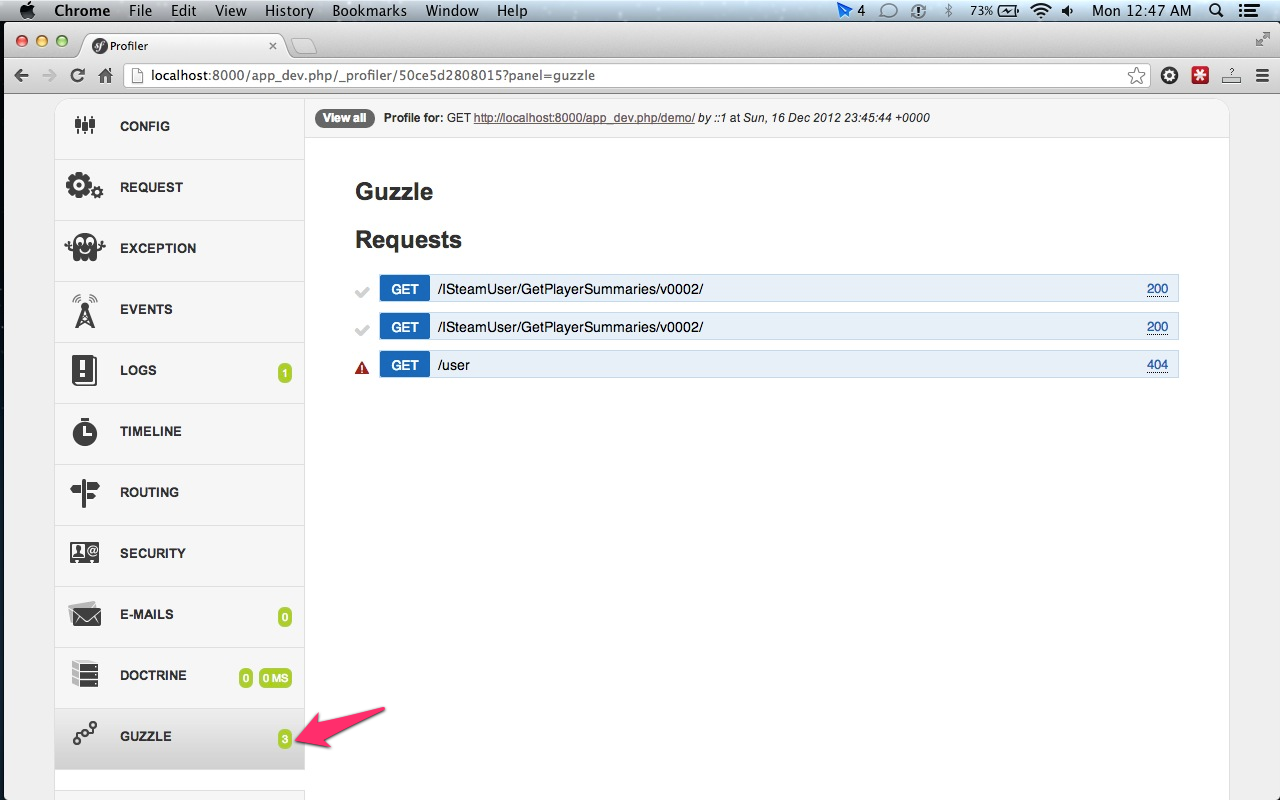
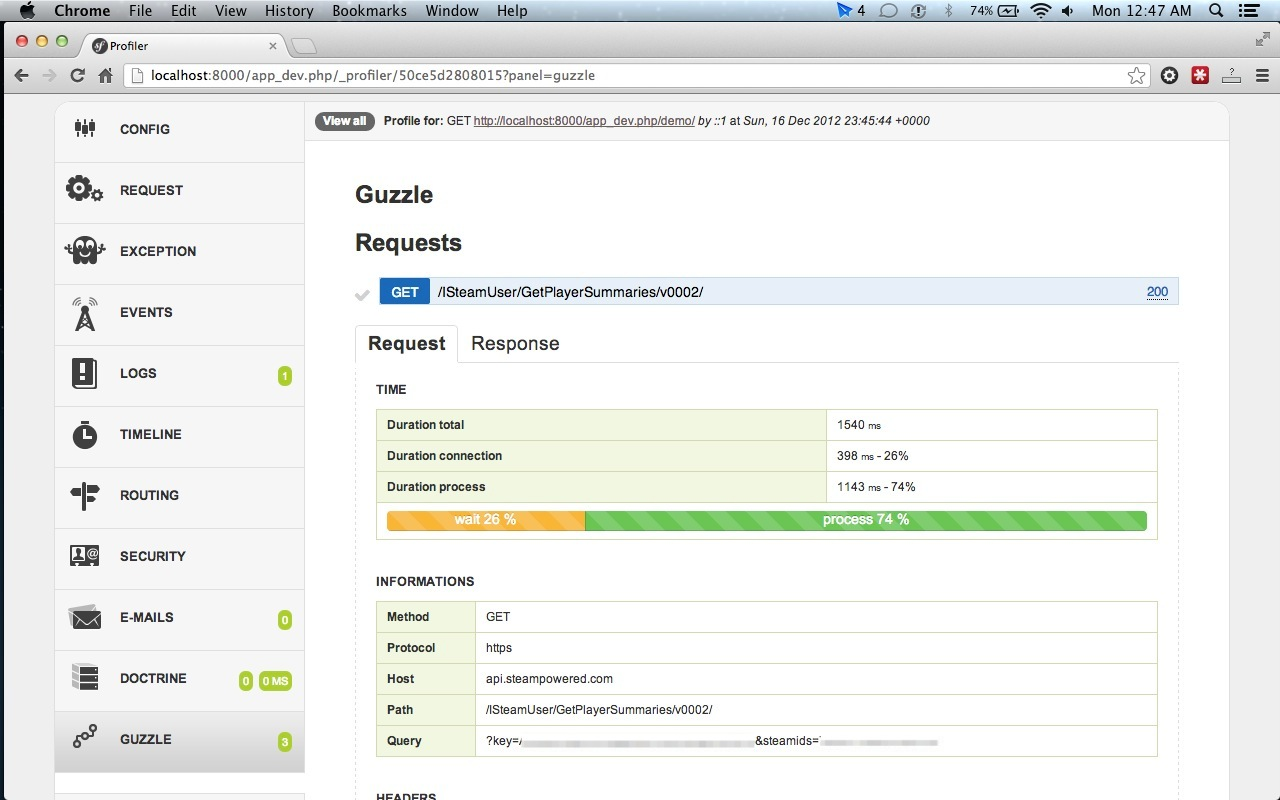
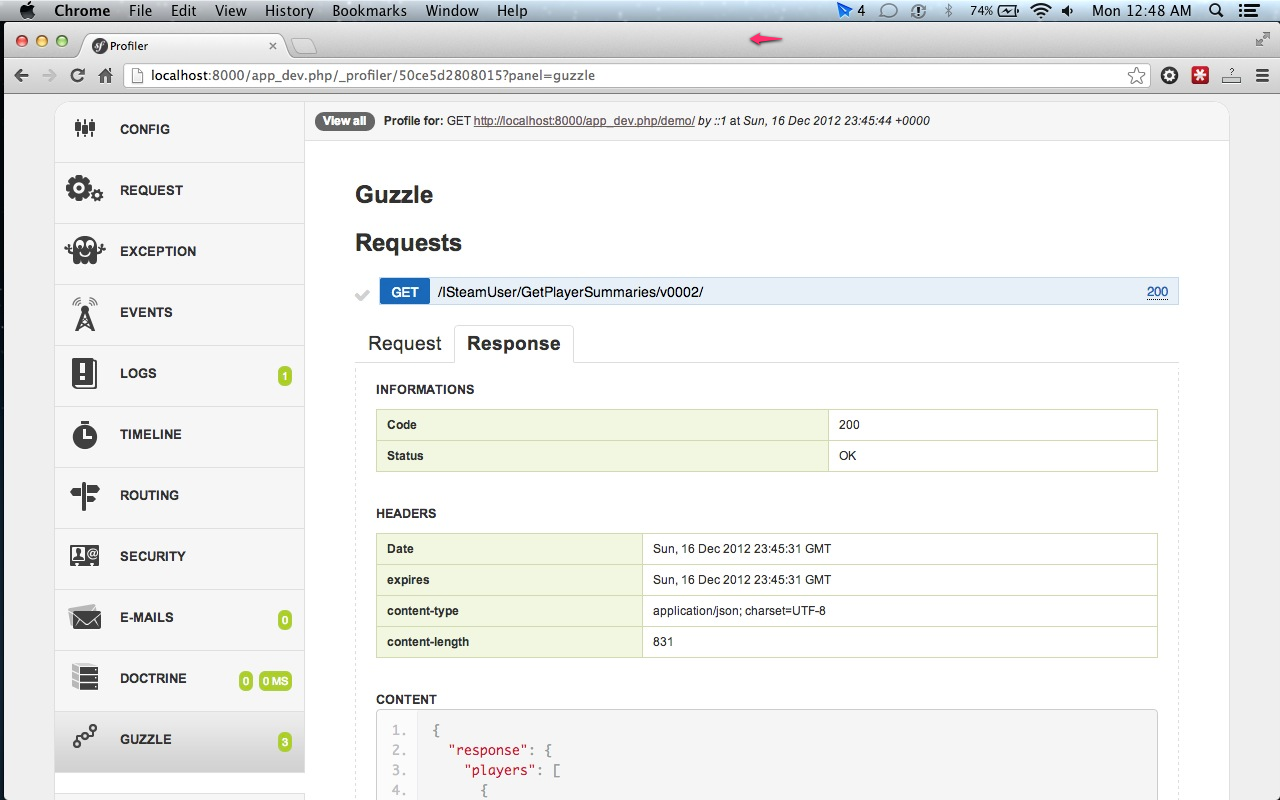
- The advanced profiler is for debug purposes and will display a dedicated report available in the toolbar and Symfony Web Profiler
- Multi-version support: Automatically detects and works with Guzzle 4.x, 5.x, 6.x, and 7.x
This bundle supports the following Guzzle versions:
- Guzzle 4.x (
guzzlehttp/guzzle:~4.0) - Guzzle 5.x (
guzzlehttp/guzzle:~5.0) - Guzzle 6.x (
guzzlehttp/guzzle:~6.0) - Guzzle 7.x (
guzzlehttp/guzzle:~7.0)
The bundle automatically detects which version you have installed and adapts accordingly.
composer require --dev playbloom/guzzle-bundleAdd the bundle to your Symfony app kernel
<?php
    // in %your_project%/app/AppKernel.php
    $bundles[] = new Playbloom\Bundle\GuzzleBundle\PlaybloomGuzzleBundle();
?>
To enable the advanced profiler & the toolbar/web profiler panel, add this line to your app/config/config_dev.yml
playbloom_guzzle:
web_profiler: trueConcrete Guzzle client creation can be easily managed by the Symfony service container thanks to a simple factory configuration, in this case, you just need to tag your guzzle service(s) with playbloom_guzzle.client.
Automatic plugin attachment via service tags works for all Guzzle versions (4, 5, 6, and 7). It will add the basic logger to your client(s). If the web_profiler is enabled in the current environment, it will also add the advanced profiler and display report on the Symfony toolbar/web profiler.
# config/services.yaml
services:
    acme.client:
        class: '%acme.client.class%'
        factory: ['%acme.client.class%', 'factory']
tags: ['playbloom_guzzle.client']If you need to handle the registration of the logger or profiler manually, you can retrieve these services from the Symfony container. The bundle automatically registers the correct service based on your Guzzle version.
use GuzzleHttp\Client;

$client = new Client(['base_url' => 'https://api.example.com']);

$logger = $container->get('playbloom_guzzle.client.plugin.subscriber.logger');
$client->getEmitter()->attach($logger);

$profiler = $container->get('playbloom_guzzle.client.plugin.subscriber.profiler');
$client->getEmitter()->attach($profiler);use GuzzleHttp\Client;
use GuzzleHttp\HandlerStack;
$stack = HandlerStack::create();
$logger = $container->get('playbloom_guzzle.client.plugin.middleware.logger');
$stack->push($logger);
$profiler = $container->get('playbloom_guzzle.client.plugin.middleware.profiler');
$stack->push($profiler);
$client = new Client([
'base_uri' => 'https://api.example.com',
'handler' => $stack
]);If you need a custom profiler panel you can extend/reuse easily the data collector and profiler template from this bundle.
For example, you have a GithubBundle which interact with the Github API. You also have a Github profiler panel to debug your developement and you want to have the API requests profiled in this panel.
It's quite easy:
First, define your own GithubDataCollector extending the Playbloom\Bundle\GuzzleBundle\DataCollector\GuzzleDataCollector
Then extends the guzzle web profiler template
{% extends 'PlaybloomGuzzleBundle:Collector:guzzle.html.twig' %}

{% block panel %}
    <div class="github">
        <h2>Github</h2>
        <ul>
            <li><strong>Github API key:</strong> {{ collector.getApiKey }}</li>
            <!-- Some custom information -->
        </ul>
    </div>

    {% include 'PlaybloomGuzzleBundle:Profiler:requests.html.twig' with {'requests': collector.requests } %}
{% endblock %}
And finally declare your data collector
# config/services.yaml
services:
    data_collector.github:
        class: Acme\GithubBundle\DataCollector\GithubDataCollector
        arguments:
            - '@playbloom_guzzle.client.plugin.profiler'
        tags:
            - { name: data_collector, template: '@AcmeGithub/Collector/github.html.twig', id: github }
That's it, now your profiler panel displays your custom information and the Guzzle API requests.
- Add extra information about the client configuration itself (thanks to the guzzle service builder?)
- Add clients|host|endpoint|time filters for http requests
This bundle is under the MIT license. See the complete license in the bundle
- Swagger for the UI