
- access the fediverse from a Solid pod
FediPod is a merger of three federating protocols - feeds from Mastodon and other Fediverse servers and from Bluesky and other ATProto servers, with all user data stored on a Solid pod. There are four different kinds of FediPod accounts :
| Kind of Account | Description | User requirements | Host requirements |
|---|---|---|---|
| FediPod Solo | Browse & interact with the fediverse and ATProto from a Solid pod | an always-on pod, a usually on local agent | — |
| FediPod Group | Host a discussion group of fediverse/ATProto users from a Solid pod | an always-on pod, a usually on local agent | — |
| FediPod Gateway | Solo or Group with spam filtering & optional community identity | same + gateway pass-through account | any always-on host, Netlify will do |
| FediPod Server | Full ActivityPub server as a CSS component | a pod on a CSS server implementing the FediPod component | a CSS server implementing the FediPod component |
You may sign up for free for a solo, group, or gateway account at https://fedipod.net/ . Wizards will walk you through install and setup. If you want to host a community, instructions are available for Fediverse User Group, the lightweight FediPod Gateway and for the full CSS component FediPod Server.
npm install -g fedipod
Needs Node 20 or newer.
Run fedipod start. You may optionally add a port number (fedipod start --port 8081) to change your local agent's port (default is 8030).
Now point your browser (any) at https://localhost:8030 — or your own port if you set one — and there you go!
If you don't want to run the agent each time, you can install it as a system service. This is recommended as leaving the agent off causes your mail to pile up on the pod host. To create a system service :
fedipod install-service
It registers every identity on this machine, one service each, so all of your actors start at boot. An identity running in a terminal is stopped and taken over by its service.
fedipod uninstall-service reverses it.
You can manage your posts, see logs, park, move, transfer your account and perform other actions. See the GUI admin and CLI admin pages.
You can also use the admin tools to create other actors, either groups or persons. You may have as many as you want on the local machine, but each one needs a separate pod.
Every agent checks once a day whether a newer FediPod is published. When one
exists, the record page offers Update, and fedipod update
does the same from the terminal. AP_UPDATE_CHECK=0 turns the check off.
Most of what a fediverse inbox receives is broadcast noise. A gateway is a shared, always-on door that verifies each delivery, drops the junk, and passes the rest to your pod — while your key and data stay on your own pod. There is a free gateway at fedipod.net. Attaching to it or detaching from it is a few wizard-guided clicks.
Users are recommended to associate with a gateway as it reduces the mail load on your pod host.
The UI is the bundled Phanpy
client (MIT, by Chee Aun). It is served same-origin over the agent's Mastodon client-API facade. Log in with one click, using https://localhost:8030 (or your own port) as the instance.
The agent federates for real: follow/unfollow, post, reply, favourite,
boost, media, delete; incoming boosts from people you follow and a
configurable public-hashtag feed (POST /tagfeed) fill the timeline.
Also: editing posts, content warnings, voting in polls, all four visibility
levels (followers-only and direct posts work only on a pod that enforces
WAC access control — on one that doesn't, the composer refuses and says why),
a conversations view for direct messages, bookmarks, favourites, lists,
keyword filters, scheduled posts, pinned posts (visible from other servers),
blocking and muting from the client, custom emojis, and web-push
notifications that reach you while the client is closed.
- Web clients: drop any static Mastodon client dist into
ui/<name>/and it is served at/<name>/, same-origin — seeui/README.md. - Desktop clients (Tuba, Whalebird, …): add
https://localhost:8030(or other port for other agent) as a custom instance. - Streaming: the agent serves the Mastodon streaming API
(
/api/v1/streaming, WebSocket) so clients update live instead of polling.
FediPod includes experimental support for ATProto. A Bluesky connection lets your FediPod agent drive an existing Bluesky (or other ATProto) account alongside your fediverse identity. When you post a public post from FediPod, it will be cross-posted to Bluesky as a mirror (a toggle you can turn off). Private DMs from FediPod to Bluesky are not currently supported. Bluesky replies and activity flow into your timeline so you see, for example, a combined Bluesky and Mastodon feed. You can like, boost, and reply to Bluesky posts from within FediPod. None of these features require Bridgy Fed, however, fully joining a FediPod group from a Bluesky client other than FediPod does require a bridge.
Activitypods requires a server which provides both an ActivityPub server and a Solid server and thus requires a specific server setup. FediPod Solo & FediPod Group, can be installed on any subdomained https-served pod without any modification to the server. It does this by splitting the ActivityPub server into two parts. The pod part provides discovery (webfinger) and stores mostly public data while the local agent provides the ActivityPub actions and storage for most private data. The exception is private direct messages which are stored on the pod protected by ACL resources. The same protected area also holds followers-only posts, and the pending-follow
and blocked collections. FediPod Gateway can be supported from any lightweight Internet-facing box including Netlify, it does not require a full server and can work with any FediPod-capable pod. FediPod Server works as a CSS server component. If the pod host installs it, anyone with a pod on that server can opt-in to using their pod as a FediPod account fed by the server itself.
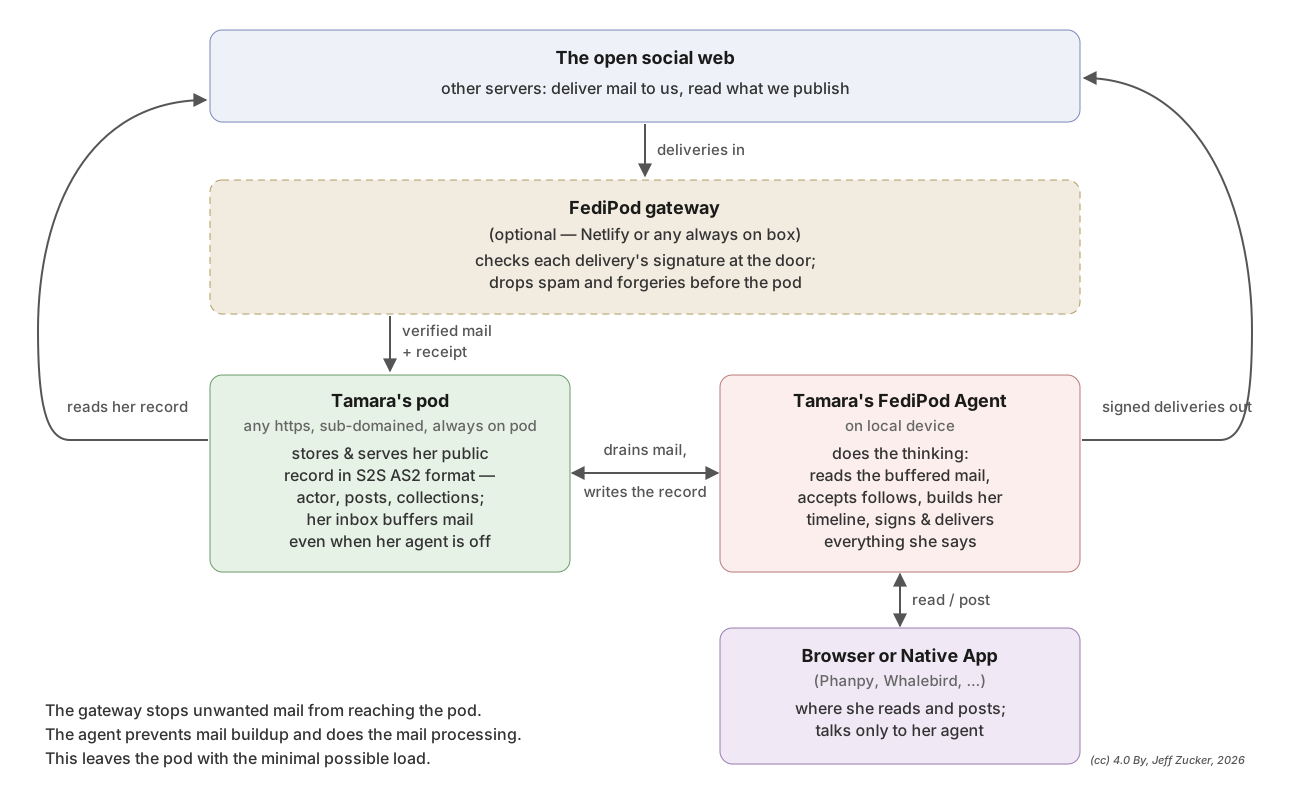
FediPod is a full ActivityPub server, on both of the spec's profiles:
server-to-server (§7) and client-to-server (§6) — POST /ap/outbox on the
agent takes an activity (or a bare Note) and does the id-minting,
side-effects and delivery, authenticated by a Solid-OIDC token whose WebID is
the owner's. The Mastodon REST API is the everyday client interface; C2S is
the spec's own.
Group actors follow FEP-1b12: a carried post names the group as its
audience, the moderator roster is published as the actor's attributedTo,
a followed group's announced Delete of a post it carried is honoured, and
the group's own moderation is announced to the membership. The FEP-4ccd
pending-follow collections and the FEP-c648 blocked collection are published
as owner-only documents. See Groups.
This project is inspired by the fantastic ActivityPods project and is meant to be a lightweight alternative rather than a replacement. Thanks to Sébastien and collaborators for all your work. Thanks to Damon, Mikhal, Alain, Sharon, and Vincent for testing and encouragement. Special thanks are due to Joseph whose client-to-server authentication approach and the netlify/fronted-identity ideas I borrowed from solid-activitypub-netlify.
This package was created using a heavily hectored claude.
(c) Jeff Zucker, 2026; may be freely used with an MIT license.