Write ISO/DD disk images to USB drives on Windows, then verify the result.


Flint is a lightweight, Windows-native utility for writing ISO and DD disk images to USB drives. It writes raw images directly to the physical disk, optionally re-reads the drive afterwards to confirm the write, and requires explicit typed confirmation before any destructive action.
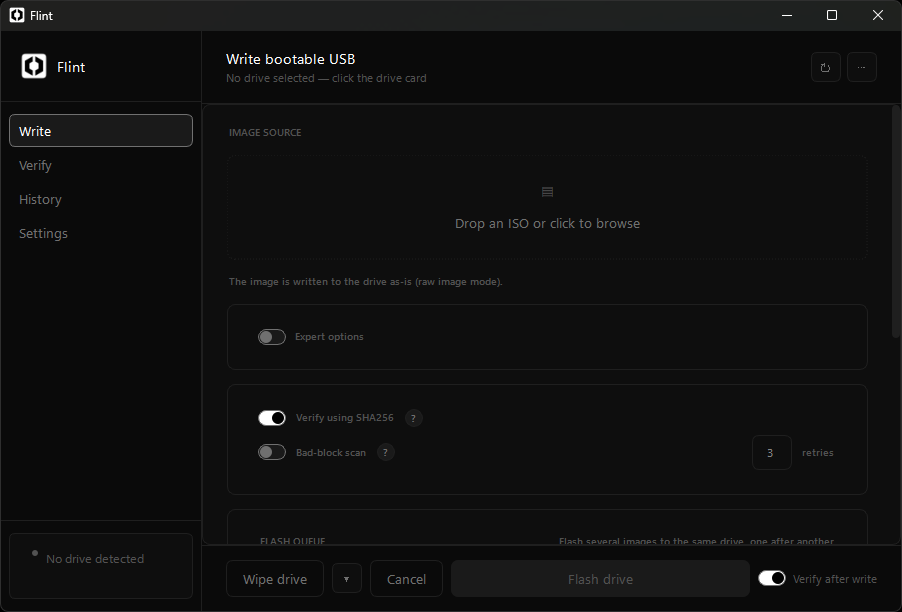
The full manual — user guide, CLI reference, troubleshooting and FAQ — lives on the Flint website.
- Drag & drop or browse for an image — a SHA-256 hash is computed for verification
- Drive picker with model, size and serial for each detected USB drive
- Optional post-write verification (SHA-256 compare with mismatch offsets)
- Bad-block scan that retries unreadable sectors and reports their locations
- Expert mode: partition scheme, target system, filesystem and write mode
- Persistence for Linux live images and Windows To Go for Windows images
- Flash history with export/import and per-flash reports
- Back up a drive to an image file, or clone a drive onto another drive
- SHA-256 sidecar files (
image.iso.sha256) validate the image before flashing - Wipe with selectable standards: zero fill, single random pass (NIST), or DoD 5220.22-M (three passes: zeros, ones, random)
- Headless/scriptable mode (
flint flash,verify,wipe,backup,clone,queue,flash-all) for automation and IT imaging workflows
- Latest release — download
flint.exe(portable, no installation required). - Windows 10/11, 64-bit.
SmartScreen: the executable is currently unsigned, so Windows may show a "Windows protected your PC" warning. Click More info → Run anyway. Verify the download against the published SHA-256 checksum first:
certutil -hashfile flint.exe SHA256and compare the result with
flint.exe.sha256on the release page.
- Pick an image — drag & drop an ISO/IMG onto the drop zone, or click it to browse (Ctrl+O).
- Choose a target drive — click the drive card and select from the list (F5 refreshes).
- Flash — click "Flash drive". Confirm the target by typing the drive serial or name when prompted.
Flint runs elevated, so it will ask for administrator permission when started. Every write and wipe is irreversible — the typed confirmation is your last guard against wiping the wrong drive.
- Verify after write re-reads the drive after writing (streaming SHA-256, live speed and remaining time).
- Verify using SHA256 compares the read-back digest against the image and reports the offsets of any mismatched regions.
- Bad-block scan retries failed reads up to the configured number of times (default 3) and reports the 4096-aligned offsets of sectors that never read back; unreadable chunks are skipped so the rest of the image is still checked.
- On mismatch, Flint offers to retry the write or abort. A cancelled verification is reported as completed-but-unverified — never as a false success.
Expert mode is enabled by default and can be turned off with the toggle on the write page. It adds:
- Partition scheme (GPT / MBR / Auto), target system (UEFI / Legacy / Auto) and filesystem (FAT32 / NTFS / exFAT).
- Write mode: raw (DD) or file copy. File-copy mode repartitions and formats the drive, then copies the image contents onto it — it is Windows-only, requires elevation, and is skipped for hybrid ISOs, which are always written raw so their boot record survives.
- Buffer size for raw writes (4–64 MiB) and an optional native writer using unbuffered disk I/O for maximum throughput.
- Persistence (Linux) and Windows To Go (Windows) options — see below.
- Inline ? buttons beside every option open the in-app reference.
Security warning: every option on this panel repartitions or rewrites a physical drive. Wrong combinations can make a drive unbootable or erase it without recovery. Only use these options when you know what your target firmware and bootloader require; back up data first.
- Persistence keeps changes between reboots on live Linux sticks
(Ubuntu
casper-rw, Debian live overlay). It requires WSL with an ext4 tool to format the persistence image. - Windows To Go applies a Windows installation ISO to the drive so it boots as a portable Windows installation (requires NTFS and elevation).
- Both features require file-copy mode, are mutually exclusive, and are only shown for supported images.
- 64-bit Windows only.
- Flint writes raw images directly to disks — this irreversibly erases data. Always confirm the target and back up important data before use.
- Before a raw write to a FAT32 target, Flint refuses images containing files over 4 GiB (impossible on FAT32) unless you switch to NTFS/exFAT.
- Flash history is stored locally on your machine.
- Back up (drive picker → "Backup this drive to an image…") streams a USB
drive into a
.imgfile, locking the drive's volumes while reading. The backup's SHA-256 is shown in the completion report. - Clone (drive picker → "Clone this drive to another…") copies a drive onto a second drive byte-for-byte. The target must be at least as large as the source, must be a different drive, and requires the same typed confirmation as a flash.
- Wipe methods (the ▾ menu next to "Wipe drive"):
- Zero fill (fast) — single pass of zeros
- Random data (NIST) — single pass of random data (NIST SP 800-88 clear)
- DoD 5220.22-M (3 passes) — zeros, then ones, then random data
If a *.sha256 file sits next to your image (ubuntu.iso.sha256 or
ubuntu.sha256), Flint reads it, verifies the image digest against it, and
shows the result under the image source. A mismatch blocks flashing — a
corrupt or wrong image can never erase a drive by accident.
Every feature is available headless for imaging labs, scripts and CI.
flint below is the flint.exe you downloaded. Commands that need it
relaunch elevated automatically (one UAC prompt); list, doctor and
completions need no privileges at all. The older --cli prefix is still
accepted as a compatibility alias:
flint list
flint flash  --image image.iso --drive E: --confirm <serial> [--verify]
flint verify --drive E: [--sha256 <hex> --image image.iso]
flint wipe   --drive E: --confirm <serial> [--method zero|random|nist|dod]
flint backup --drive E: --out backup.img [--confirm <serial>]
flint clone  --from E: --to F: --confirm <serial of --to>
flint queue  --file list.txt --drive E: --confirm <serial>
flint flash-all --image image.iso [--image image2.iso ...] --confirm ARM [--timeout <seconds>]
flint doctor
flint completions | Out-File -Append $PROFILE
flint help [<command>]
--driveaccepts a serial number, volume letter (E:) or physical path (\\.\PHYSICALDRIVE1); it only selects the drive.--confirmis the safety check: it must match the full serial of the drive being destroyed, validated against the live drive list — a wrong serial can never match another drive.flint listprints every detected drive with the exact serial--confirmexpects.flash-allis fleet mode: it writes every--imageto every drive that is — or becomes — plugged in, until the time budget expires (default 3600 s). Arming requires the literal wordARM.- When
--confirmis omitted on an interactive terminal, the serial is prompted for; a piped command without--confirmis refused, never guessed. verifywithout a digest runs a read-only bad-block scan; with--sha256it compares only the image's byte range against the drive, so--imageis required to know how many bytes to check.- The queue file holds one image path per line (
#comments allowed); images are flashed to the same drive in order, stopping on the first failure. --jsonswitches all output to NDJSON (progress, results, drive lists);FLINT_PROGRESS=jsonis equivalent andFLINT_VERIFY=1makesflashverify by default.- Streams are split: data and the final
RESULT ok|fail|canceled: …line go to stdout;FLINT <pct> <speed>MB/s ETA <s>sprogress and notes go to stderr, so scripts capture stdout as pure data without2>&1noise. - Exit codes:
0ok,1failure,2cancelled,3usage/validation,4elevation denied.
The release workflow signs flint.exe automatically when the
WINDOWS_SIGNING_PFX (base64 PFX) and WINDOWS_SIGNING_PASSWORD repository
secrets are set. To sign locally once you have a certificate:
.\scripts\sign.ps1 -PfxPath .\cert.pfx -PfxPassword 'secret'- User guide and full documentation: https://flintweb.vercel.app
- Report issues and open pull requests on GitHub: https://github.com/gowthvm/Flint
- MIT License — Copyright (c) 2026 Gowtham G.K