

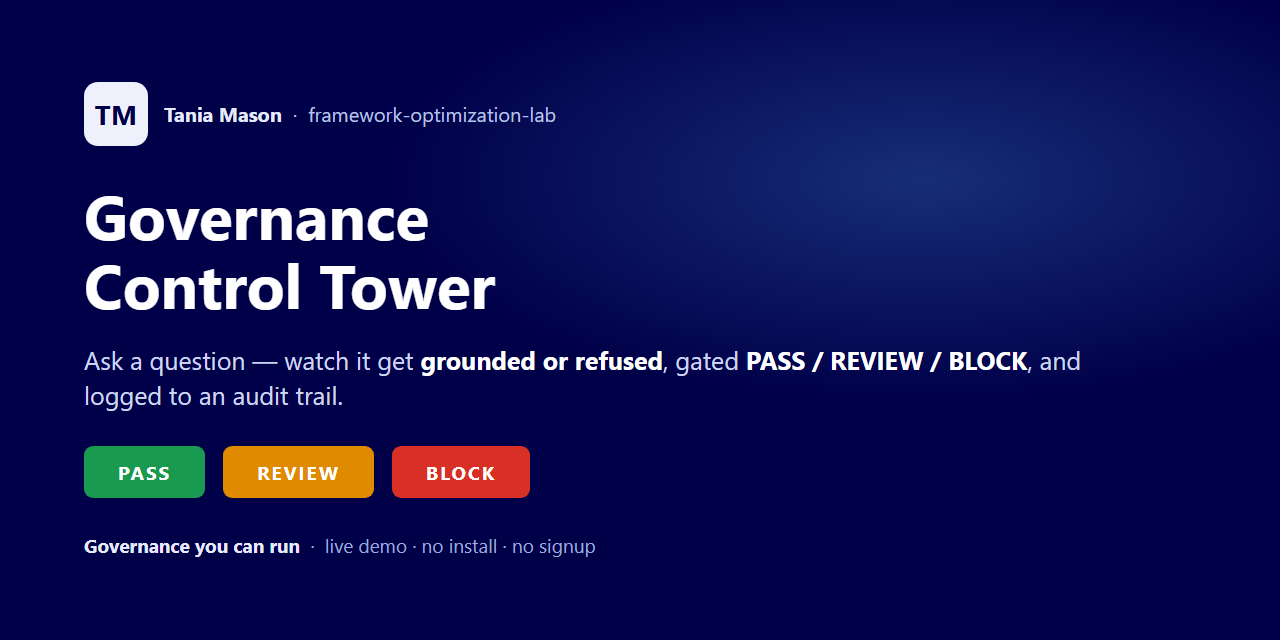
No install, no signup, no backend — the whole demo is one self-contained HTML file. Ask a question and watch it get grounded or refused, watch a deterministic seven-control gate issue PASS / REVIEW / BLOCK, sign off as a named human, then read the audit trail it left behind.
| Try this | What you will see |
|---|---|
| Ask | Answers bounded by retrieved playbook passages, with citations and a confidence tier |
| Gate | Break a decision record on purpose and watch the controls fire |
| Review | Human sign-off with a written rationale; BLOCK cannot be signed away |
| Dashboard | The audit trail and control metrics, end to end |
Tania Mason — AI governance, decision support, and delivery frameworks, built inside large-scale healthcare payer platform operations.
Everything here demonstrates one idea: an AI system you can act on needs governance designed in, not bolted on.
Each repository is a small, runnable build of a governance pattern drawn from enterprise AI work — re-authored clean-room, with synthetic, domain-neutral data only. The pattern is always the same: a written model of the controls, then code that actually enforces them, then tests that confirm each control fires.
| Repository | What it is | The controls it demonstrates |
|---|---|---|
| 🗼 governance-control-tower | The live demo above — all three patterns joined into one flow, as one self-contained HTML file: run it here with no backend, no model, and no dependencies | Grounded retrieval, mandated refusal, policy-as-code verdicts, human sign-off, and the audit trail — every verdict reproducible with literally no model in the loop |
| 📘 governed-playbook-assistant | A governed RAG question-answering app over an operating playbook | Answers come only from retrieved, citable evidence; out-of-scope questions are refused before the model is even called; every answer carries a confidence tier and sources |
| 🛡️ ai-decision-governance-gate | A policy-as-code checkpoint for AI "decision records" | No output ships without passing policy: PASS / REVIEW / BLOCK verdicts enforcing provenance, no fabrication, mandated refusal, and human sign-off — with the full governance model in docs/ |
The assistant governs answers on the way in — only evidence reaches the model. The gate governs decisions on the way out — nothing is released ungoverned.
- Evidence over assertion — every claim traces to a registered, citable source.
- Refusal instead of guessing — "insufficient evidence" produces a logged refusal, never a fabricated answer.
- Deterministic code owns correctness — the LLM orchestrates and explains; it never states a number it computed itself.
- A named human stays accountable — high-risk decisions require explicit sign-off before action.
- Auditable by construction — every run leaves a record you can defend after the fact.
These patterns come from designing AI-enabled decision support, identifier governance, and delivery frameworks inside large-scale healthcare payer platform operations — an environment where an unsupported number or an unowned decision has real consequences. The repositories are the generalized, runnable versions of that work.
All data is fictional.
LinkedIn: linkedin.com/in/tania-mason-payertech