



scikit-package offers tools and practices for the scientific community to make better and more reusable Scientific Python packages and applications:
- We help scientists share scientific code to amplify research impact.
- We help scientists save time, allowing them to focus on writing scientific code.
- We offer best practices from the group's experience in developing scientific software.
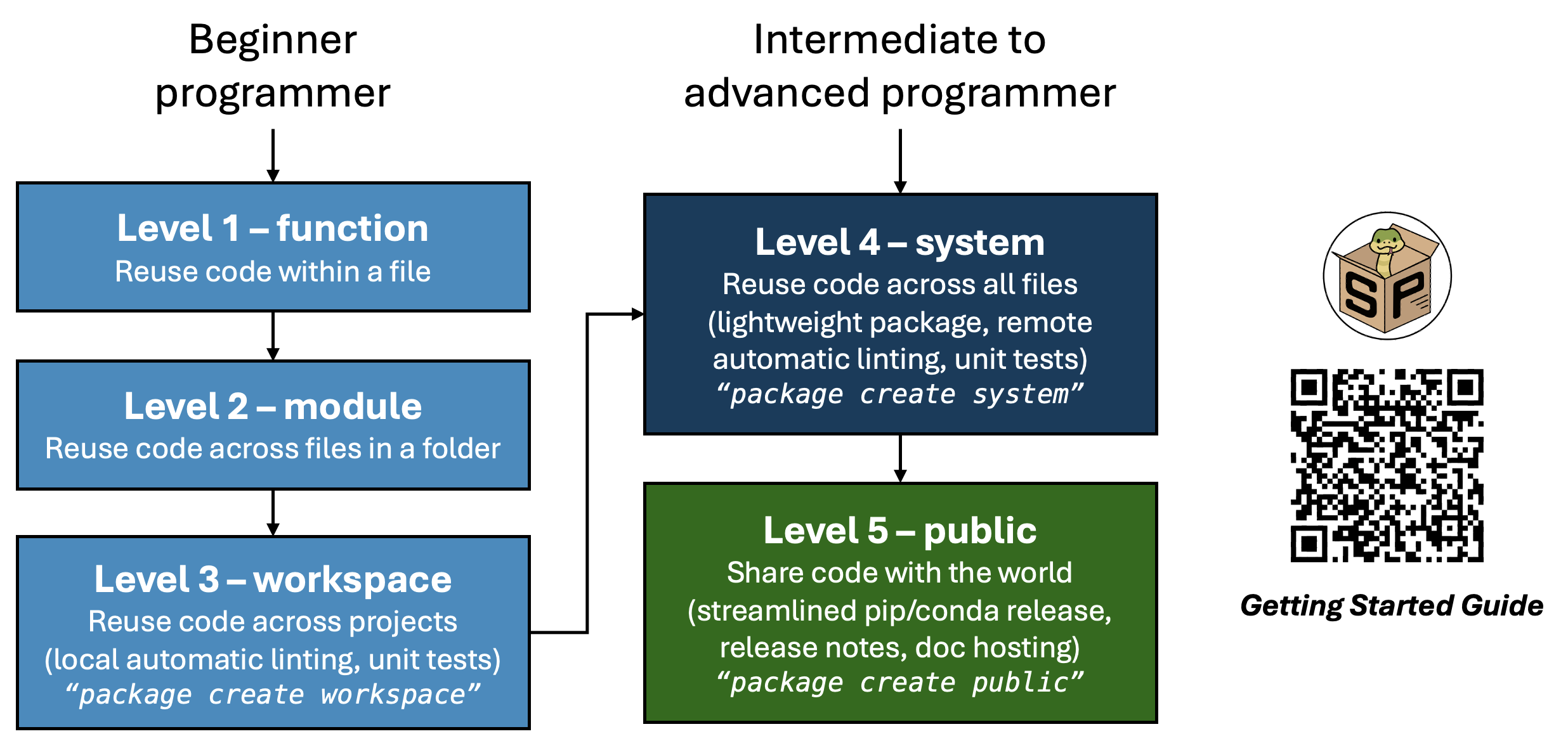
Here is an overview of the 5 levels of sharing code and the key features of scikit-package:
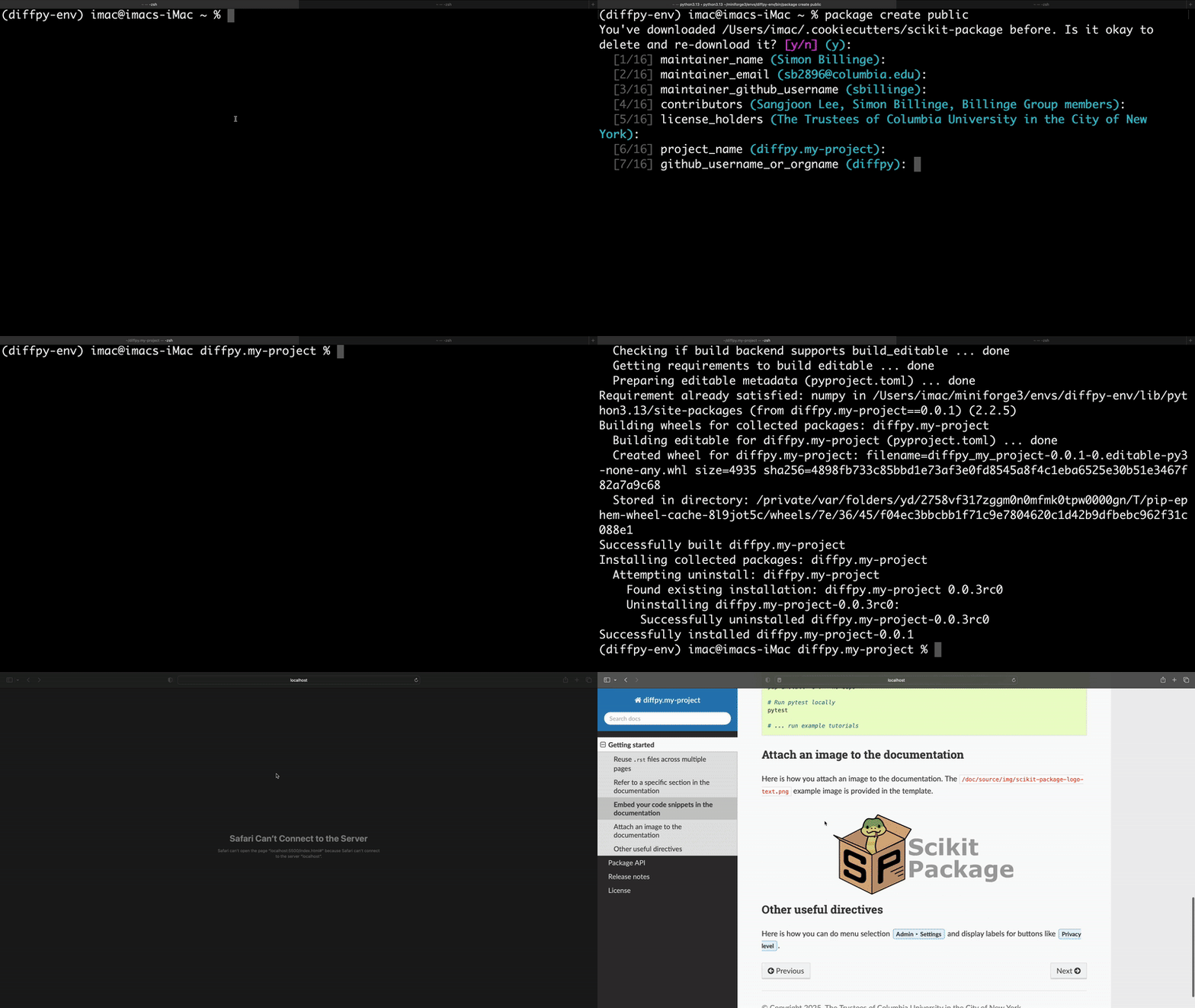
Here is how you can use the package create public command to create a new Level 5 Python package called diffpy.my-project in just 1–2 minutes:
Are you interested in using scikit-package? Begin with the Getting Started page in our online documentation at https://scikit-package.github.io/scikit-package!
The preferred method is to use Miniconda Python and install from the "conda-forge" channel of Conda packages.
To add "conda-forge" to the conda channels, run the following in a terminal.
conda config --add channels conda-forge
We want to install our packages in a suitable conda environment.
The following creates and activates a new environment named skpkg_env
conda create -n skpkg_env scikit-package
conda activate skpkg_env
To confirm that the installation was successful, type
python -c "import scikit_package; print(scikit_package.__version__)"
The output should print the latest version displayed on the badges above.
If the above does not work, you can use pip to download and install the latest release from
Python Package Index.
To install using pip into your skpkg_env environment, type
pip install scikit-package
If you prefer to install from sources, after installing the dependencies, obtain the source archive from
GitHub. Once installed, cd into your scikit-package directory
and run the following
pip install .
This package also provides command-line utilities. To conform the installation, type
package --version
To view the basic usage and available commands, type
package --h
If you use scikit-package to standardize your Python software, we would like you to cite scikit-package:
- Lee and C. Myers and A. Yang and T. Zhang and S. J. L. Billinge, scikit-package - software packaging standards and roadmap for sharing reproducible scientific software (https://arxiv.org/abs/2507.03328)
If you see a bug or want to request a feature, please report it as an issue and/or submit a fix as a PR.
Feel free to fork the project and contribute. To install scikit-package in a development mode, with its sources being directly used by Python rather than copied to a package directory, use the following in the root directory
pip install -e .
To ensure code quality and to prevent accidental commits into the default branch, please set up the use of our pre-commit hooks.
- Install pre-commit in your working environment by running
conda install pre-commit. - Initialize pre-commit (one time only)
pre-commit install.
Thereafter your code will be linted by black and isort and checked against flake8 before you can commit. If it fails by black or isort, just rerun and it should pass (black and isort will modify the files so should pass after they are modified). If the flake8 test fails please see the error messages and fix them manually before trying to commit again.
Improvements and fixes are always appreciated.
Before contributing, please read our Code of Conduct.
For more information on scikit-package please visit the project web-page or email Simon Billinge at sb2896@columbia.edu}}.
This GitHub repository is built and maintained with the help of scikit-package as well.