
A Tailored Computational Workflow Enabling Rapid, User-Friendly Genotyping and Epidemiological Surveillance of the Enterobacter cloacae Complex









- What's New in v1.1.0
- 🎯 Overview
- ✨ Key Features
- ⚡ Quick Start (CLI)
- 🔧 Installation (CLI)
- 🐳 Docker Usage
- 🖥️ Singularity for HPC Clusters
- 🔗 Integrated External Tools & Dependencies
- 🚀 Usage Guide (CLI)
- 📁 Output Structure
- 🔍 Analytical Modules
- 🔬 Validation & Accuracy
- 🤖 AI Integration Guide
- 🔮 Future Development
- ❓ Frequently Asked Questions
- 🐛 Troubleshooting
- 📚 Citation
- 🙏 Acknowledgements
- 👥 Authors & Contact
- 📄 License
- 📚 Third‑Party Tool Citations
Release Date: 2026-07-06
We’ve upgraded EnteroScope with a fully temporary‑directory execution model (HPC‑friendly), added point mutation reporting, introduced dynamic filtering thresholds, and improved the Ultimate Reporter with a dedicated Mutations tab and grouping by MLST.
- ✅ HPC‑Ready Orchestrator: All modules now run inside temporary directories (
/tmpby default) and are automatically cleaned up. This eliminates permission errors on clusters and keeps your working directory pristine. - ✅ Point Mutation Reporting (AMRfinderPlus): AMRfinderPlus now runs with
--plusby default, and the Ultimate Reporter displays a gene‑centric Mutation tab with grouping by MLST – instantly see which clones carry mutations ingyrA,parC,rpoB, or 23S rRNA. - ✅ Dynamic Threshold Flags:
--amr-min-identityand--amr-min-coverage– custom cutoffs for AMR hits (0..1).--skip-amr-mutations– disable point mutation reporting if you only want acquired genes.--amr-force-update– force a fresh AMR database download before analysis.--abricate-min-identityand--abricate-min-coverage– custom cutoffs for ABRicate (default 80%).
- ✅ Better Logging: Each module’s stdout/stderr is captured in
enteroscope_run.logfor full traceability. - ✅ Cleaner Output: Mutation summary files (
mutation_summary.html,mutation_summary.tsv,mutation_master_summary.json) are now placed insideenteroscope_amrfinder_results/and automatically copied to the summary module. - ✅ Ultimate Reporter Updates:
- Mutations tab is always shown; if no mutations are found, a friendly message appears.
- Grouping by MLST is now available on the AMR, Virulence, BACMET, Plasmids, and Mutations tabs – click a button to reorganise genome lists by sequence type.
- Sortable tables on every tab.
- Scientific quotes rotate after each module and at the end for inspiration.
- ✅ Docker & Singularity: The container now runs without permission errors – use
--writable-tmpfsfor Singularity and all outputs are owned by your user.
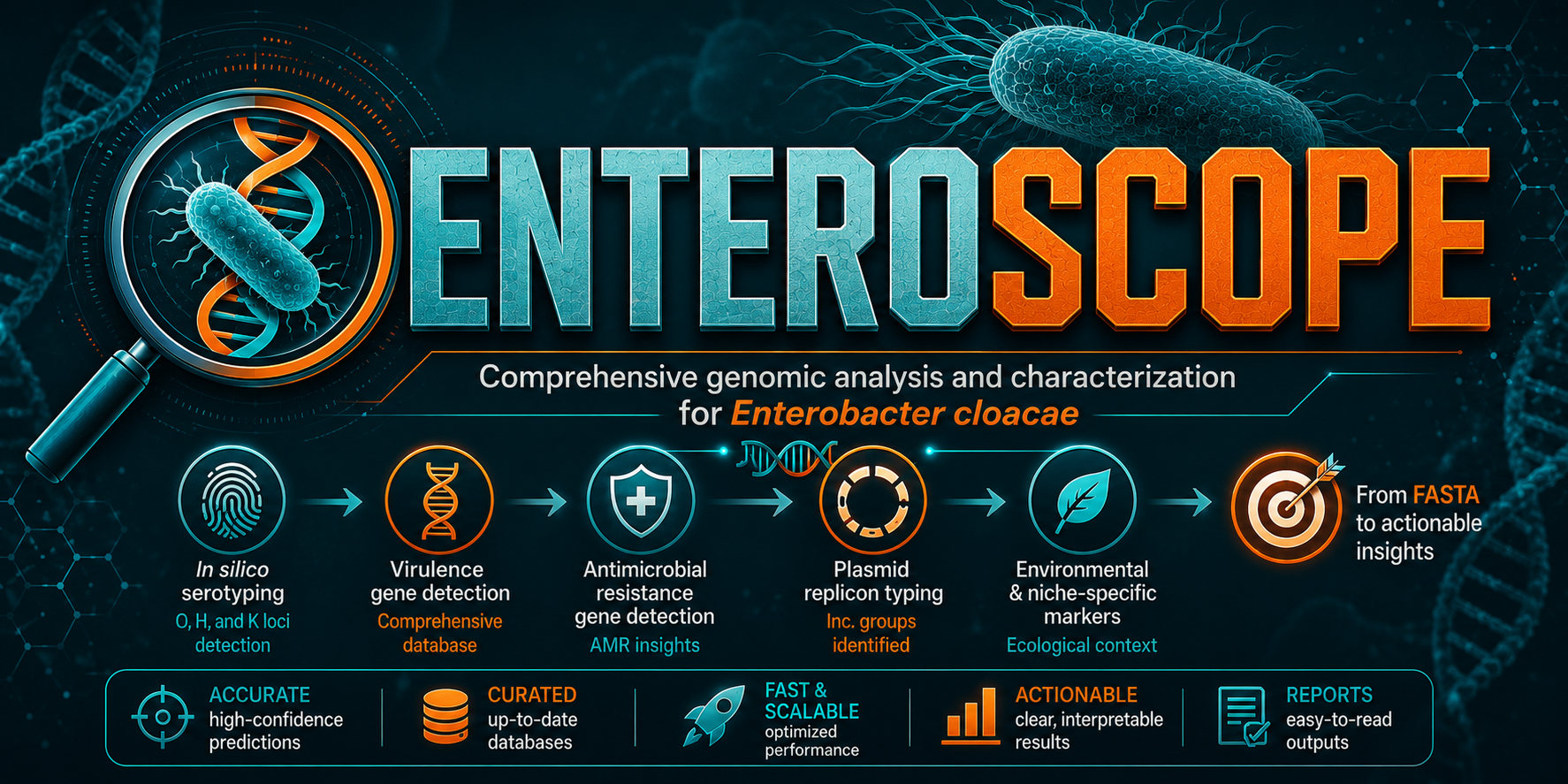
EnteroScope is an automated, locally‑executable pipeline designed specifically for comprehensive genomic surveillance of the Enterobacter cloacae – an opportunistic pathogen that increasingly important in healthcare‑associated infections and carbapenem resistance (CREC). It integrates six essential genotyping methods into a single, cohesive workflow.
- Emerging Threat: Enterobacter cloacae is a leading cause of neonatal sepsis and hospital outbreaks, with CREC mortality rates exceeding 40%.
- Fragmented Workflows: Traditional analysis requires 5+ separate tools (MLST, AMR, virulence, plasmids) with conflicting dependencies.
- Data Overload: Raw outputs lack epidemiological context and actionable insights.
- Resource Barriers: Web services raise privacy concerns; local solutions are hard to install.
EnteroScope delivers:
- ✅ Single‑command installation via Conda or Docker.
- ✅ 3‑4 hrs complete analysis (100 samples, 16 cores).
- ✅ 100% local execution – your data stays private.
- ✅ Interactive HTML reports with rotating educational facts about E. cloacae.
- ✅ Gene‑centric tables (scrollable, wrapped genome lists).
- ✅ Automatic detection of critical resistance: KPC, NDM, OXA‑48, VIM, IMP, mcr, tet(X).
- ✅ Point mutation reporting with grouping by MLST.
Perfect for: Clinical labs, outbreak investigations (CREC), public health surveillance, and research studies.
See a complete interactive report generated by EnteroScope:
The report includes AMR, Virulence, BACMET, Plasmid, and Mutations tabs, each with grouping by MLST, filter buttons, sortable headers, and scrollable genome lists.
| Module | Purpose | Key Outputs | Speed |
|---|---|---|---|
| FASTA QC | Assembly quality (N50, GC%, contigs) | HTML, TSV, JSON | <30 sec |
| MLST | Sequence typing (7 housekeeping genes) | ST, allele profile | <1 min |
| AMR Profiling | Resistance genes (AMRFinderPlus) | Carbapenemases, ESBLs, mcr, tet(X) | 2‑3 min |
| ABRicate | Multi‑database (9 DBs) – virulence/plasmids | VFDB, ResFinder, CARD, PlasmidFinder | 3‑4 min |
| BACMET2 | Biocide & heavy metal resistance | qac, mer, ars, czc, etc. | 1‑2 min |
| PlasmidFinder | Replicon typing (IncL/M, IncFII, IncHI2) | Outbreak plasmid tracking | 1‑2 min |
| Mutations (AMRfinderPlus) | Point mutations (gyrA, parC, rpoB, 23S) |
Gene‑centric table, grouped by ST | 1‑2 min |
| Ultimate Reporter | Interactive HTML (gene‑centric, scrollable lists, grouping) | All results in one place | <1 min |
- Intrinsic AmpC handling: Automatic flagging of ACT/MIR genes (chromosomal) with clinical interpretation.
- Carbapenemase detection: Word‑boundary pattern matching for KPC, NDM, OXA‑48‑like, VIM, IMP, IMI (chromosomal).
- Colistin & tigecycline resistance: mcr‑1 to mcr‑10, tet(X) variants, efflux pumps (AcrAB‑TolC, OqxAB).
- Plasmid epidemiology: Highlights IncL/M (OXA‑48), IncFII (KPC), IncHI2 (NDM/mcr).
- Educational facts: 20 rotating facts about E. cloacae in the report header.
- Point mutation surveillance: Tracks resistance‑associated mutations in gyrA, parC, rpoB, 23S rRNA.
- Low memory footprint: runs on 4 GB RAM, scales to HPC clusters.
- Dynamic resource allocation (psutil).
- Temporary‑directory execution – no leftover files, HPC‑friendly.
# Conda (Recommended) Recipe submitted to Bioconda
conda create -n enteroscope -c conda-forge -c bioconda -c enteroscope -y
conda activate enteroscope

# Mamba (Faster)
mamba create -n enteroscope -c conda-forge -c bioconda -c enteroscope -y
mamba activate enteroscope# Single genome
enteroscope -i genome.fasta -o results/
# Batch processing (100 genomes)
enteroscope -i "*.fna" -o batch_results --threads 16
# Complete in ~4 hrs! 🎉# AMR with custom identity & coverage, skip mutations
enteroscope -i "*.fna" -o results --amr-min-identity 0.95 --amr-min-coverage 0.9 --skip-amr-mutations
# ABRicate with custom thresholds
enteroscope -i "*.fna" -o results --abricate-min-identity 85 --abricate-min-coverage 85
# Force AMR database update before analysis
enteroscope -i "*.fna" -o results --amr-force-update
# Keep temporary directories for debugging
enteroscope -i "*.fna" -o results --keep-temp| Resource | Minimum | Recommended | Production |
|---|---|---|---|
| CPU Cores | 2 | 8+ | 16+ |
| RAM | 4 GB | 8 GB | 16 GB |
| Storage | 2 GB | 10 GB | 50 GB+ |
| OS | Linux, macOS, WSL2 | Linux | Linux Cluster |
# 1. Install Miniconda (if needed)
wget https://repo.anaconda.com/miniconda/Miniconda3-latest-Linux-x86_64.sh
bash Miniconda3-latest-Linux-x86_64.sh
source ~/.bashrc

# 2. Add channels
conda config --add channels conda-forge
conda config --add channels bioconda

# 3. Create environment
conda create -n enteroscope python=3.9 enteroscope -y
conda activate enteroscope

# 4. Update databases (recommended)
abricate --setupdb
enteroscope --update-amr-db # Only needed once# Pull the image
docker pull bbeckleyhub/enteroscope:latest
# Test
docker run --rm bbeckleyhub/enteroscope:latest --help
# Analyse your data
docker run --rm \
-v $(pwd)/genomes:/data/input \
-v $(pwd)/results:/data/output \
bbeckleyhub/enteroscope:latest \
-i "/data/input/*.fasta" -o /data/output -t 4
# Fix ownership (output files owned by root)
sudo chown -R $USER:$USER ./resultsOn HPC clusters that support Singularity/Apptainer, you can run EnteroScope without sudo and output files will belong to your user automatically.
Important: EnteroScope writes temporary files inside its own installation directory. Singularity mounts containers as read‑only by default, so you must add the
--writable-tmpfsflag.
singularity pull enteroscope.sif docker://bbeckleyhub/enteroscope:latest
singularity run --writable-tmpfs -B $(pwd):/data enteroscope.sif -i "/data/*.fasta" -o /data/outputOn a machine with Docker:
docker pull bbeckleyhub/enteroscope:latest
docker save bbeckleyhub/enteroscope:latest -o enteroscope.tar
singularity build enteroscope.sif docker-archive://enteroscope.tar
Copy enteroscope.sif to the HPC. Then:
singularity run --writable-tmpfs -B $(pwd):/data enteroscope.sif -i "/data/*.fasta" -o /data/output| Flag | Purpose |
|---|---|
--writable-tmpfs |
Creates a temporary writable overlay – required for EnteroScope. |
-B $(pwd):/data |
Binds current directory to /data inside the container. |
-i "/data/*.fasta" |
Input pattern (quotes prevent host expansion). |
-o /data/output |
Output directory (appears as ./output on host). |
After the run, all results in ./output are owned by your HPC user – no sudo chown needed.
These tools are automatically installed as Conda dependencies (see environment.yml). EnteroScope’s MIT license does not cover them; each tool is used under its own license.
| Tool | Purpose | Source | License |
|---|---|---|---|
| MLST | Sequence typing | tseemann/mlst | GPL v2 |
| ABRicate | Mass screening | tseemann/abricate | GPL v2 |
| AMRFinderPlus | AMR gene & mutation detection | ncbi/amr | Public domain |
| PlasmidFinder | Replicon typing | genomicepidemiology/plasmidfinder | Apache‑2.0 |
| BACMET2 | Biocide/metal resist. | bacmet2 | Academic free |
# Single genome
enteroscope -i genome.fasta -o results/

# Batch processing with wildcards
enteroscope -i "*.fna" -o results_2025 --threads 8

# Skip modules
enteroscope -i sample.fna -o results --skip-abricateusage: enteroscope [-h] [-i INPUT] [-o OUTPUT] [-t THREADS] [--skip-qc] [--skip-mlst] [--skip-abricate] [--skip-amr] [--skip-summary]
[--amr-min-identity AMR_MIN_IDENTITY] [--amr-min-coverage AMR_MIN_COVERAGE] [--skip-amr-mutations]
[--amr-force-update] [--abricate-min-identity ABRICATE_MIN_IDENTITY]
[--abricate-min-coverage ABRICATE_MIN_COVERAGE] [--update-amr-db] [--force-update-amr-db] [--keep-temp]
[--clean-output] [--version]
Enteroscope_results/
├── fasta_qc_results/                # QC metrics (HTML, TSV, JSON)
├── mlst_results/                    # MLST typing (ST, allele profile)
├── enteroscope_abricate_results/    # ABRicate outputs (9 databases)
│   ├── enteroscope_card_summary_report.html
│   ├── enteroscope_vfdb_summary_report.html
│   ├── enteroscope_plasmidfinder_summary_report.html
│   └── ...
├── enteroscope_amrfinder_results/   # AMRfinderPlus results
│   ├── enteroscope_amrfinder_summary_report.html
│   ├── mutation_summary.html        # Gene-centric mutation table (for internal use)
│   ├── mutation_summary.tsv
│   └── mutation_master_summary.json
├── ENTERO_ULTIMATE_REPORTS/         # Final HTML dashboard
│   ├── enteroscope_ultimate_report.html  # Main interactive report
│   ├── enteroscope_ultimate_report.json  # Full data for AI
│   ├── amr_genes.csv
│   ├── virulence_genes.csv
│   ├── bacmet_genes.csv
│   ├── plasmid_markers.csv
│   ├── mutations.csv                     # Exported point mutation table
│   ├── enterobacter_samples.csv
│   └── mlst_distribution.csv
└── enteroscope_run.log              # Detailed log file
- Metrics: N50, N70, N90, L50, GC%, total length, contigs.
- Formats: HTML (interactive), TSV, JSON.
- Loci: dnaA, fusA, gyrB, leuS, pyrG, rplB, rpoB
- Database: PubMLST (updated via
mlst --make)
-
5,000 resistance genes; critical flags: carbapenemases (KPC, NDM, OXA‑48‑like, VIM, IMP), ESBLs, mcr, tet(X)
- Risk categories: Critical / High / Standard
- Point mutations: gyrA (quinolone), parC (quinolone), rpoB (rifampin), 23S rRNA (linezolid)
- Databases: VFDB, ResFinder, CARD, PlasmidFinder, MegaRes, NCBI, ARG‑ANNOT, ECOH, EcoLi_VF
- Thresholds: user‑adjustable via
--abricate-min-identityand--abricate-min-coverage(default: 80%)
- Biocides: qac, cepA, formA
- Heavy metals: mer, ars, cop, sil, chr, cad, znt, czc
- Replicons: IncL/M (OXA‑48), IncFII (KPC), IncHI2 (NDM/mcr), Col‑like, etc.
- Category: “Incompatibility group X” or “Colicin plasmid”
- AMRfinderPlus reports point mutations in genes like gyrA, parC, rpoB, and 23S rRNA.
- EnteroScope creates a gene‑centric mutation table with grouping by MLST, shown in the Ultimate Reporter’s Mutations tab.
- Mutations can be exported as CSV for further analysis.
- Interactive HTML with scrollable genome lists, filter buttons, combination tables, rotating educational facts, AI‑ready JSON, and grouping by MLST on all gene‑centric tabs (AMR, Virulence, BACMET, Plasmids, Mutations).
| Strain | Expected | EnteroScope result |
|---|---|---|
| E. cloacae ATCC 13047 | ST114 | ✅ ST114 |
| E. hormaechei subsp. oharae | ST78 | ✅ ST78 |
| KPC‑producing isolate | ST171, blaKPC‑2 | ✅ ST171, blaKPC‑2 |
- Carbapenemase genes: 8 isolates (33%): KPC‑2 (5), NDM‑1 (2), OXA‑48 (1)
- Colistin resistance (mcr‑9): 2 isolates
- Dominant STs: ST171 (6), ST78 (5), ST114 (4)
EnteroScope’s HTML reports are designed for AI analysis.
- “Which samples carry carbapenemase genes (KPC, NDM, OXA‑48)?”
- “List all isolates with mcr genes (colistin resistance).”
- “What are the common plasmid replicons in ST171?”
- “Show me the co‑occurrence of blaKPC and IncFII plasmids.”
- “Summarise the AMR profile of sample XYZ.”
- “Which isolates have gyrA mutations?”
- “Show me the mutation table grouped by MLST.”
Upload the HTML or JSON file to ChatGPT, Claude, or Gemini and ask away.
- Raw read support (FASTQ → assembly → typing)
- Real‑time database updates
- Machine learning module for AMR phenotype prediction
- Integration with local CREC outbreak databases
Q: Does EnteroScope detect the intrinsic IMI carbapenemase?
A: Yes. The word‑boundary pattern matching in categorize_gene() specifically handles blaIMI without false positives (e.g., not matching “fimI”).
Q: Can I use it for E. coli or Klebsiella?
A: No. Please use our dedicated tools: EcoliTyper and Kleboscope.
Q: The AMR databases are huge. Why aren’t they in the repo?
A: The databases are downloaded on‑the‑fly via the download_databases.sh script. This keeps the repository small and the installation legal.
Q: How do I disable point mutation reporting?
A: Use the --skip-amr-mutations flag.
Q: Where are mutation summary files?
A: They are inside enteroscope_amrfinder_results/ and are automatically copied to the summary module. The Ultimate Reporter’s Mutations tab displays them.
| Problem | Solution |
|---|---|
amrfinder not found |
Run enteroscope --update-amr-db |
abricate databases missing |
Run abricate --setupdb |
| Permission denied (Docker) | Use sudo chown -R $USER:$USER ./output |
| Singularity “No such file or directory” | Add --writable-tmpfs flag |
| MLST fails (unknown scheme) | Run mlst --make to update PubMLST data |
| Temporary directories not cleaning up | Use --keep-temp to debug; normally they are auto‑removed |
If problems persist, open an issue on GitHub.
If you use EnteroScope in your research, please cite:
Beckley, B.(2026). EnteroScope: a species‑optimized computational pipeline for rapid and accessible Enterobacter cloacae genotyping and surveillance.
@article{beckley2026enteroscope,
  title={EnteroScope: A Tailored Computational Workflow Enabling Rapid, User-Friendly Genotyping and Epidemiological Surveillance of the Enterobacter cloacae Complex},
  author={Beckley Brown},
  journal={In preparation},
  volume={?},
  pages={??},
  year={??},
  doi={??}
}We thank the open‑source bioinformatics community, especially:
- Torsten Seemann (MLST, ABRicate)
- NCBI AMRFinderPlus team
- CGE (PlasmidFinder)
- BACMET2 creators
- University of Ghana Medical School for support
Brown Beckley (Primary developer)
📧 brownbeckley94@gmail.com
🐙 bbeckley-hub
🔗 LinkedIn
- EnteroScope pipeline code: MIT License (see LICENSE).
- Third‑party tools: each under its own license (see section above).
Click to expand BibTeX citations
@software{seemann_mlst_2018,
  author = {Seemann, T.},
  title = {MLST: Scan contig files against traditional PubMLST typing schemes},
  year = {2018},
  url = {https://github.com/tseemann/mlst}
}

@article{jolley_pubmlst_2018,
  author = {Jolley, K. A. and Bray, J. E. and Maiden, M. C. J.},
  title = {Open-access bacterial population genomics: BIGSdb software, the PubMLST.org website and their applications},
  journal = {Wellcome Open Research},
  volume = {3},
  pages = {124},
  year = {2018},
  doi = {10.12688/wellcomeopenres.14826.1}
}

@software{seemann_abricate_2018,
  author = {Seemann, T.},
  title = {ABRicate: Mass screening of contigs for antimicrobial resistance and virulence genes},
  year = {2018},
  url = {https://github.com/tseemann/abricate}
}

@article{feldgarden_amrfinderplus_2019,
  author = {Feldgarden, M. et al.},
  title = {AMRFinderPlus and the Reference Gene Catalog facilitate examination of the genomic links among antimicrobial resistance, stress response, and virulence},
  journal = {Scientific Reports},
  volume = {11},
  pages = {12728},
  year = {2019},
  doi = {10.1038/s41598-021-91456-0}
}

@article{carattoli_plasmidfinder_2014,
  author = {Carattoli, A. et al.},
  title = {In silico detection and typing of plasmids using PlasmidFinder and plasmid multilocus sequence typing},
  journal = {Antimicrobial Agents and Chemotherapy},
  volume = {58},
  number = {7},
  pages = {3895-3903},
  year = {2014},
  doi = {10.1128/AAC.02412-14}
}

