Lightweight VM isolation for containers



Run each container in its own lightweight QEMU/KVM virtual machine
TL;DR: Experimental containerd runtime providing VM-level isolation with ~300ms boot times. Get the security of VMs with the UX of containers.
- ✅ Strong isolation — One VM per container via KVM hardware virtualization
- ✅ Fast boot — ~300ms with optimized kernel and systemd
- ✅ Standard networking — CNI plugin compatible (Calico, Cilium, etc.)
- ✅ Efficient storage — EROFS snapshots with inline compression
- ✅ Snapshot & commit — Persist VM state like Docker images
- ✅ containerd native — Works with existing tooling (ctr, nerdctl, crictl)
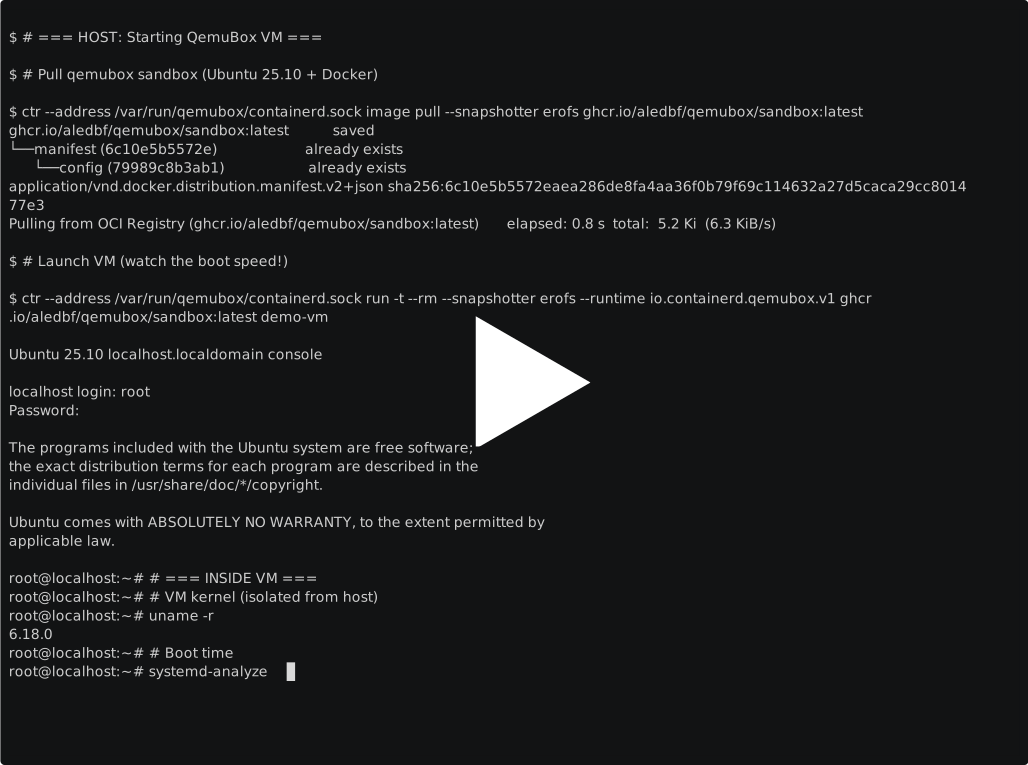
Launch a full Ubuntu VM with Docker pre-installed. Shows ~300ms boot time with systemd, running containers inside the isolated VM - nested virtualization without the overhead.
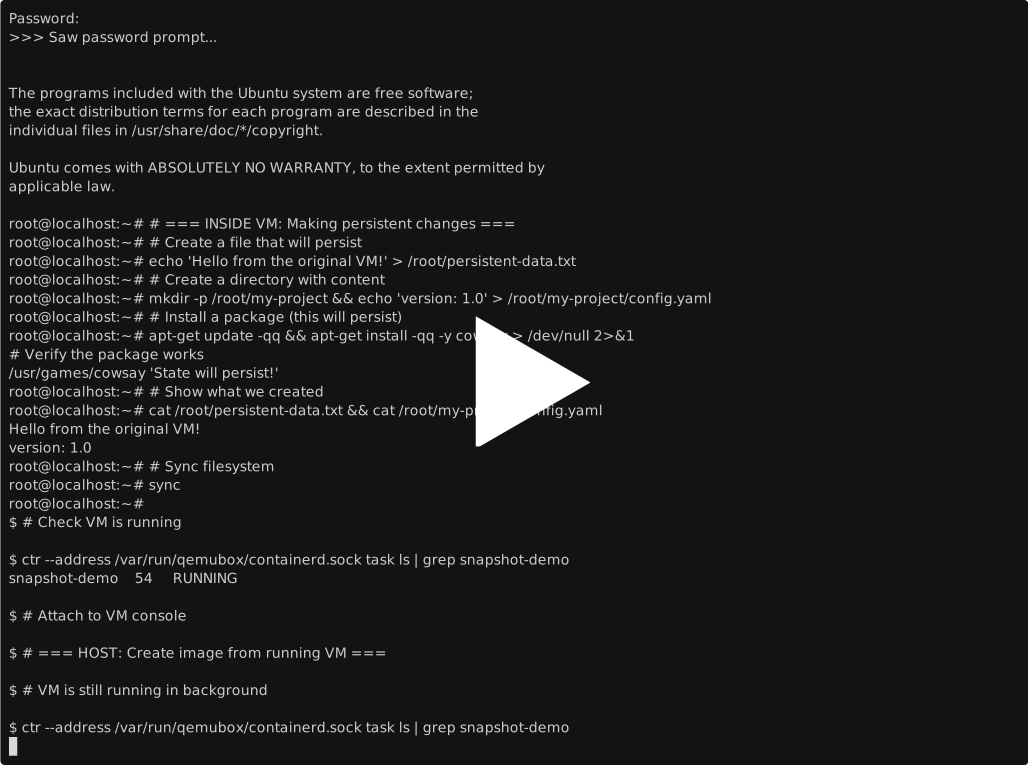
Persist disk state between VM runs: install packages, create files, then commit to a new image with nerdctl commit. The next VM boots with all changes preserved - like Docker commits, but for entire VMs.
Note: Snapshot support (for EROFS) requires a custom containerd build from aledbf/containerd@aledbf/erofs-snapshot-narrow until the changes are upstreamed.
qemubox is inspired by nerdbox, which pioneered the "shim-level VM isolation" approach for containerd using libkrun.
qemubox takes a different path, optimized for Linux server workloads:
| nerdbox | qemubox | |
|---|---|---|
| VMM | libkrun (Rust) | QEMU/KVM |
| Platforms | Linux, macOS, Windows | Linux only |
| Focus | Cross-platform, rootless | Server workloads, KVM features |
| Networking | libkrun networking | Standard CNI plugins |
Why QEMU/KVM?
- QEMU's maturity - Battle-tested VMM with extensive device support, debugging tools (QMP, gdbstub), and broad kernel compatibility
- Standard CNI networking - Reuse existing CNI plugins (Calico, Cilium, etc.) instead of custom networking
- KVM-specific features - CPU/memory hotplug, vhost-net, virtio-fs, and other Linux-specific optimizations
- Simpler deployment - Single static binary VMM without Rust runtime dependencies
If you need cross-platform support or rootless containers, check out nerdbox.
VM isolation provides a stronger security boundary than namespace-based containers, while maintaining compatibility with standard containerd tooling.
- Linux with KVM (
/dev/kvmaccessible)
Download the latest release and run the installer:
tar xzf qemubox-VERSION-linux-x86_64.tar.gz
cd qemubox-VERSION-linux-x86_64
sudo ./install.sh
The release includes everything: containerd, QEMU, kernel, CNI plugins, and configuration.
For systems with existing containerd, use shim-only mode:
sudo ./install.sh --shim-onlySee ./install.sh --help for all options.
sudo systemctl enable --now qemubox-containerd
sudo systemctl start --now qemubox-containerd# Add qemubox binaries to PATH
export PATH=/usr/share/qemubox/bin:$PATH
# Pull an image
ctr --address /var/run/qemubox/containerd.sock image pull \
--snapshotter nexus-erofs ghcr.io/aledbf/qemubox/sandbox:v0.0.11
# Run with qemubox runtime
ctr --address /var/run/qemubox/containerd.sock run -t --rm \
--snapshotter nexus-erofs \
--runtime io.containerd.qemubox.v1 \
ghcr.io/aledbf/qemubox/sandbox:v0.0.11 test-qemu-shim(use root:qemubox to log in)
Key components:
- Shim: Manages VM lifecycle and proxies I/O via vsock
- CNI: Standard CNI plugin chains for networking
- QEMU: Boots lightweight VMs with virtio devices
- vminitd: Init daemon inside VM that runs crun
📐 View Architecture Diagram
graph LR
    %% Host (Linux)
    subgraph host ["**Host (Linux)**"]
        direction TB
        containerd:::hostproc
        shim[containerd-shim-qemubox-v1]:::hostproc
        cni[CNI Plugins<br/>bridge, firewall, IPAM]:::netdev
        tap[TAP device]:::netdev
        store[EROFS snapshots]:::block
        kernel[VM kernel]:::hostvm
        initrd[VM initrd]:::hostvm
        qemu[QEMU/KVM]:::hypervisor

        containerd -- "shim v2 ttrpc" --> shim
        shim -- "CNI setup
        (netns/tap/IPAM)" --> cni
        cni -- "create/attach" --> tap
        shim -- "spawn/config
        (kernel args, vsock CID)" --> qemu
        store -- "rootfs via
        virtio-blk" --> qemu
        kernel -- "bzImage" --> qemu
        initrd -- "initrd" --> qemu
        qemu -.->|virtio-net to TAP| tap
    end

    %% Linux VM
    subgraph vm ["**Linux VM**"]
        direction TB
        vminitd[vminitd<br/>PID 1 / TTRPC]:::vmcore
        systemsvc[system service]:::srv
        bundlesvc[bundle service]:::srv
        crun[crun<br/>OCI Runtime]:::runtime
        container[Container Process]:::ctr

        vminitd --> systemsvc
        vminitd --> bundlesvc
        vminitd --> crun
        crun --> container
    end

    %% Connections between host and VM
    shim -.->|vsock ttrpc + stdio| vminitd

    %% Styling with classDefs for consistency and clarity
    classDef hostproc fill:#2962ff,stroke:#152f6b,stroke-width:2px,color:#fff
    classDef netdev fill:#26a69a,stroke:#00695c,stroke-width:2px,color:#fff
    classDef block fill:#ffee58,stroke:#666600,stroke-width:2px,color:#111
    classDef hostvm fill:#ec407a,stroke:#880e4f,stroke-width:2px,color:#fff
    classDef hypervisor fill:#6d4c41,stroke:#442b2d,stroke-width:2px,color:#fff
    classDef vmcore fill:#8e24aa,stroke:#4a148c,stroke-width:2px,color:#fff
    classDef srv fill:#80cbc4,stroke:#004d40,stroke-width:2px,color:#111
    classDef runtime fill:#ffb300,stroke:#6d4c00,stroke-width:2px,color:#111
    classDef ctr fill:#ef5350,stroke:#b71c1c,stroke-width:2px,color:#fff

    class containerd,shim hostproc
    class cni,tap netdev
    class store block
    class kernel,initrd hostvm
    class qemu hypervisor
    class vminitd vmcore
    class systemsvc,bundlesvc srv
    class crun runtime
    class container ctr

    linkStyle 9 stroke-dasharray:4 4,stroke-width:2px,stroke:#6d4c41
    linkStyle 8 stroke-width:2px,stroke:#00acc1,stroke-dasharray:3 6
- containerd calls the qemubox shim to create a container
- CNI allocates an IP and creates a TAP device
- QEMU boots a microVM with kernel, network, and storage
- vminitd (PID 1 in VM) connects to shim via vsock
- crun starts the container process with resource limits
- Container I/O flows through vsock to containerd
📊 View Container Lifecycle Sequence Diagram
sequenceDiagram
    autonumber

    %% Group host-side actors in a blue box
    box Host (Linux)
        participant C as containerd
        participant S as containerd-shim
        participant N as CNI Plugins
        participant Q as QEMU/KVM
    end

    %% Group VM-side actors in a green box
    box VM (Guest Linux)
        participant V as vminitd (PID 1)
        participant R as crun
    end

    %% --- Create Phase ---
    rect rgb(220,240,255)
    note over C,R: Create Phase
    activate C
    C->>+S: CreateTask(bundle, rootfs)
    activate S
    S->>S: Check KVM<br/>Load OCI spec<br/>Prepare VM
    S->>S: Setup EROFS mounts
    S->>N: Setup network (CNI)
    N-->>S: Return TAP device + IP config
    S->>Q: Start VM<br/>(kernel, initrd, virtio-devs)
    deactivate S
    activate Q
    Q-->>V: Boot kernel<br/>start vminitd (PID 1)
    deactivate Q
    activate V
    V-->>S: Connect via vsock
    S->>V: Send bundle (OCI, rootfs)
    S->>V: CreateTask
    V->>R: OCI create container
    activate R
    R-->>V: Container created
    deactivate R
    V-->>S: Return PID
    S-->>C: Return PID
    deactivate C
    deactivate S
    deactivate V
    end

    %% --- Start Phase ---
    rect rgb(224,255,224)
    note over C,R: Start Phase
    activate C
    C->>S: Start
    activate S
    S->>V: Start
    activate V
    V->>R: Start container
    activate R
    R-->>V: Running
    deactivate R
    V-->>S: PID
    S-->>C: PID
    deactivate C
    deactivate S
    deactivate V
    end

    %% --- Delete Phase ---
    rect rgb(255,228,216)
    note over C,R: Delete Phase
    activate C
    C->>S: Delete
    activate S
    S->>V: Delete
    activate V
    V->>R: Delete container
    activate R
    R-->>V: Deleted
    deactivate R
    V-->>S: Exit status
    deactivate V
    S->>S: Stop hotplug controllers
    S->>Q: Shutdown VM
    activate Q
    Q-->>S: VM exited
    deactivate Q
    S->>N: Release network
    N-->>S: Network cleaned
    S-->>C: Exit status
    deactivate C
    deactivate S
    end
Multiple isolation layers:
- VM boundary: Hardware virtualization (KVM) isolates each container
- Network: Isolated TAP devices, firewall rules via CNI
- Storage: Read-only EROFS via virtio-blk
- Resource: cgroups v2 prevents resource exhaustion
- Communication: vsock (no network-based IPC)
- Linux only (KVM required)
- x86_64 only (arm64 untested)
- One VM per container (no sharing)
- Cold start for each container (no VM pooling)
# Install Task runner
go install github.com/go-task/task/v3/cmd/task@latest

# Build everything (requires Docker for kernel/initrd)
task build

# Create release tarball
task releasecmd/ - Entrypoints (shim, vminitd)
internal/ - Implementation
host/ - VM, network, storage management
shim/ - Containerd shim implementation
guest/ - vminitd and guest services
config/ - Configuration management
api/ - Protobuf/TTRPC definitions
build/ - Build inputs (kernel config)
deploy/ - Installation scripts and configs
examples/ - Example configurations
hack/ - Development scripts
images/ - Container/VM image builds
| Project | Approach | Trade-offs |
|---|---|---|
| qemubox | VM per container (QEMU/KVM) | Strong isolation, Linux-only, cold start overhead |
| nerdbox | VM per container (libkrun) | Cross-platform, rootless, newer VMM |
| Kata Containers | VM per container (multiple VMMs) | Production-ready, more complex |
| gVisor | User-space kernel | No VM overhead, different syscall compatibility |
| runc | Namespaces only | Fast, weaker isolation |
- Remove KVM requirement: Support PVM (Protected Virtual Machine) kernel for environments without
/dev/kvm(LWN article) - Filesystem merge snapshots: Leverage containerd's fsmerge feature for more efficient storage
- Metrics and tracing: Add TTRPC tracing to provide detailed observability into VM and container behavior
- Annotations for features: Allow enabling/disabling features (CPU/memory hotplug, etc.) via OCI annotations
Snapshot demo: Demonstrate VM snapshots - restart a VM with previous state/changes preserved✓ Done
Apache 2.0
Experimental project. Issues and PRs welcome.