
The provided project is a technical demo used to demonstrate implemented opportunities of a game creation using Go native tools. Provided demo is an isometric world set in space.
The project implements the following logical components and systems:
- State Management: A centralized system to track the application's status, inspired by the Redux approach.
- Rendering Pipeline: A custom-built graphics engine designed to draw visuals from scratch.
- Network Management: Smart networking that separates real-time game data from standard API requests to reduce lag.
- External Activity Interpolation: A system that smooths out the movement of other players or objects to prevent visual jittering.
- Debug IMGUI Menu: An on-screen developer menu for testing, tweaking variables, and debugging while the app is running.
- Multilayer Screen Transitions: Handles smooth visual fading or sliding when moving between different menus or game screens.
- Input System: Full support for both keyboard/mouse and gamepad controllers.
- Sound Management: A custom audio engine that handles background music and sound effects separately.
- Collision System: A tailored system that detects when objects hit or overlap with each other.
- Interaction System: Logic that allows the user to select and interact with items in the world.
- Events System: An internal messaging system that lets different parts of the code talk to each other without being tightly connected.
- Abstract Database Layering: A flexible storage system that allows you to swap different database technologies without rewriting code.
- Collectable Objects System: Logic for spawning, picking up, and storing items in an inventory.
- Global Notifications System: A UI manager for displaying alerts, errors, or success messages to the user.
- Subtitles System: Handles the loading and display of text for dialogue or captions.
- Runtime Settings: Allows users to change video, audio, or gameplay settings instantly without restarting the application.
- Translation System: A localization framework for easily switching between different languages.
- Monitoring System: Performance tracking integrated with Grafana and Prometheus to keep an eye on system health.
All setup related operations are processed via Makefile placed in the root directory.
In order to build the project, it's required to execute the next commands:
# Performs client build for operational version
make build-client-operational

# Performs client build for testing version
make build-client-testing
Different versions are used to have two independent clients on the same host(used for testing)
# Performs server build with included UI
make build-server-ui

# Performs server build with CLI only
make build-server-cliThis technical demo utilizes a combination of public domain tilesets and AI-generated content.
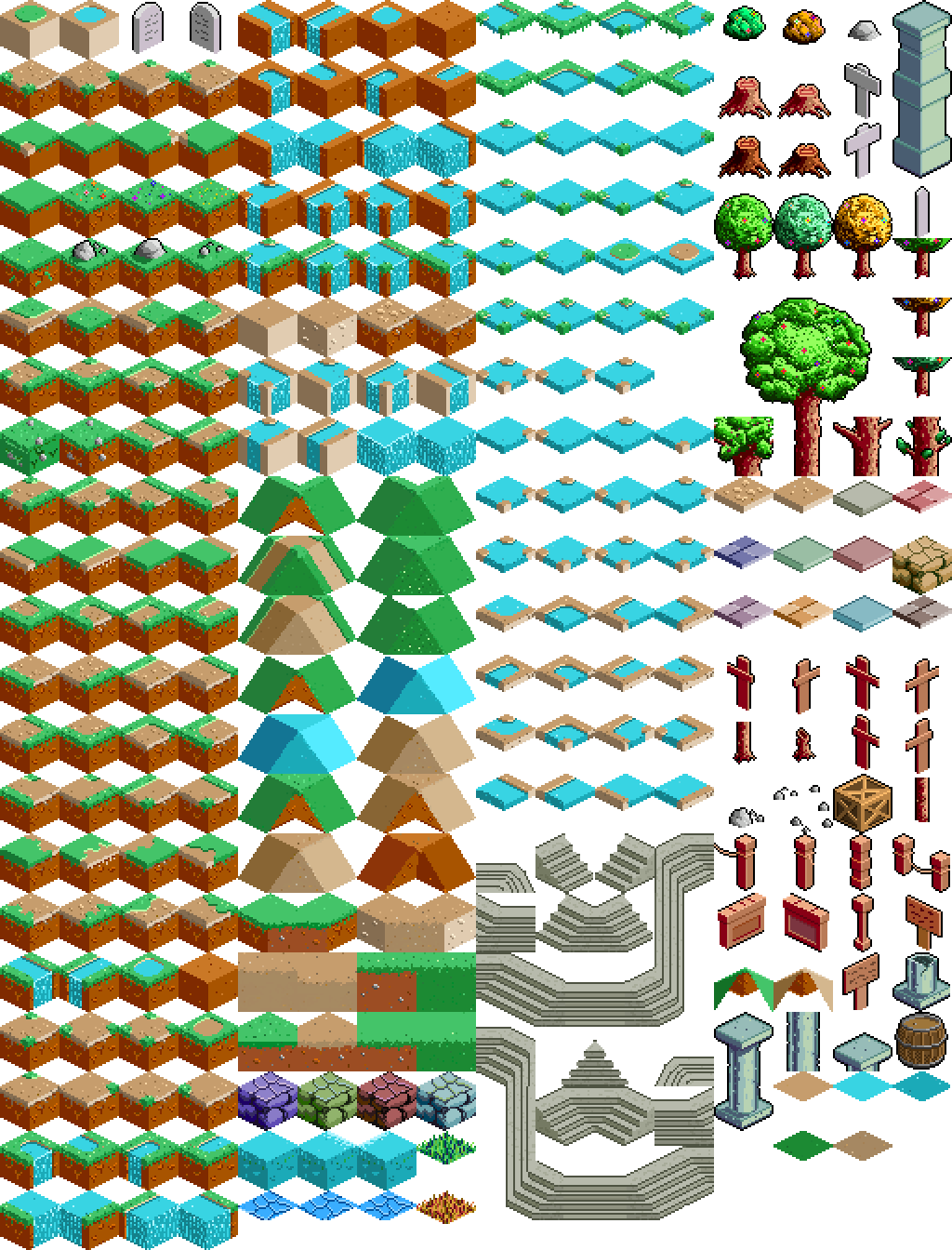
- Tileset: Big Isometric Tileset (64x32) via OpenGameArt.
- AI Generation: Additional images and assets created using PixelLabAI.
- Sound Effects: Generated using ElevenLabs.