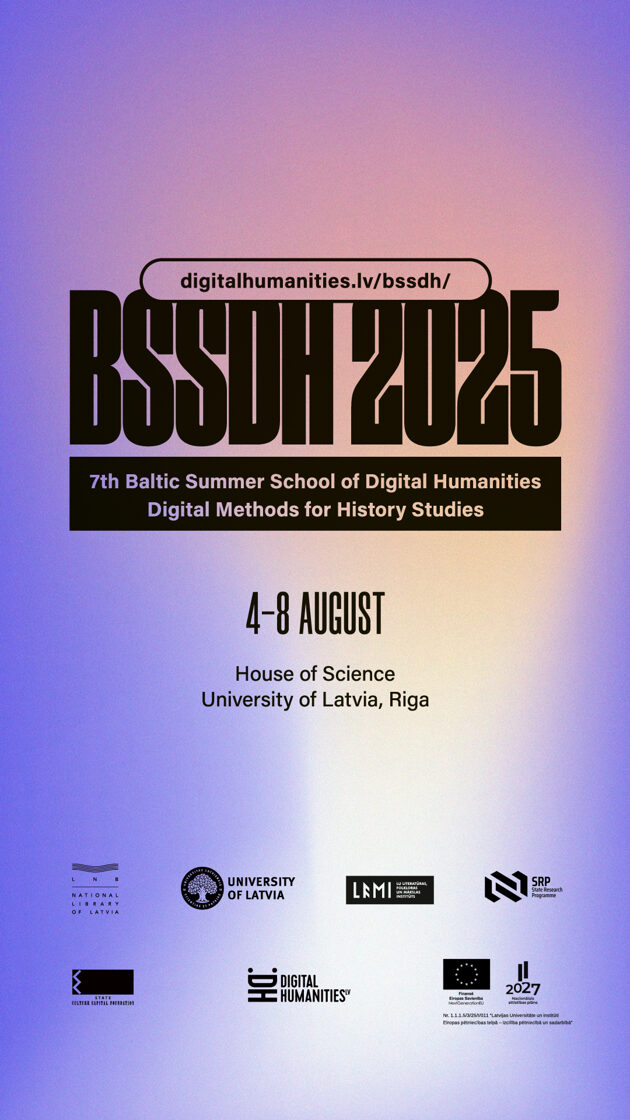
About Baltic Summer School of Digital Humanities 2025
- https://github.com/ValRCS/BSSDH_2025_workshop_LLM_API - this repository with main workshop materials and notebooks
- https://github.com/LNB-DH/BSSDH_2025_workshop_data - datasets used in workshop exercises
💡 Tip: Right-click on the Colab badges below and select "Open link in new tab" to keep this page open while working with the notebooks.
-
Workshop Session 1 in Google Colab:
-
Workshop Session 2 in Google Colab:
-
Workshop Session 3 in Google Colab:

In this workshop, participants will learn how to access large language models via API and utilize them for bulk data analysis using Python. Through practical examples, we will explore prompt engineering techniques for tasks such as concept mining and named entity recognition in textual data. Additionally, we will examine challenges associated with historical digitized texts, including optical character recognition (OCR) errors, which may affect compatibility with language models. Participants will gain insights into how these models can be leveraged for error correction and translation, enhancing the usability of imperfect textual data.
The workshop is designed for researchers, data analysts, and professionals in text analysis, digital humanities, and computational linguistics. Only a basic familiarity with Python is required, which can be gained by attending introductory workshops at the summer school or reviewing the provided preparatory materials.
Welcome to the annual Baltic Summer School of Digital Humanities (BSSDH 2025)!
The 7th Baltic Summer School for Digital Humanities will be held in Riga at the University of Latvia's House of Science from August 4–8. This year’s Summer School will focus on topics relevant to history researchers, students, and anyone interested in exploring history and humanities through digital methods. Lectures and workshops will cover subjects such as automated digitization of handwritten texts, network visualization, historical networks, spatial analysis and mapping (GIS), as well as a practical overview of the emerging AI technologies and their use in humanities research, by using chat prompting versions and also accessing LLM (large language models) with API. You can see the confirmed keynote lectures and workshops here, the full programme will be finalized during March.
Valdis Saulespurēns works as a researcher and developer at the National Library of Latvia. Additionally, he is a lecturer at Riga Technical University, where he teaches Python, JavaScript, and other computer science subjects. Valdis has a specialization in Machine Learning and Data Analysis, and he enjoys transforming disordered data into structured knowledge. With more than 30 years of programming experience, Valdis began his professional career by writing programs for quantum scientists at the University of California, Santa Barbara. Before moving into teaching, he developed software for a radio broadcast equipment manufacturer. Valdis holds a Master's degree in Computer Science from the University of Latvia. When not working or spending time with his family, Valdis enjoys biking and playing chess, sometimes even at the same time.
Anda Baklāne is a researcher and curator of digital research services at the National Library of Latvia. She teaches Introduction to Digital Humanities and Digital Social Sciences and Text Analysis and Visualization courses at the University of Latvia. Anda holds a master’s degree in philosophy and a PhD in literary theory. Her research interests include Latvian contemporary literature, metaphor, models, distant reading, and academic data visualization.