weird .resume() behaviors : executed regargless of context #1956

Description

Platform: All
Node Version: no matter
MagicMirror Version: at least 2.10 over
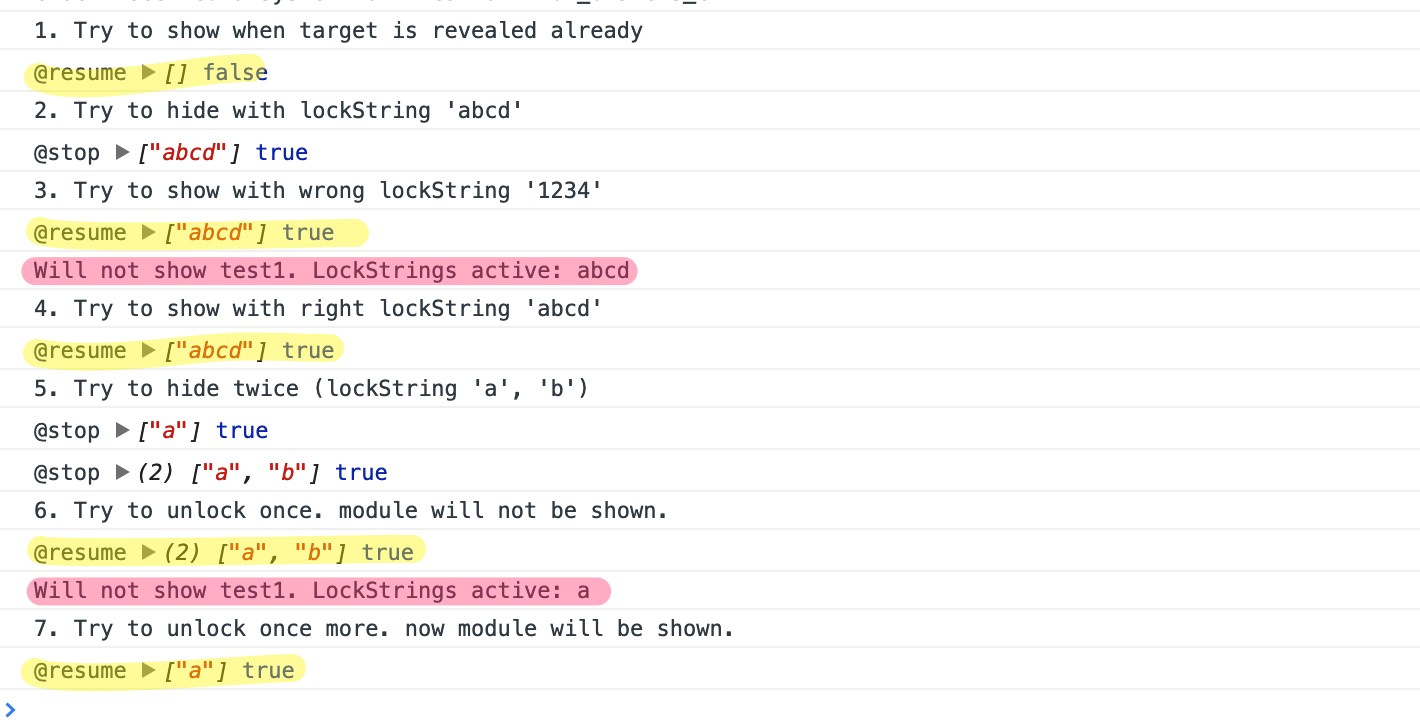
Description: .resume()(and .suspend() also be the same case.) is executed whenever .show() is called regardless of context. It might not be a bug but useless in real usage.
- executable even when the module is already revealed.
- executable with wrong
lockString, so the module itself should not be revealed really, but.resume()is called. - executable under multiple locked, so the module itself should not be revealed really, but
.resume()is called.
Inside of .resume(), I can't find any way to measure this calling is proper on not. .lockStrings and .hidden would be changed after this .resume() calling.
Description of dev guide says.
When a module is requested to be shown (using the module.show() method),
the resume() method will be called.
By subclassing this method you can perform tasks restarting the update timers.
But by subclassing, I cannot perform tasks restarting properly. Because whenever any module calls .show(), .hide(), .resume() and .suspend() would be called without context, so my task would become a mess.
Is it the right behavior? If so, this .resume() looks useless except for counting how many times .show() is called.
Or is there a way to determine a proper calling inside of .resume()?
Steps to Reproduce: List the step by step process to reproduce the issue.
I tested with these test modules.
module:test1
Module.register("test1", {
  start: function(){
    this.working = true
  },

  suspend: function () {
    console.log("@stop", this.lockStrings, this.hidden)
    this.working = false
    this.stopMyTask()
  },

  resume: function() {
    console.log("@resume", this.lockStrings, this.hidden)
    this.working = true
    this.resumeMyTask()
  },

  notificationReceived: function() {},
  stopMyTask: function() {},
  resumeMyTask: function() {},
})
module:test2
Module.register("test2", {
  notificationReceived: function(noti, payload, sender) {
    if (noti == "DOM_OBJECTS_CREATED") {
      this.test()
    }
  },

  test: function() {
    const asleep = async (ms) => {
      return new Promise(resolve => setTimeout(resolve, ms))
    }

    var target = null

    MM.getModules().enumerate((m)=>{
      if (m.name == "test1") target = m
    })

    const scenario = async () => {
      await asleep(1000)
      console.log("1. Try to show when target is revealed already")
      target.show()
      await asleep(1000)
      console.log("2. Try to hide with lockString 'abcd'")
      target.hide(0, {lockString:'abcd'})
      await asleep(1000)
      console.log("3. Try to show with wrong lockString '1234'")
      target.show(0, {lockString:'1234'})
      await asleep(1000)
      console.log("4. Try to show with right lockString 'abcd'")
      target.show(0, {lockString:'abcd'})
      await asleep(1000)
      console.log("5. Try to hide twice (lockString 'a', 'b')")
      target.hide(0, {lockString:'a'})
      await asleep(500)
      target.hide(0, {lockString:'b'})
      await asleep(1000)
      console.log("6. Try to unlock once. module will not be shown.")
      target.show(0, {lockString:'b'})
      await asleep(1000)
      console.log("7. Try to unlock once more. now module will be shown.")
      target.show(0, {lockString:'a'})
    }

    scenario()

  }
})
Expected Results:
I expect .resume() would be called on scenario no. 4 and 7. (hmmm, no.1 also be acceptable at least)
Actual Results: