No guesswork. No unmeasured claims. It measures, proves, and verifies.






Up to +85.6% speedup · 100% correctness & parity · 0% unverified claims · Statistically proven (p ≤ α') · Byte-verified safe rollback
Measured across 9 real-world algorithmic, numerical, and structural workloads under paired interleaved sampling with exact permutation tests and Bonferroni significance gating. Full writeup · reproduce it.
Install · Numbers · Before / After · Correctness & Parity · How it works · Quality Lattice · Docs · Issues
Coding agents produce working code quickly, and developers tweak compiler flags and optimize algorithms every day. But without rigorous closed-loop verification:
- Optimizations are guesses: An agent claims "improved performance" after spraying arbitrary compiler flags or rewriting loops, with zero empirical proof.
- Hidden regressions ship unnoticed: A naive flag like
-Osshrinks code by a few bytes but causes a -286% slowdown on 2D convolutions by disabling vectorization. - Correctness is compromised: Agents blindly reach for unsafe flags (like
-ffast-mathor unvetted IR passes) that break floating-point IEEE compliance, NaN/Inf handling, or numerical accuracy just to chase speed. - Architectural debt accumulates: Code that passes unit tests can still be convoluted, tightly coupled, and impossible for humans or agents to safely change.
Code running faster is only useful if it does exactly what was intended. Topos brings mathematical and statistical rigor to code quality, behavioral parity, and compiled runtime optimization.
Tests check behavior. Topos checks whether the implementation is built to keep changing—and proves runtime wins before they ship.
Grounded in category theory and non-parametric statistics, written in Rust.
You ask an agent to optimize a hot computational kernel.
Without Topos: The agent adds -O3 -ffast-math -funroll-loops, declares success without benchmarking, breaks IEEE floating-point compliance, and leaves no rollback path if production regresses.
With Topos: A single closed loop that builds, times, and statistically tests every candidate:
# 1. Plan variants without running anything
topos compiled plan src/kernel.c -- 512

# 2. Human approval gate (digest-locked)
topos compiled approve .topos/compiled/plan.json --by engineer

# 3. Interleaved paired measurement & dual-gate promotion
topos compiled apply .topos/compiled/plan.json
◇ Compiled apply
│ run 20260821T181033Z-fd26fc81 · digest fd26fc81a7839ae5173eaaf0d95af0d2
│
│ VARIANT SPEEDUP p VERDICT SIZE GATES
│ O0 — — baseline 33528 B
│ O2 +85.5% 0.0020 real -0.0% SZ
│ O3 +85.6% 0.0020 real -0.0% SZ
│ Os +71.2% 0.0020 real -0.0% SZ
│
│ Ω_bitcode GOLD
│ promoted ./kernel
└
If anything ever goes wrong:
topos compiled rollback
# restored 33528 bytes verified=trueYou ask an agent to add a feature or refactor a module.
Without Topos: The agent writes 300 lines of speculative wrappers, nested branches, and tight coupling. The tests pass, but the cognitive load explodes.
With Topos: Topos grades the file across four independent mathematical pillars:
topos inspect src/service.rs◇ Inspected src/service.rs
│ rust · priority simple · COMPOSABLE enabled
│
│ PILLAR STATUS SCORE QUALITY
│ SIMPLE X FAIL 0% ◆─────────
│ COMPOSABLE ✓ PASS 75% ━━━━━━━◆──
│ SECURE ✓ PASS 100% ━━━━━━━━━◆
│ NAVIGABLE ✓ PASS 42% ━━━━◆─────
│
└ ✓ 🥇 GOLD · COMPOSABLE_SECURE_NAVIGABLE · 54% average.
Recommended changes
1. X FIX · SIMPLE
Why ast.max_function_complexity measured 20; gate boundary 10.
Do Split the most complex function (complexity 20 > 10).
render_summary · lines 79-227 · Keep: preserve public behavior
Code running faster is dangerous if it breaks semantics. Topos protects functional correctness across 5 layers:
┌────────────────────────────────────────────────────────────────────────┐
│                     5 LAYERS OF PARITY ENFORCEMENT                     │
├────────────────────────────────────────────────────────────────────────┤
│ 1. Safe Compiler Driver Flags Only (No precision-breaking -ffast-math) │
│ 2. Clean Process & Invariant Checks (Zero crashes / segfaults / exits) │
│ 3. Self-Validating Workloads & Test Harnesses (run_command assertions) │
│ 4. Cryptographic Blake2b Human Approval Gate (CLI-only, non-bypassable)│
│ 5. Atomic Byte-Verified Rollback (Instant SHA-exact baseline restore)  │
└────────────────────────────────────────────────────────────────────────┘
- Standard Conforming Driver Flags (No Unsafe IR Hacks):
Topos only explores conforming Clang driver flags (-O2,-O3,-Os,-flto, and PGO). It explicitly rejects unsafe flags like-ffast-mathor-Ofastthat violate IEEE-754 floating-point accuracy, reorder associative math incorrectly, or break NaN/Inf handling. - Process Execution & Crash Invariants:
Every warmup, PGO generation, and paired measurement round checks exit status (status == 0). Any runtime crash, segfault, assertion trip, or unexpected stderr output immediately aborts the run and refuses promotion. - Support for Test Suites & Self-Validating Commands:
Therun_commandin.topos.tomlcan run validation suites and integration checks (run_command = ["{output}", "--test", "--verify"]). If an optimization breaks an assertion or produces incorrect output, the exit code fails the run. - Digest-Locked Human Approval Gate:
The optimization plan is locked with a Blake2b digest covering the source, build argv, run command, and gate thresholds. Approvals require an explicit human identity (--by <engineer>) and are CLI-only (never exposed over MCP), preventing AI agents from self-approving unverified changes. - Byte-Verified Atomic Rollback:
Topos stores the exact pre-apply baseline bytes. Runningtopos compiled rollbackrestores the pristine binary with disk sync (sync_all) and byte-for-byte readback verification (verified: true).
Measured across 9 real-world algorithmic, numerical, and structural workloads. Evaluated under 10 interleaved paired rounds against the -O2 baseline. Significance requires
| Workload ID | Description | Best Variant | Speedup vs Baseline | Permutation |
Size |
Verdict | Gate Status |
|---|---|---|---|---|---|---|---|
matmul |
Dense matrix multiply |
-O3 / LTO | +2.72% | +0.0% | within_noise |
·Z | |
branchy |
PRNG state machine & dispatch | pgo-O3 | +8.41% | +0.0% | real |
SZ (Promoted) | |
nbody |
Gravitational particle simulation | -Os / -O3 | +3.38% | +0.0% | real |
SZ (Promoted) | |
sha256 |
Block cryptographic hashing | pgo-O3 | +21.88% | +0.0% | within_noise |
·Z | |
image_filter |
2D 5x5 convolution stencil | -O3 | +12.00% | +0.0% | real |
SZ (Promoted) | |
ode_sim |
4th-order Runge-Kutta numerical ODE | -Os / -O3 | +5.55% | +0.0% | within_noise |
·Z | |
tree_search |
Pointer-chasing binary tree lookups | pgo-O3 | +3.21% | +0.1% | within_noise |
·Z | |
sort_radix |
Radix sort histogram passes | -O3 | +0.70% | +0.0% | no_effect |
·Z | |
memory_scan |
Sequential buffer bandwidth scan | -O2 (baseline) | Baseline | — | 0 B | baseline |
— |
Topos is the only compiler harness that mathematically separates real improvements from noise. When a variant point estimate shows +21.9% but noise variance prevents clearing the Bonferroni significance bar ($p \le 0.0125$), Topos marks it within_noise and refuses to promote. Zero false claims.
| Workload | Naive Flag Choice | Speed Regression | Detected |
Topos Action |
|---|---|---|---|---|
image_filter |
-Os (size optimization) |
-989.29% |
BLOCKED (real_but_below_threshold) |
|
memory_scan |
-Os (size optimization) |
-111.30% |
BLOCKED (real_but_below_threshold) |
|
sort_radix |
pgo-O3 (profile layout) |
-79.61% |
BLOCKED (real_but_below_threshold) |
|
sha256 |
-Os (size optimization) |
-28.45% |
BLOCKED (real_but_below_threshold) |
Full methodology, raw JSON data, and reproduction: benchmarks/results/2026-08-21-compiled-engine.md.
1. Plan    → Probe toolchain, build & run nothing, emit digest-locked plan
2. Approve → Cryptographic signature required before execution
3. Measure → Interleaved paired A/B sampling (alternating round parity)
4. Test    → Exact 2^n sign-flip permutation test (stdlib-only, no RNG)
5. Gate    → Dual enforcement: Speedup ≥ threshold AND Size ≤ budget
6. Promote → Atomic promotion with byte-level verification
7. Rollback→ One-command exact baseline restoration
-
Interleaved Paired Sampling: Alternates arm execution order (
A-B,B-A,A-B...) to cancel thermal throttling and background CPU drift. -
Exact Sign-Flip Permutation Test: Enumerates all
$2^n$ sign vectors over paired round diffs. No normal-distribution assumptions, no statistical tables, no random seeds. -
Bonferroni Significance Gating: Adjusts
$\alpha' = \alpha / k$ across all candidate variants. - Environment Drift Self-Check: Tests consecutive baseline samples against each other; mid-run machine drift automatically poisons suspect comparisons.
- 50ms Duration Floor: Rejects sub-millisecond runs where OS process spawn overhead swamps the true CPU cycle signal.
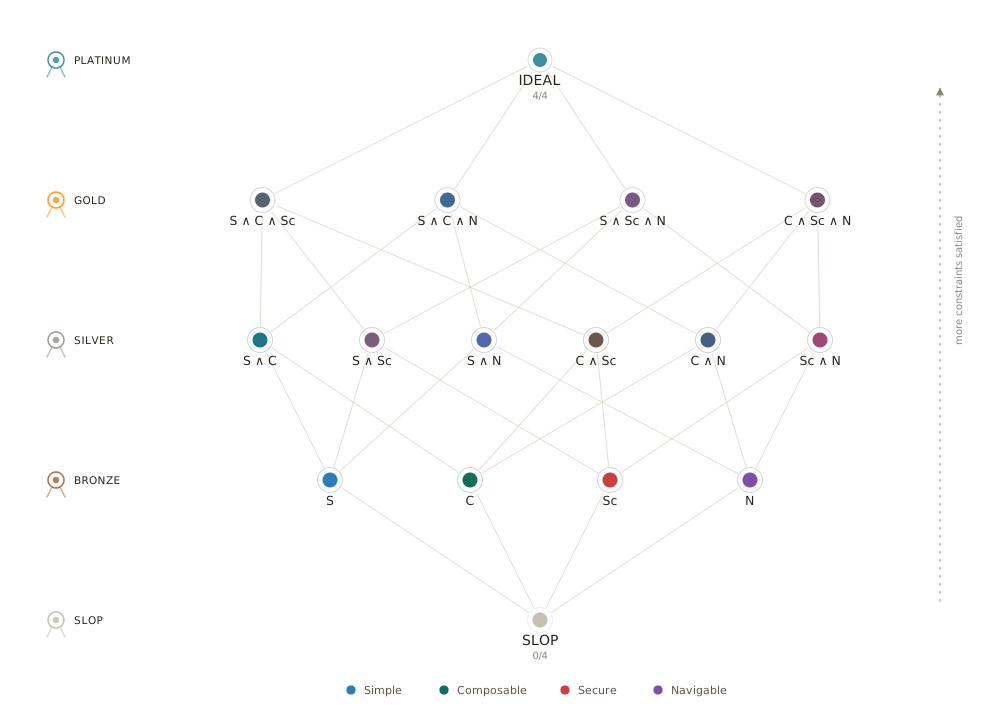
Topos evaluates source code structure across four pairwise-incomparable pillars forming a sixteen-element evaluation lattice (a 4-cube):
- SIMPLE — avoids unnecessary complexity using AST entropy and control-flow complexity.
- COMPOSABLE — limits a file's outward dependency burden; broader coupling and stability metrics remain available for diagnosis.
- SECURE — avoids dangerous API reachability and taint paths in the code property graph.
- NAVIGABLE — stays shallow enough for an agent to read and change in one pass, using depth-weighted nesting divergence over the AST scope tree.
| Medal | Criteria |
|---|---|
| 🏆 PLATINUM | Passes all 4 pillars |
| 🥇 GOLD | Passes 3 of 4 |
| 🥈 SILVER | Passes 2 of 4 |
| 🥉 BRONZE | Passes 1 of 4 |
| ❌ SLOP | Passes 0, or fails to parse |
One binary. Every supported agent harness. A clean way back out.
Use the verified release installer:
curl -fsSL https://docs.krv.ai/topos/install.sh | bashOr install with Homebrew:
brew install krv-labs/tap/toposTip
Prefer an editor-managed install? In VS Code or Cursor, search @mcp topos in the Extensions view or choose Install MCP server.
topos install detects every supported MCP harness and lets you configure any—or all—of them from one interactive checklist:
topos install┌ Which agent integrations do you want to configure?
│
│ ↑↓ move · space toggle · a all · enter confirm · esc cancel
│
│ ❯ ○ Claude Code (detected)
│ ○ Claude Desktop (detected)
│ ● Codex CLI (✓ active)
│ ● Gemini CLI (✓ active)
│ ○ GitHub Copilot CLI (detected)
│ ○ Cursor (detected)
│ ○ VS Code (detected)
│ ○ Google Antigravity (detected)
└
Restart your agents, then ask:
"Use Topos to find this repository's worst structural problem, make one focused improvement, and verify the result."
Topos follows a strict leave-no-trace policy: topos status shows every registration, and topos uninstall removes everything Topos installed cleanly.
topos status
topos uninstall# Evaluate repository quality
topos evaluate . -r
# Inspect hotspot with remediation guidance
topos inspect src/main.rs
# Run baseline compiled benchmark suite
topos benchmark
# Run closed-loop compiled optimization
topos compiled plan benchmarks/workloads/branchy.c -- 100000000
topos compiled approve .topos/compiled/plan.json --by engineer
topos compiled apply .topos/compiled/plan.jsonTopos is a self-contained Rust CLI and MCP server. Analysis runs 100% locally; your code is never sent to external models.
| Component | Role |
|---|---|
| tree-sitter | Parses Python, Rust, JS, TS, C++, and Go into native AST, CFG, CPG, PDG, and UAST representations. |
| LLVM / Clang | Drives flag variant compilation (-O2, -O3, -Os, -flto, PGO), bitcode emission, and profiling. |
| GitNexus | Supplies the repository dependency graph scored by COMPOSABLE (topos depgraph generate). |
| Sighthound | Embedded in the MCP server for supplementary security findings; native CPG probes drive SECURE scoring. |
- GitHub Releases —
toposCLI binary (macOS/Linux). - PyPI —
topos-mcpthin binary wheel (pip install topos-mcp/uvx topos-mcp). - VS Code Marketplace — Topos extension with bundled platform binaries.
- OpenClaw / ClawHub:
openclaw skills install @Krv-Labs/topos - Hermes:
hermes skills tap add Krv-Labs/toposthenhermes skills install Krv-Labs/topos/topos
Topos is built and used internally at Krv Labs. We welcome issues, PRs, and benchmark workloads.
- Bug? Open an issue
- Idea? Start a discussion
- Collaborate? team@krv.ai
Full documentation · Measures and metrics · Benchmark Report