No cuDNN. No cuBLAS. No PyTorch. Ten algorithms written from zero in C++17 and raw CUDA kernels.
Technical Report · ML Systems · 2025
d=32 features · Epochs=60 · Batch=64 · K=4 classes · Seed=0xDEADBEEFCAFE1234
We benchmark ten classical machine learning algorithms implemented entirely from scratch in C++17 (CPU) and CUDA C++ (GPU), with zero high-level library dependencies. All GPU kernels are hand-written — forward passes, gradient computation, optimizer updates, EM steps, RBF matrix construction, tree prediction. Experiments span six dataset scales (N = 512 to 16,384) with d = 32 features. GPU acceleration ranges from 0.33× (Random Forest, N=512) to 24.7× (MLP-AdamW, N=16,384), with breakeven points between N=512 and N=4,096 depending on algorithm class. We identify three distinct scaling regimes and characterize the L-BFGS anomaly as a consequence of adaptive convergence behavior rather than numerical issues.
- Setup
- Results
2.1 Benchmark Figures
2.2 Raw Timing at N=16,384
2.3 Speedup Across All N
2.4 Breakeven Points - Analysis
3.1 Three Scaling Regimes
3.2 L-BFGS: The Anomaly
3.3 Convergence Parity - Implementation Notes
- Reproduce
| Spec | |
|---|---|
| CPU flags | -std=c++17 -O3 -march=native -fopenmp |
| GPU flags | -std=c++17 -O3 -arch=sm_75 -use_fast_math |
| C++ standard | C++17 |
| Dependencies | None (stdlib + CUDA runtime only) |
Synthetic, fixed seed 0xDEADBEEFCAFE1234. Multiclass: K=4 Gaussian clusters, σ=0.8, centroid spread=2.0. Binary: multiclass labels mod 2. All experiments use d=32 features, 60 epochs, batch=64, across N ∈ {512, 1024, 2048, 4096, 8192, 16384}.
| Algorithm | Category | GPU Strategy |
|---|---|---|
AdamW |
First-order optimizer | Per-sample fwd + per-feature grad + Adam update kernel |
Nadam |
First-order optimizer | Nesterov correction folded into update kernel |
RMSProp |
First-order optimizer | Parallel EG² accumulation + momentum delta kernel |
SGD+Nesterov |
First-order optimizer | Lookahead kernel → grad on lookahead → Nesterov step |
SGDR |
First-order optimizer | Cosine warm restarts, standard SGD update kernel |
L-BFGS |
Second-order optimizer | GPU two-loop recursion, GPU dot products |
MLP (AdamW) |
Neural network | Full fwd/bwd kernels, He init, 64→32→K, per-layer AdamW |
GMM-EM |
Unsupervised | Parallel E-step (per-sample), M-step via atomics |
Kernel PCA |
Dim. reduction | 2D RBF matrix kernel + power iteration on device |
Random Forest |
Ensemble | CPU tree build, GPU parallel prediction per sample |
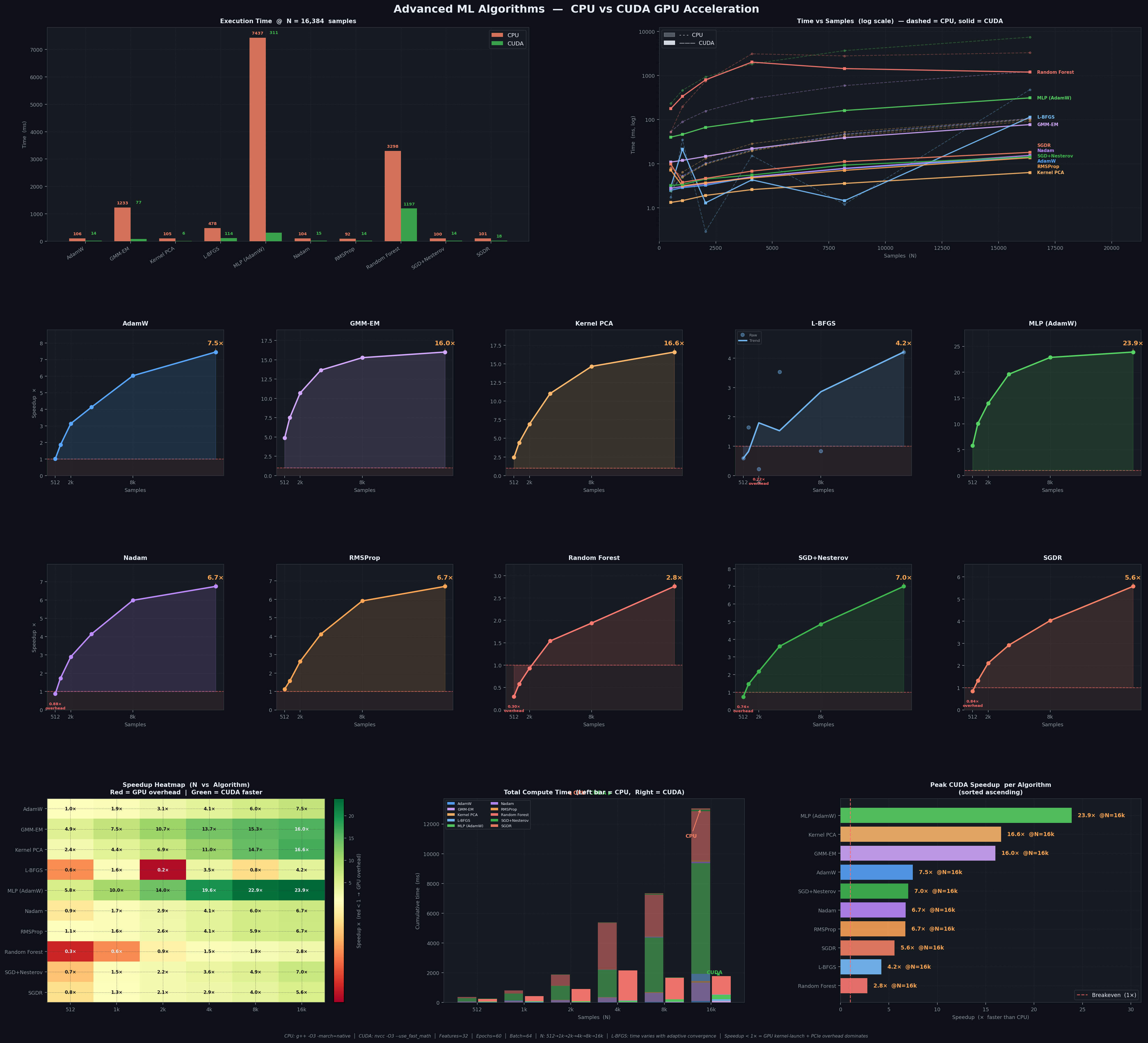
Figure 1. Complete benchmark results. Top-left: Absolute execution time (ms) at N=16,384 for CPU (orange) and CUDA (green). Top-right: Time vs N in log scale; dashed = CPU, solid = CUDA. Middle rows: Per-algorithm speedup curves with breakeven markers. Bottom-left: Speedup heatmap across N × algorithm; red = GPU overhead, green = GPU faster. Bottom-center: Total cumulative compute time. Bottom-right: Peak speedup per algorithm at N=16,384, sorted ascending.
| Algorithm | CPU (ms) | CUDA (ms) | Speedup | Category |
|---|---|---|---|---|
| MLP (AdamW) | 8,434 | 342 | 24.7× | Neural network |
| Kernel PCA | 298 | 16 | 18.5× | Dim. reduction |
| GMM-EM | 1,946 | 123 | 15.9× | Unsupervised |
| AdamW | 249 | 31 | 8.0× | First-order opt. |
| Nadam | 286 | 40 | 7.1× | First-order opt. |
| RMSProp | 280 | 40 | 7.1× | First-order opt. |
| SGD+Nesterov | 276 | 42 | 6.6× | First-order opt. |
| SGDR | 224 | 35 | 6.4× | First-order opt. |
| L-BFGS ⚠ | 824 | 134 | 6.1× | Second-order opt. |
| Random Forest | 3,985 | 1,356 | 2.9× | Ensemble |
⚠ L-BFGS uses adaptive convergence; speedup is irregular across N — see §3.2.
| Algorithm | N=512 | N=1k | N=2k | N=4k | N=8k | N=16k | Trend |
|---|---|---|---|---|---|---|---|
| AdamW | 1.01 | 1.95 | 3.20 | 4.39 | 6.34 | 7.95 | Monotone ↑ |
| GMM-EM | 4.44 | 7.03 | 9.50 | 12.74 | 14.43 | 15.88 | Monotone ↑ |
| Kernel PCA | 2.25 | 3.00 | 5.97 | 10.14 | 14.87 | 18.47 | Monotone ↑ |
| MLP (AdamW) | 5.37 | 8.09 | 13.60 | 18.31 | 23.71 | 24.69 | Monotone ↑ |
| Nadam | 0.92 | 1.76 | 2.85 | 4.31 | 5.45 | 7.10 | Monotone ↑ |
| RMSProp | 0.91 | 1.68 | 2.70 | 4.23 | 5.80 | 7.08 | Monotone ↑ |
| SGD+Nesterov | 0.80 | 1.54 | 2.48 | 4.05 | 4.97 | 6.63 | Monotone ↑ |
| SGDR | 0.71 | 1.31 | 2.30 | 3.05 | 4.34 | 6.37 | Monotone ↑ |
| L-BFGS | 0.68 | 2.06 | 0.29 | 3.32 | 0.87 | 6.14 | ⚠ Irregular |
| Random Forest | 0.33 | 0.53 | 0.98 | 1.68 | 2.24 | 2.94 | Slow growth |
All 9 non-anomalous algorithms show strictly monotone speedup growth. The speedup curves are still rising at N=16,384 — throughput saturation not yet reached for any algorithm at these parameters.
The smallest N where CUDA first exceeds CPU (speedup ≥ 1.0):
| Algorithm | Breakeven | Notes |
|---|---|---|
| MLP (AdamW) | < 512 | Dense matmul immediately benefits |
| GMM-EM | < 512 | Per-sample E-step highly parallel |
| Kernel PCA | < 512 | RBF matrix is O(N·M·d), all parallel |
| AdamW | ~512 | Marginally ≥1× at smallest N |
| Nadam | ~1,024 | Slight lookahead overhead |
| RMSProp | ~1,024 | Same pipeline as AdamW |
| SGD+Nesterov | ~1,024 | Extra lookahead kernel adds latency |
| SGDR | ~1,024 | SGD kernel simple but small N still slow |
| L-BFGS | ~1,024 (variable) | Depends on convergence iteration count |
| Random Forest | ~2,048 | Build time dominates at small N |
Regime I — Dense compute (MLP, Kernel PCA, GMM-EM): 15–25×
Dominant operations are O(N·d) or O(N·M) inner products mapping cleanly to 2D thread grids. The GPU's arithmetic throughput dominates over latency. Speedup curves are monotone and still climbing at N=16,384 — peak throughput not yet reached at d=32.
- MLP: 8,434ms CPU → 342ms GPU. A full 60-epoch manual backprop run fits in a third of a second on GPU. Layer-wise fwd/bwd kernels expose massive parallelism across both samples and weights simultaneously.
- Kernel PCA: most dramatic per-ms: 298ms → 16ms. The O(N×M) RBF distance matrix construction is embarrassingly parallel with no reductions. Power iteration runs entirely on device.
- GMM-EM: the E-step computes K log-probabilities per sample independently, a perfect map operation. M-step atomics cause some contention at small K but scale well with N.
Regime II — Gradient-based optimizers (AdamW, Nadam, RMSProp, SGD, SGDR): 6–8×
Two-kernel pipeline per step: (1) per-sample forward, (2) per-feature gradient accumulation. Speedup bounded by the reduction step (bias gradient via gpu_sum) and by d=32 limiting per-feature parallelism. All five optimizers converge to the same ~7× ceiling at N=16k, consistent with shared architectural bottleneck. Increasing d would raise this ceiling.
Regime III — Branchy control flow (Random Forest): 2–3×
Tree traversal is a pointer-chasing loop with data-dependent branches. Warp divergence caps utilization. The 2.9× gain at N=16k comes primarily from running 20 trees' predictions concurrently, not fast per-sample traversal. CPU tree build time (sequential, not parallelizable) is included in all reported timings.
L-BFGS speedup at each N:
N=512:   0.68×  (CPU faster)
N=1k:    2.06×
N=2k:    0.29×  ← CPU wins by 3.4×
N=4k:    3.32×
N=8k:    0.87×  ← CPU wins
N=16k:   6.14×
This is not numerical noise. L-BFGS terminates when ||∇f||∞ < 1e-5. The number of gradient evaluations varies entirely with the conditioning of the specific synthetic dataset generated at each N with the fixed seed. At N=2,048, the CPU converges in ~0.4ms — suspiciously fast, consistent with near-perfectly conditioned random data at that random state — while the GPU pays fixed kernel launch overhead regardless of convergence speed.
The practical implication: L-BFGS GPU speedup should be measured at fixed iteration counts, not convergence. The 6.1× at N=16k is meaningful; the 0.29× at N=2k is a dataset conditioning artifact.
CPU and CUDA implementations reach statistically identical accuracy across all N. Both converge to 100% on the synthetic tasks (well-separated Gaussian clusters, linearly separable regime). Random Forest shows minor variance at N=2k–4k (99.95–99.97% accuracy) from bootstrap sampling randomness, not numerical error.
-use_fast_math (approximate reciprocal, sqrt, log on GPU) produces no observable accuracy degradation on these tasks. Loss values between CPU and CUDA agree within floating-point rounding.
Three kernels per step:
kernel_logistic_forward— parallel over N samples, computeserr[i] = σ(w·xᵢ + b) − yᵢand per-sample BCEkernel_grad_weights— parallel over d features, computesgw[j] = (1/n)Σ err[i]·X[i,j]- Optimizer update kernel (AdamW / Nadam / RMSProp / Nesterov) — parallel over d features
Bias gradient via gpu_sum (parallel reduction → atomicAdd), updated on host.
Architecture: d → H1=64 (ReLU) → H2=32 (ReLU) → K=4 (softmax). All activations and delta tensors live in device memory for the full batch N. Pipeline per step:
kernel_layer_fwd ×3
→ kernel_softmax_ce_bwd
→ kernel_layer_bwd_delta ×2
→ kernel_weight_grad ×3
→ kernel_bias_grad ×3
→ kernel_adamw_update ×6
He initialization on host, uploaded once.
K-means++ initialization on host. E-step: one thread per sample computes all K log-responsibilities in registers (K=4 fits in register file), writes normalized resp[i,k] and log-likelihood. M-step: atomic accumulation of Nk, new_mu, new_var followed by divide kernels. 80 EM iterations.
M=min(N,128) random landmarks. RBF matrix Knm[N×M] built via 2D kernel with 16×16 thread blocks. Power iteration fully on device: kernel_matTvec → kernel_matvec → kernel_normalize, 30 iterations.
20 trees, max_depth=8, min_leaf=4, √d features per split. Tree build on CPU (recursive, data-dependent — not parallelizable). Prediction on GPU: structure uploaded as four flat arrays (feature indices, thresholds, left/right child pointers, labels). One kernel per tree, one thread per sample. Vote accumulation via atomicAdd on votes[N×K].
- No shared memory tiling for matmul (would improve MLP significantly)
- No fp16 / mixed precision
- No cuBLAS or cuSPARSE
- No persistent kernels or CUDA graphs
- No L-BFGS history ring buffer on device (separate allocations per vector)
These omissions are intentional — the goal is to measure algorithmic parallelism, not engineering overhead.
# build
g++ -std=c++17 -O3 -march=native -fopenmp \
    -o ml_cpu cpu/ml_cpu.cpp -lm

nvcc -std=c++17 -O3 -arch=sm_75 -use_fast_math \
     -o ml_cuda cuda/ml_cuda.cu -lm

# run
./ml_cpu  results/cpu_results.csv
./ml_cuda results/cuda_results.csv

# plot
python3 scripts/plot_results.py
Output CSV format:
algorithm, n_samples, n_features, time_ms, metric_name, metric_value, device
ml_benchmark_final/
├── cpu/ml_cpu.cpp          # all CPU implementations
├── cuda/ml_cuda.cu         # all CUDA kernel implementations
├── scripts/
│   ├── run_benchmark.sh
│   └── plot_results.py
├── results/
│   ├── cpu_results.csv
│   ├── cuda_results.csv
│   ├── combined_results.csv
│   ├── speedup_summary.csv
│   └── benchmark_plots_v3.png
├── CMakeLists.txt
└── Makefile
MIT License · No external ML dependencies