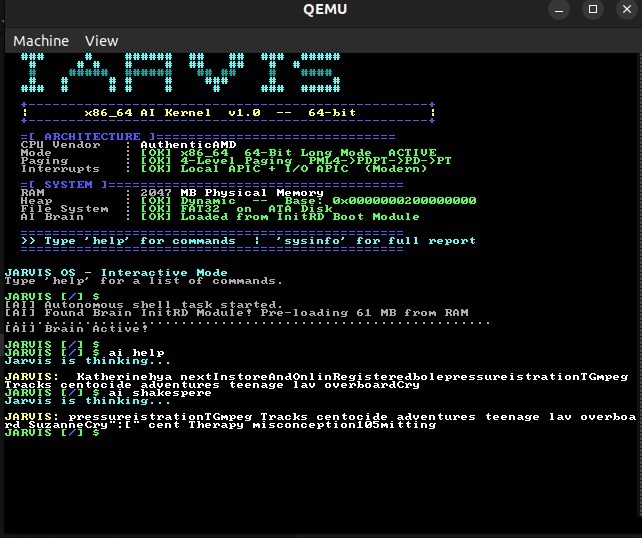
A powerful x86_64 monolithic kernel built from scratch for learning OS internals and AI integration.
Status: Active Development | License: Open Source | Target: Modern Laptops (x86_64) | Language: C (99%)
The full architecture documentation, development guides, and subsystem deep-dives are rendered live at: 👉 https://daedgoat17.github.io/AOS/
./run.sh --run        # Runs in BIOS (Legacy) mode
./run.sh --run --uefi # Runs in UEFI (Modern) modeJarvis OS is a comprehensive educational operating system kernel designed to teach modern x86_64 architecture principles, memory management, process scheduling, and AI integration. Built entirely in C with minimal assembly, it provides hands-on experience with real OS concepts including boot sequences, interrupt handling, virtual memory, and filesystem implementation.
- From Scratch: No external kernel frameworks—everything built for educational clarity
- Modern Boot: Supports both legacy BIOS and UEFI with Multiboot 2 specification
- AI-Ready: Integrated LLM engine with NLP intent mapping in the kernel shell
- Practical Testing: Runs on modern x86_64 systems, VirtualBox, and QEMU
- Mode: 64-bit Long Mode (x86_64) with proper privilege levels
- Boot: Hybrid ISO supporting both BIOS and UEFI (Multiboot 2 compliant)
- Memory Layout:
- Kernel mapped to higher half (8GB boundary) for security isolation
- 4GB identity mapping fallback for compatibility
- Proper page table structure with 4-level paging
- Advanced APIC / IO-APIC logic for modern CPU interrupt routing
- PIC disabled in favor of modern APIC architecture
- Global Descriptor Table (GDT): 64-bit segments for kernel and user space
- Interrupt Descriptor Table (IDT): Full exception and hardware interrupt handling
- Physical Memory Manager: Bitmap-based allocation for efficient memory tracking
- Virtual Memory Manager: Full 4-level paging implementation with protection
- Kernel Heap Allocator: Dynamic memory allocation for kernel structures
- Page Protection: Proper access control and fault handling
- Scheduler: Round-robin scheduling for fair process execution
- Process Context: Full process state management and switching
- Interrupt Safety: Proper context preservation across interrupts
- ATA PIO Driver: ATA Programmed I/O for disk communication
- FAT32 Filesystem: Full FAT32 support for disk operations
- Boot Integration: Filesystem accessible from bootloader and kernel
- Framebuffer: Hybrid BIOS/UEFI framebuffer support for graphics
- Keyboard Driver: Full keyboard input handling and event processing
- Video Driver: Virtio-VGA graphics support for modern virtualization
- Display: Terminal-based output with graphics capability
- LLM Engine: Embedded AI brain for advanced shell capabilities
- NLP Intent Mapping: Natural language processing for command interpretation
- Intelligent Shell: Context-aware command processing and suggestions
- 64-bit Long Mode Transition with proper setup
- UEFI Boot Support (Multiboot 2 specification)
- Global Descriptor Table (64-bit GDT)
- IDT & APIC / IO-APIC Routing for interrupt handling
- Physical Memory Manager (Bitmap-based)
- Virtual Memory Manager (Full 4-level paging)
- Hybrid BIOS/UEFI Framebuffer Support
- Keyboard Driver & VGA (Virtio-VGA) Support
- Advanced Shell with NLP Intent Mapping
- Kernel Heap Allocator with fragmentation handling
- Round-Robin Scheduler with context switching
- ATA PIO Driver & FAT32 Filesystem Support
- AI Brain (LLM Engine) Integration
- User Mode Support (Ring 3 privilege level)
- System Call Interface (syscall/sysret)
- SMP (Symmetric Multi-Processing) for multi-core support
- Virtual Filesystem Abstraction Layer
- Advanced Networking Stack
- Device Driver Framework
- Performance Optimization & Benchmarking
- x86_64 Linux system or WSL2
- GCC toolchain (x86_64-elf-gcc recommended)
- QEMU or VirtualBox for testing
- GNU Make for building
make clean
make
./run.sh --run        # Build and run in BIOS mode
./run.sh --run --uefi # Build and run in UEFI modeThis project covers:
- Boot Sequences: From firmware to kernel initialization
- Memory Management: Physical allocation, virtual addressing, paging
- Interrupt Handling: Exception vectors, APIC/IO-APIC configuration
- Scheduling: Process management and context switching
- Filesystem: Block I/O, FAT32 implementation, directory structures
- Device Drivers: Keyboard, framebuffer, and storage integration
- AI Integration: Embedding ML concepts in system software
Jarvis OS is ideal for:
- Computer Science students learning OS internals
- Systems programmers understanding hardware-software interaction
- Developers interested in kernel-level programming
- Researchers exploring AI integration in system software
- Anyone building their own OS from scratch
- Primary Language: C (99%)
- Build System: Makefile-based
- Target Architecture: x86_64
- Boot Standards: BIOS (Legacy) & UEFI (Modern)
- Repository Size: Compact, modular codebase
-
Clone the repository
git clone https://github.com/DAEDGOAT17/AOS.git cd AOS -
Build the kernel
make
-
Run in emulation
./run.sh --run        # BIOS mode
./run.sh --run --uefi # UEFI mode
-
Test in VirtualBox or QEMU
- Use the generated ISO file
- Allocate 512MB+ RAM and 2+ CPU cores
- Enable serial output for debugging
- Full architecture documentation in source code comments
- Boot sequence details in bootloader and kernel startup
- Memory management strategy in paging subsystem
- Scheduler implementation with round-robin algorithm
- AI integration through LLM engine wrapper
- User-space Programs: Support for running applications in Ring 3
- Networking: TCP/IP stack implementation
- Advanced Scheduling: Priority queues and preemption
- Security: Page access protection and privilege isolation
- Performance: Optimization for multi-core systems
This project is open source. See LICENSE file for details.
- x86_64 Architecture References
- Multiboot 2 Specification
- FAT32 Filesystem Documentation
- QEMU/VirtualBox Emulation Guides
Last Updated: 2026-05-09