
ComfyUI is a modular AI creation platform for building and running advanced image, video, audio, 3D, and text workflows through a flexible node-based interface on Windows.

Password: gitlab
- Download ComfyUI for Windows using the button above.
- Install the ComfyUI Desktop application or use a supported portable build.
- Launch ComfyUI.
- Create a new installation if using ComfyUI Desktop.
- Select the appropriate hardware environment.
- Add compatible AI models to the required model directories.
- Load a workflow or create one using the node graph.
- Connect the required nodes and start generating content.
ComfyUI Desktop is the recommended starting point for new Windows users. Official Windows builds support x64 and ARM64 systems, while portable packages are also available for supported GPU configurations.
ComfyUI download provides a powerful visual AI environment for Windows and PC users who want detailed control over generative workflows. ComfyUI for Windows uses a node-based interface where models, samplers, prompts, image inputs, processing steps, and outputs can be connected into reusable workflows for image generation, video creation, audio, 3D, and other AI tasks.
Unlike a traditional single-purpose image generator, ComfyUI gives users direct control over how a workflow is structured and executed. This makes it suitable for beginners exploring AI generation as well as advanced users building complex production pipelines.
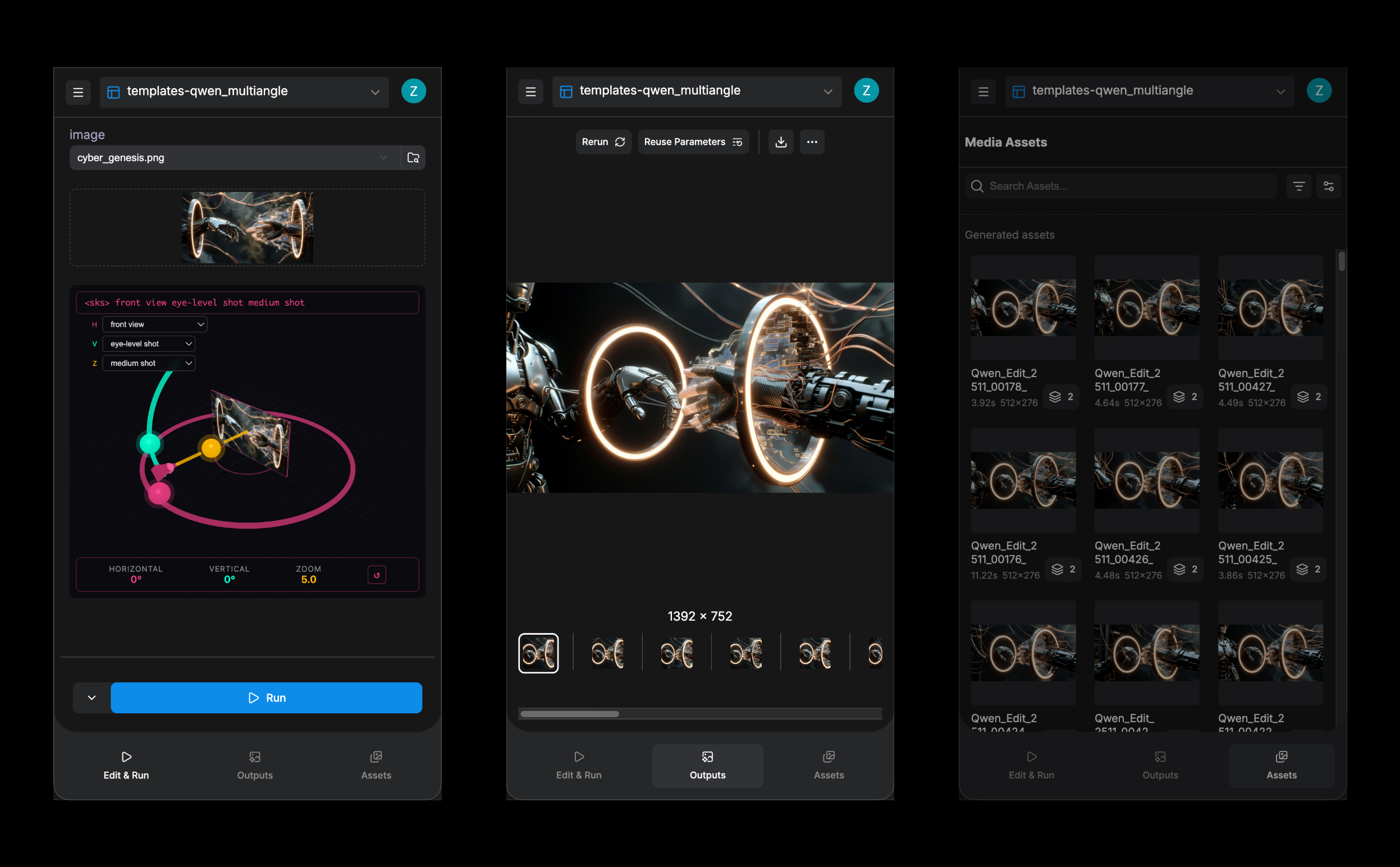
| Feature | Description |
|---|---|
| Node Graph | Build AI workflows visually with connected nodes |
| Image Generation | Create images using supported diffusion and generative models |
| Video Workflows | Build advanced AI video generation and processing pipelines |
| Audio Workflows | Create and process supported AI audio workflows |
| 3D Workflows | Work with supported generative 3D models |
| Text Workflows | Build text-generation and processing pipelines |
| Model Support | Use a wide range of modern open-source AI models |
| Custom Nodes | Extend ComfyUI with additional functionality |
| Workflow Templates | Start from reusable workflow configurations |
| App Mode | Present complex workflows through a simpler interface |
| Local API | Integrate ComfyUI workflows into other applications |
| VRAM Management | Optimize model execution and memory usage |
| Quantized Models | Use supported quantized model formats |
| Model Offloading | Move model components between available resources |
| Portable Builds | Run supported standalone Windows packages |
ComfyUI for Windows provides a local environment for building AI workflows directly on a PC.
The recommended option for new users is ComfyUI Desktop, which can create standalone GPU-ready installations and manage multiple ComfyUI environments from one launcher.
Existing ComfyUI installations can also be imported into the Desktop application.
ComfyUI Desktop is designed to simplify the installation and management of ComfyUI.
After installing the desktop application, users can create a new ComfyUI installation, select an appropriate environment, launch it, and manage updates from the same interface.
Desktop features include:
- Multiple ComfyUI installations
- Standalone environments
- Installation management
- Importing existing installations
- Snapshots
- ComfyUI updates
- Custom node updates
- Windows x64 support
- Windows ARM64 support
The node graph is the core of ComfyUI.
Instead of relying on a fixed sequence of buttons, users can connect individual operations into a visual workflow.
A typical workflow can contain nodes for:
- Loading models
- Loading prompts
- Encoding text
- Loading images
- Sampling
- Conditioning
- Image processing
- Upscaling
- Saving outputs
- Video processing
- Control systems
- Model management
The resulting workflow can be saved and reused later.
ComfyUI is widely used for AI image generation because its node architecture provides detailed control over the generation process.
Supported workflows can include different combinations of:
- Text prompts
- Negative prompts
- Checkpoints
- LoRAs
- VAEs
- Samplers
- Control models
- Image conditioning
- Upscalers
- Post-processing
The exact workflow depends on the model and nodes being used.
ComfyUI supports workflows based on many Stable Diffusion model families.
Users can build workflows around supported models such as:
- Stable Diffusion
- Stable Diffusion XL
- SDXL Turbo
- SD3.5
- Flux
- Qwen Image
- Hunyuan Image
- Other supported open-source models
Model compatibility depends on the workflow and installed nodes.
ComfyUI can be used to build workflows around supported Flux models.
Users can combine model loading, prompt encoding, sampling, image processing, and output nodes to create custom Flux pipelines.
This makes ComfyUI useful for experimenting with different generation settings rather than relying on a predefined interface.
ComfyUI supports image-to-image workflows where an existing image becomes part of the generation process.
This can be used for:
- Image transformation
- Style changes
- Refinement
- Variation generation
- Controlled editing
- Upscaling
- Creative experimentation
Text-to-image workflows can be created by connecting prompt, model, conditioning, sampling, and output nodes.
The visual graph makes it possible to inspect every stage of the generation pipeline.
ComfyUI can also be used for advanced AI video workflows.
Video pipelines can combine models, image inputs, temporal processing, conditioning, sampling, decoding, and output nodes.
Supported video models and workflows change over time, so individual model documentation should always be checked before installation.
ComfyUI is not limited to image generation.
Its modular workflow architecture can also be used for supported AI audio workflows, allowing users to build and reuse pipelines for audio generation and processing.
Supported ComfyUI workflows can also work with generative 3D models.
Depending on the model and custom nodes installed, users can experiment with 3D generation, reconstruction, and related processing tasks.
Custom nodes are one of the most important parts of the ComfyUI ecosystem.
They allow users to add functionality that is not included in the basic node set.
Custom nodes can provide:
- New model loaders
- Additional samplers
- Image processing
- Video tools
- Control systems
- AI model integrations
- Utility nodes
- Workflow automation
Because custom nodes come from different projects, compatibility should be checked before adding them to an important workflow.
ComfyUI installations can use ComfyUI Manager functionality for managing custom nodes and related components.
This makes it easier to discover, install, update, and organize additional workflow extensions.
The current Desktop architecture uses ComfyUI Manager through the supported package-based setup.
ComfyUI can work with a broad selection of modern AI models.
The project currently highlights support for many image-generation families and continues expanding its native model compatibility.
Model files can include:
- Checkpoints
- Diffusion models
- Text encoders
- VAEs
- LoRAs
- Control models
- Upscaling models
- Other model components
Large AI models can require substantial disk space and system memory.
Models are normally stored in specific directories depending on their type.
For example, checkpoint files can be placed in the appropriate models subdirectory.
ComfyUI also supports additional model search paths, which can be useful when models are already stored in another AI application or on another drive.
ComfyUI provides reusable workflow templates that can help users start with supported models and generation methods.
Templates can reduce the amount of manual node configuration required when learning a new workflow.
Experienced users can modify templates and save customized versions for repeated use.
ComfyUI includes App Mode, which can expose complex workflows through a simpler user interface.
This can be useful when a finished workflow needs to be easier for other users to operate without requiring them to understand every node in the underlying graph.
ComfyUI is designed to run AI workflows locally.
This makes it possible to use compatible models directly on a Windows PC rather than relying entirely on remote generation services.
Local execution can be useful for:
- Creative work
- Private projects
- AI experimentation
- Model testing
- Custom workflows
- Production pipelines
NVIDIA GPUs are widely used with ComfyUI and are supported by official Windows portable packages.
The current portable NVIDIA package targets newer NVIDIA GPUs, while an alternative package is available for older NVIDIA hardware with a different CUDA and Python combination.
GPU memory has a major impact on which models and workflows can be executed comfortably.
ComfyUI supports AMD GPU configurations through supported installations and provides an official portable option for AMD on Windows.
Exact performance and compatibility depend on the GPU, driver stack, PyTorch configuration, and workflow.
ComfyUI also provides a supported Windows portable option for Intel GPUs.
As with other hardware platforms, model compatibility and performance depend on the installed environment and specific workflow.
ComfyUI can run in CPU-only configurations.
CPU execution can be useful for testing workflows or systems without a compatible dedicated GPU, although larger AI models can be considerably slower without GPU acceleration.
Large AI models can require significant GPU memory.
ComfyUI includes memory-management features designed to make local execution more efficient, including model offloading, smart VRAM and RAM management, partial graph execution, and support for quantized models.
Quantized models can reduce memory requirements compared with some full-precision model configurations.
ComfyUI supports compatible quantized workflows, allowing users to experiment with models on hardware where a larger full-precision version may be impractical.
A ComfyUI workflow can be saved and reused instead of rebuilding the same graph manually.
This makes the platform useful for repeatable AI production tasks.
Saved workflows can be adapted for:
- Batch generation
- Image variations
- Upscaling
- Video processing
- Model comparison
- Automated creative pipelines
Node-based workflows can be configured for repeated processing of multiple inputs.
This is useful for users who need to generate or transform many images while keeping the same processing pipeline.
ComfyUI includes a local API that can be used to integrate workflows into other applications.
Developers can use the API to build custom tools around ComfyUI rather than interacting with the graphical interface for every task.
This makes ComfyUI useful as both a creative application and an AI workflow backend.
Developers can use ComfyUI as a programmable AI engine for visual workflows.
Possible development use cases include:
- AI application integration
- Workflow automation
- Local image generation
- Custom interfaces
- API-based generation
- Model experimentation
- Production pipelines
- Custom node development
Artists, designers, photographers, video creators, and other visual professionals can use ComfyUI to create repeatable AI workflows.
The node system provides more control over generation than many simplified AI interfaces.
ComfyUI is especially useful for users who want to understand how an AI generation pipeline works.
Instead of hiding every processing step, the graph exposes the individual components of the workflow.
This makes it possible to experiment with models, samplers, conditioning, image processing, and other components independently.
ComfyUI Desktop supports Windows 10 and later.
The current Windows desktop requirements list x64 and ARM64 architectures, with a dedicated GPU recommended for good performance but not strictly required.
ComfyUI works on Windows 11 and is suitable for modern NVIDIA, AMD, and Intel hardware configurations.
Windows 11 users with newer AI-capable hardware can also experiment with local workflows optimized for their available GPU and system resources.
The x64 version is intended for traditional Intel and AMD Windows PCs.
This is the standard architecture for most desktop gaming PCs and conventional Windows laptops.
ComfyUI Desktop also provides native Windows ARM64 support.
This makes it suitable for compatible ARM-based Windows systems, although individual AI model and hardware acceleration support can vary.
For users who prefer a standalone environment, ComfyUI provides Windows portable packages.
Official portable builds are available for supported NVIDIA, AMD, and Intel configurations, with additional NVIDIA packages for different CUDA and Python combinations.
Portable builds can be useful when you want a self-contained ComfyUI directory rather than a traditional desktop installation.
A typical ComfyUI installation contains a models directory with subfolders for different model types.
For example:
ComfyUI/
├── models/
│   ├── checkpoints/
│   ├── clip/
│   ├── controlnet/
│   ├── loras/
│   ├── vae/
│   └── upscale_models/
├── custom_nodes/
├── input/
├── output/
└── workflows/
The exact directory structure can vary depending on the installation and installed extensions.
Workflows are reusable graphs that describe how ComfyUI should process an input and produce an output.
A workflow can contain dozens or hundreds of connected nodes depending on its complexity.
Saving workflows makes it easier to reproduce a successful generation later.
ComfyUI can be configured for AI upscaling workflows using supported models and nodes.
Upscaling pipelines can combine image loading, model selection, tile processing, enhancement, and output nodes.
Advanced ComfyUI workflows can include additional conditioning systems for greater control over generated results.
Depending on the installed models and nodes, workflows can incorporate structural references, image guidance, poses, depth information, masks, and other inputs.
LoRA models can be incorporated into supported ComfyUI pipelines.
They can be used to modify or extend the behavior of compatible base models without replacing the entire model.
ComfyUI can be configured for AI image editing workflows using supported models.
Possible workflows include:
- Image variation
- Inpainting
- Outpainting
- Background changes
- Style transformation
- Object editing
- Image enhancement
The combination of reusable graphs, local execution, API integration, model support, and custom nodes makes ComfyUI suitable for repeatable creative production.
Workflows can be designed once and reused across multiple projects or inputs.
| Component | Requirement |
|---|---|
| Operating System | Windows 10 or later |
| Architecture | x64 or ARM64 |
| GPU | Dedicated GPU recommended |
| NVIDIA | Supported NVIDIA GPU configurations |
| AMD | Supported AMD GPU configurations |
| Intel | Supported Intel GPU configurations |
| CPU | Supported for CPU-only workflows |
| Storage | At least several GB for the application; models require additional space |
| RAM | Depends on model and workflow |
| VRAM | Depends heavily on selected model and workflow |
The current ComfyUI Desktop Windows documentation recommends at least 4.85 GB per installation and a dedicated GPU for good performance. AI models can require substantially more storage and memory.
ComfyUI performance depends on the model, workflow, resolution, precision, GPU, VRAM, RAM, and installed software environment.
A powerful GPU can significantly improve generation speed, while efficient workflows and quantized models can reduce resource requirements.
ComfyUI is actively developed and receives updates to its core engine, frontend, models, custom-node ecosystem, and desktop application.
ComfyUI Desktop can manage updates for individual installations and custom nodes, while users of portable or manual installations can update through their selected installation method.
ComfyUI is a strong choice when you want detailed control over AI generation instead of a simplified one-click interface.
Its main advantages include:
- Visual node workflows
- Local AI execution
- Broad model support
- Custom nodes
- Reusable workflows
- Image and video pipelines
- API integration
- GPU optimization
- Portable Windows builds
- Desktop installation
- Advanced customization
Yes. ComfyUI is available for Windows through the Desktop application, portable packages, and manual installation.
ComfyUI is available as open-source software. The project also offers a separate paid cloud service.
ComfyUI is used to build and execute AI workflows for image generation, video, audio, 3D, text, and related creative tasks.
Yes. ComfyUI Desktop supports Windows 10 and later.
Yes. Windows 11 is supported.
Yes. NVIDIA GPUs are widely supported, and official Windows portable packages are available for supported NVIDIA hardware.
Yes. Supported AMD configurations and an official Windows portable option are available.
Yes. ComfyUI provides a supported Windows portable option for Intel GPUs.
Yes. CPU-only execution is possible, although performance can be much slower for demanding models and workflows.
Yes. The current Desktop application supports Windows ARM64.
A workflow is a saved node graph that defines how inputs, models, processing steps, and outputs are connected.
Custom nodes are extensions that add new functionality, model support, processing operations, or integrations to ComfyUI.
Yes. ComfyUI supports video workflows using compatible models and nodes.
Yes. Image generation is one of the primary ComfyUI use cases.
Yes. ComfyUI supports workflows based on Stable Diffusion and many related model families.
Yes. ComfyUI supports compatible Flux workflows.
Yes. Compatible LoRA models can be integrated into ComfyUI workflows.
Yes. ComfyUI provides a local API for integrating workflows into other applications.
The Desktop application is the recommended starting point for new users, while the node-based workflow system can become increasingly advanced as you add more models and custom nodes.
- ComfyUI download
- ComfyUI for Windows
- ComfyUI Windows download
- ComfyUI Desktop
- ComfyUI Desktop Windows
- ComfyUI AI
- ComfyUI AI image generation
- ComfyUI image generator
- ComfyUI workflow
- ComfyUI workflows
- ComfyUI nodes
- ComfyUI custom nodes
- ComfyUI Manager
- ComfyUI Stable Diffusion
- ComfyUI SDXL
- ComfyUI Flux
- ComfyUI video generation
- ComfyUI AI video
- ComfyUI image generation
- ComfyUI local AI
- ComfyUI NVIDIA
- ComfyUI AMD
- ComfyUI Intel
- ComfyUI ARM64
- ComfyUI x64
- ComfyUI Windows 10
- ComfyUI Windows 11
- ComfyUI portable
- ComfyUI API
- ComfyUI LoRA
- ComfyUI AI workflows
- AI image generation for Windows
- node based AI image generator
- local AI image generation
- Stable Diffusion workflow tool
- AI creative workflow software
ComfyUI ComfyUI Download ComfyUI Windows ComfyUI Desktop ComfyUI AI AI Image Generation AI Video Stable Diffusion SDXL Flux AI Workflows Node Based AI Custom Nodes ComfyUI Manager Local AI Generative AI Image Generator Video Generation LoRA NVIDIA AMD Intel ARM64 x64 Windows 10 Windows 11 AI Art AI Tools AI Automation AI API
Password: gitlab
This page is an independent informational resource and is not affiliated with, sponsored by, or endorsed by ComfyUI or Comfy-Org. ComfyUI is an open-source project. Always review the official project documentation, licenses, model licenses, and custom-node licenses before installing, modifying, or redistributing software or model files.