
A headless CMS suite for .NET 8: an event-sourced engine, opt-in modules, an admin UI, and a PWA kit.




BarakoCMS is a headless, API-first CMS built on FastEndpoints and Marten (event sourcing over PostgreSQL). The core stays small and generic; everything else, from accounting and analytics to email, file storage and auth providers, ships as opt-in modules you compose per project. It comes with a Next.js admin UI that surfaces your content and every installed module, and it's multi-tenant out of the box.
The name Barako comes from kapeng barako, a bold Philippine coffee varietal, hence the coffee-bean mark. The full-module image is "Barako"; the lean core is "Decaf".
Reachable. No sales call, no partner tier, no procurement cycle, no discovery call. Clone it and it runs. That is the part deliberately not for sale.
Free at any scale. MPL-2.0, no seat cap, no revenue cap, no metered AI, and every module in this repository included rather than sold separately. The contributor terms bound the licence grant to OSI-approved licences, so this cannot be closed later even if someone wanted to.
Not an enterprise vendor. There is no SLA, no support contract, no compliance pack for procurement, no continuity guarantee. If your evaluation involves legal and a security questionnaire, that is a real gap and you should weigh it. What you get instead is the whole system, the reasoning behind it in DECISIONS.md, and the ability to fix anything yourself.
Versioning. Semantic within a major. Public members are not removed or resignatured inside a major version; the old form is kept and marked obsolete with a removal version at least one major away. See CHANGELOG.md.
Named here rather than discovered later. All of these are real:
| Multi-language content | No variants. One language per content item |
| Multi-site | Tenancy is not the same primitive |
| Approval workflow | "Workflow" here means automation rules, not draft, review and sign-off |
| Media library | File upload and download exist; cropping, focal points and variants do not |
| Forms builder | Absent |
| GraphQL | REST only |
| Managed hosting | Self-host or nothing |
If any of those is load-bearing for your project, Umbraco is free too, MIT licensed, and has all of them. That is a genuine recommendation, not a hedge.
- Quick start · Live demo · The admin · Modules
- Frontend kit · Architecture
- How the pieces fit · Module, or core? · Why this and not that
- Docs · Support · License
The fastest path is the quickstart bundle, the full suite (core + every module),
the admin UI, and PostgreSQL, from prebuilt images, driven by one documented .env. No build, no
clone.
curl -O https://raw.githubusercontent.com/BaryoDev/barakoCMS/master/quickstart/docker-compose.yml
curl -O https://raw.githubusercontent.com/BaryoDev/barakoCMS/master/quickstart/.env.example
cp .env.example .env      # then set DB_PASSWORD, JWT_KEY (32+ chars), ADMIN_PASSWORD
docker compose up -d- Admin UI → http://localhost:3000 · API → http://localhost:5005 · health at
/health - Every module ships in the image and stays off/mock until you add its keys, so you grow into Umami analytics, Resend email, social sign-in, and the rest without touching the compose.
See quickstart/README.md for every variable, enabling modules, and going behind a domain with TLS. To build from source instead, see the getting-started guide.
https://playground.baryo.dev/barakocms. Sign in as demo_admin / BarakoDemo2026!. The API
is at https://playground.baryo.dev/barakocms-api (health).
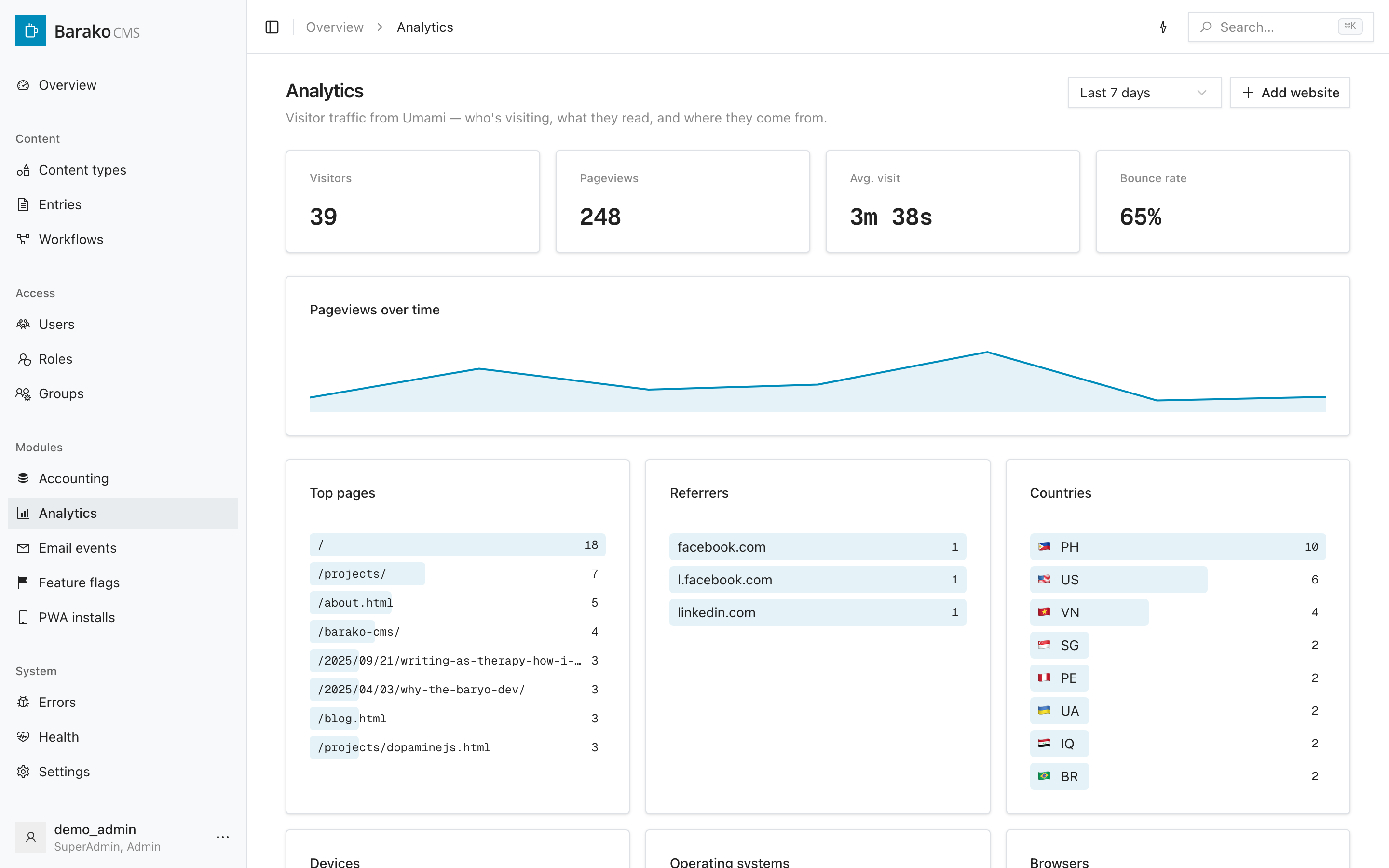
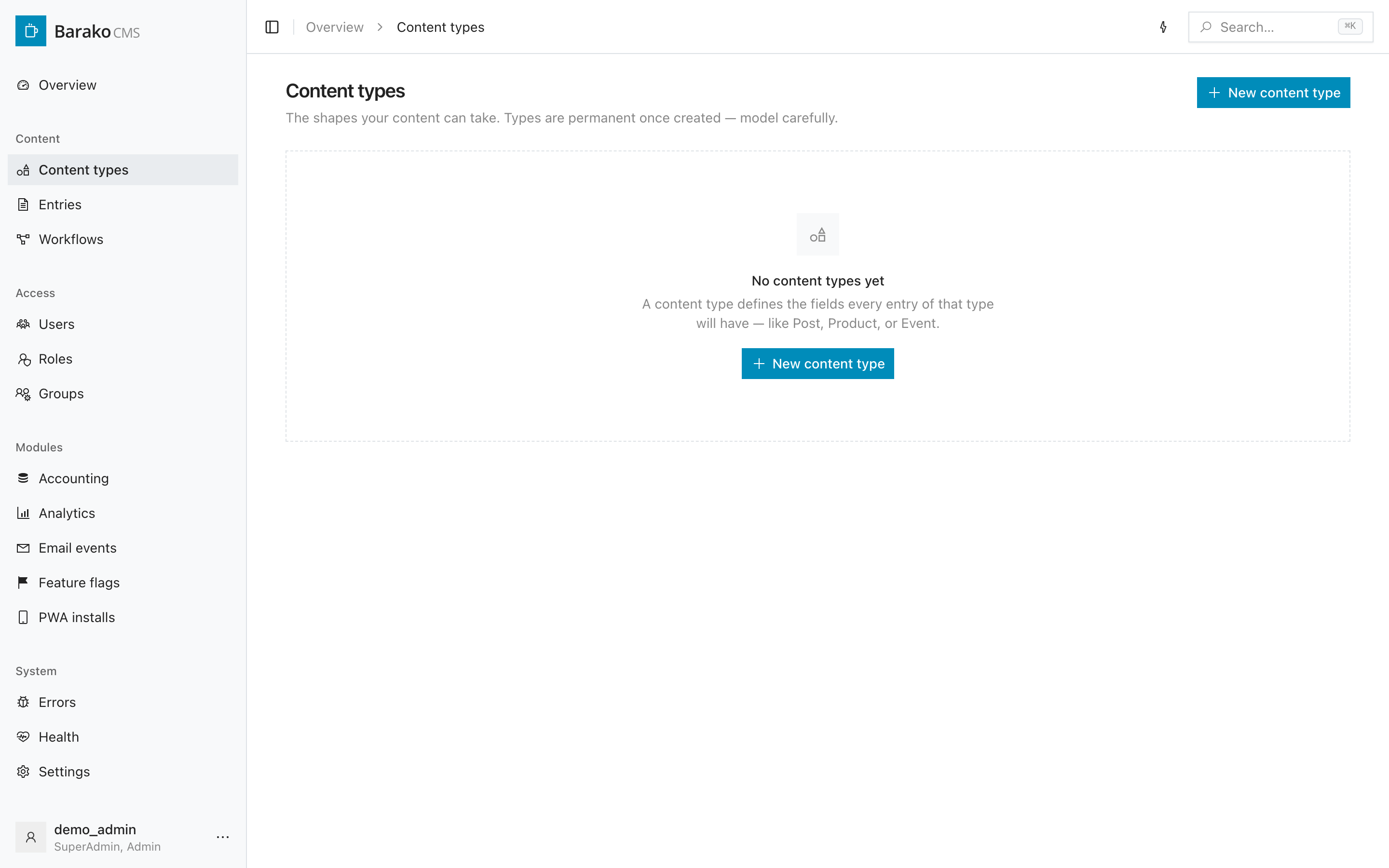
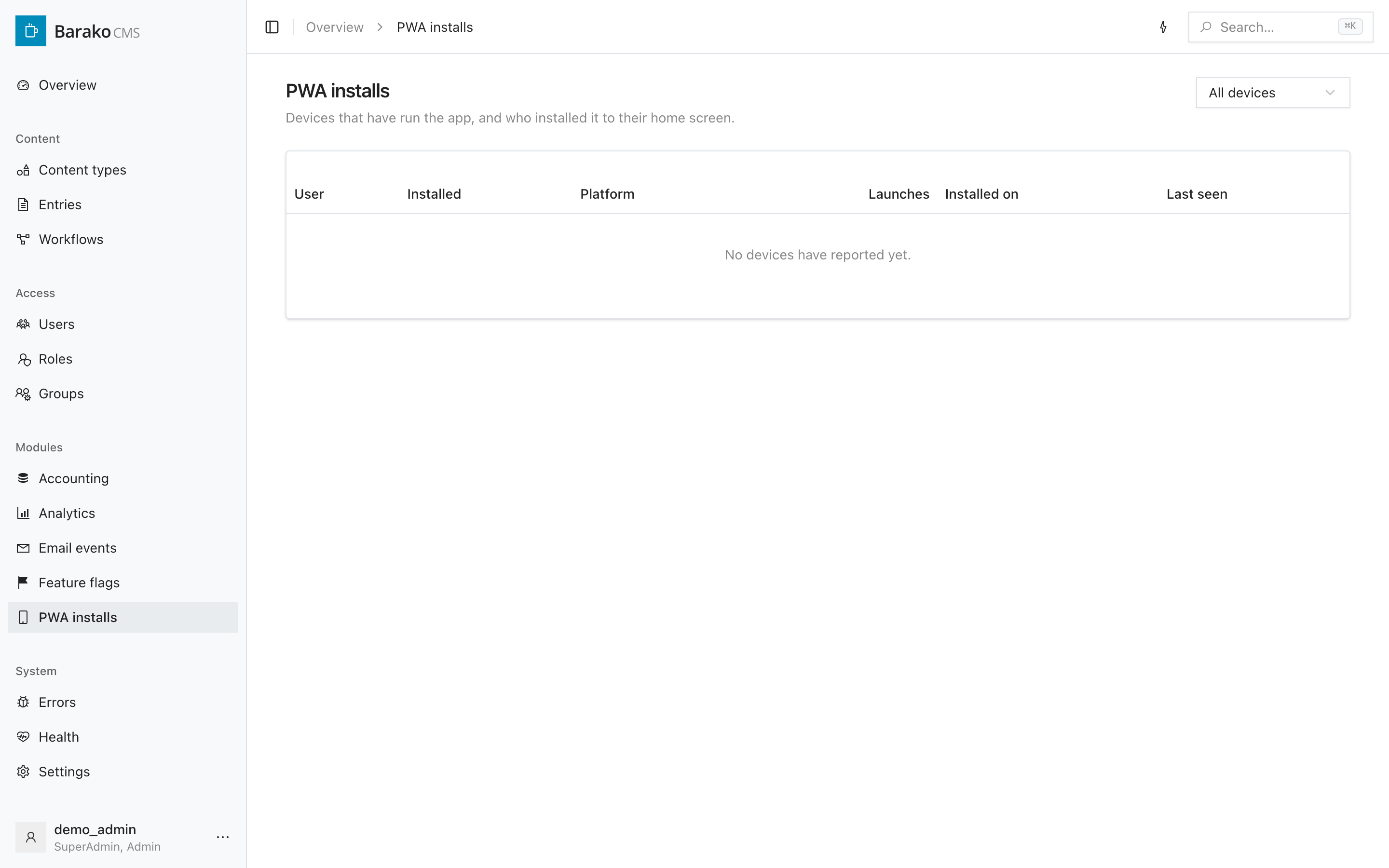
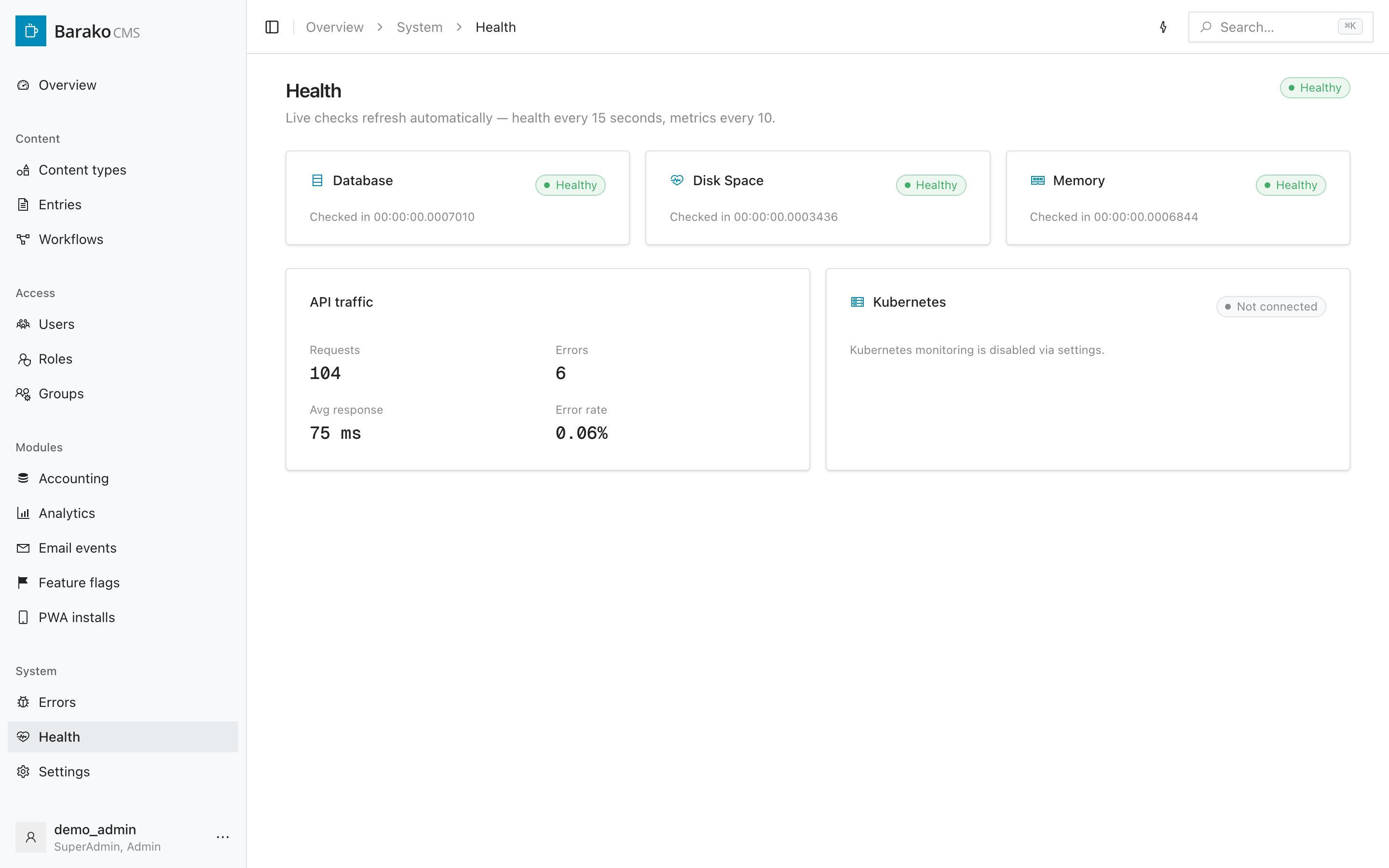
A Next.js admin for modeling content, managing access, and running the system. Installed modules appear automatically as their own sections, so the admin is a window into your whole deployment.
- Content. Define content types with typed fields (including per-field sensitivity/masking), write and version entries, and automate with workflows.
- Access. Users, roles, and groups with fine-grained RBAC.
- Multi-tenancy. Auto-scopes to your tenant on sign-in, with a switcher to move between the tenants you belong to; all data reloads under the one you pick.
- Module sections. Accounting, Analytics, Email events, Feature flags, PWA installs, and more, each shown only when its module is installed.
 |
 |
 |
 |
Core stays lean and generic. Capabilities ship as optional NuGet modules you opt into per
project, through the same IBarakoModule contract you can implement yourself.
| Module | Package | What it adds |
|---|---|---|
| Accounting | BarakoCMS.Accounting |
A double-entry ledger: chart of accounts, balanced journal entries, balances, and per-account ledgers. |
| Import | BarakoCMS.Import |
Bulk import .xlsx/CSV into content via Talaan, through the CMS's own validation, permissions, and event sourcing. |
| Files | BarakoCMS.Files |
File upload/download stored in Postgres via Marten: receipts, photos, documents. |
| Email.Resend | BarakoCMS.Email.Resend |
An IEmailService over the Resend API, plus a delivery webhook and an email-events feed (bounces/complaints). |
| DeviceTrust | BarakoCMS.DeviceTrust |
Remembers trusted devices; step-up OTP when a new one signs in. |
| ExternalAuth | BarakoCMS.ExternalAuth |
"Continue with Google / GitHub / Facebook / LinkedIn" via OAuth, behind one master switch. |
| FeatureFlags | BarakoCMS.FeatureFlags |
Create, toggle, and target flags by tenant, user, or percentage: viewable/toggleable in the admin. |
| Portability | BarakoCMS.Portability |
Export/import content-type definitions and data as a JSON bundle, for backup, migration, and seeding. |
| Diagnostics | BarakoCMS.Diagnostics |
Captures client-side (browser) errors and shows a deduped, resolvable error log in the admin. |
| Analytics.Umami | BarakoCMS.Analytics.Umami |
A server-side proxy over self-hosted Umami: visitors, pages, referrers, countries, devices, plus registering sites and verifying install. |
| Pwa | BarakoCMS.Pwa |
Tracks PWA installs / installed-app launches (anonymous or tied to the signed-in user) so the admin shows who installed the app. |
| AI | BarakoCMS.AI |
Semantic search over published content using a self-hosted embedding model (Ollama by default), with no third-party API key. Indexes only public fields; results are re-checked as published + public at query time. |
Enable the ones you want when you register the CMS:
builder.Services.AddBarakoCMS(builder.Configuration, modules =>
{
    modules.Add(new BarakoCMS.Accounting.AccountingModule());
    modules.Add(new BarakoCMS.Email.Resend.ResendEmailModule());
    modules.Add(new BarakoCMS.Analytics.Umami.UmamiAnalyticsModule());
    modules.Add(new BarakoCMS.Pwa.PwaModule());
    modules.Add(new BarakoCMS.AI.AiModule()); // semantic search (Ollama)
    // …add only what you need
});

await app.RunBarakoModuleSeedersAsync(); // module baseline data (roles, reference data)
A module contributes DI services, its own Marten documents, FastEndpoints endpoints, and seed data,
implementing only the hooks it needs. See each module's page in the docs.
Want every module in one image? Use ghcr.io/baryodev/barako-cms (Barako, full suite); for the
lean core, ghcr.io/baryodev/barako-cms-decaf (Decaf) and add your own.
BarakoCMS is headless, so you build the frontend. These BaryoDev packages help:
- @baryodev/pwa-kit. Service-worker registration + versioned
caching, install hints, standalone viewport handling, and a PWA-install reporter that pairs with the
Pwamodule (reportPwaStatus). - @baryodev/read-aloud. A "listen to this" control using Microsoft Edge's free neural voices: a Node TTS endpoint plus a framework-free browser reader with word highlighting. Drop it into any frontend for accessible, read-aloud content.
- Talaan. A zero-dependency
.xlsx/CSV reader used by the Import module.
- Event-sourced. Content changes are events in Marten; you get full version history, rollback, and async projections for free.
- Modular. Core knows nothing about any module; the
IBarakoModulecontract wires services, documents, endpoints, and seeders. Build your own the same way. - Multi-tenant. Conjoined tenancy: one deployment, many tenants; data scoped by tenant, with global users/roles and per-tenant memberships.
- RBAC. Roles, groups, and per-content-type permissions, with field-level sensitivity/masking.
- MFA. Optional TOTP second factor (authenticator app) with one-time recovery codes; enforced on every sign-in path (password, email code, social), with encrypted secrets and replay protection.
- Public delivery. Anonymous, cacheable, published-only reads for content types explicitly
opted in to public delivery, with
keyword search (
/api/public/{type}/search), an RSS feed (/api/public/{type}/feed.xml), and, via the AI module, semantic search (/api/public/{type}/semantic). It emits only allowlisted public fields, fail-closed by design. - Scheduled publishing. Arm any item with a publish and/or unpublish time; a background sweep promotes and retires content on schedule, per tenant, emitting real events so workflows fire.
- FastEndpoints + Kestrel. Minimal-overhead HTTP; health checks and Prometheus metrics built in.
                      ┌──────────────────────────────────────────┐
   admin UI ─────────▶│  /api/contents  /api/content-types       │
   (Next.js)          │  /api/users  /api/roles  /api/workflows  │  authenticated
   barako-client ────▶│  /api/api-keys  /api/tenants  /api/audit │
                      └──────────────────────────────────────────┘
                                        │
   any browser ──────▶  /api/public/{type}  ──┐                     anonymous, and only
                        /feed.xml  /search    │                     for types opted in
                                        ┌─────▼──────┐
                                        │    CORE    │
                                        │            │
                                        │  content   │  a document bag + a runtime
                                        │  types     │  type definition, not classes
                                        │  auth      │  JWT, API keys, MFA, RBAC
                                        │  tenancy   │  conjoined: one database, many tenants
                                        │  delivery  │  opt-in, field-masked, fail-closed
                                        │  workflows │  events in, actions out
                                        └─────┬──────┘
                                              │ IBarakoModule
                    ┌─────────────────────────┼─────────────────────────┐
                    ▼                         ▼                         ▼
              Accounting                    Files ◀── Files.S3        AI
              FeatureFlags                  Import                    Analytics.Umami
              Portability                   Email.Resend              Pwa
              ExternalAuth                  DeviceTrust               Diagnostics
                    │                         │                         │
                    └─────────────────────────┼─────────────────────────┘
                                              ▼
                                       PostgreSQL (Marten)
                                  documents + event streams, one store
A module contributes services, its own document types, its own endpoints and its own seed data. Core knows none of them by name. See MODULES.md for the contract.
The question every contribution runs into, so here is the answer we use.
It is a module if any of these is true:
| Test | Because |
|---|---|
| Two sensible projects would disagree about wanting it | Core is what nobody gets a choice about, and every choice belongs to the person deploying |
| It names a vendor, a product or a business domain | Resend, Umami, S3, Accounting. Core's vocabulary is content, users, tenants, permissions and nothing else |
| It brings a dependency core does not already carry | An SDK, an API client, a file format. Core's dependency list is a promise to everyone who installs it |
| Removing it still leaves a working CMS | If content, auth, tenancy and delivery survive without it, it was never core |
These tests assume the module contract can express what you are building. Where it cannot, the
answer is core by necessity rather than by principle, and it should say so out loud: Workflows
below is exactly that case.
It is core if any of these is true:
| Test | Because |
|---|---|
| Something else cannot work without it | Content, content types, auth, tenancy, permissions. Everything stands on these |
| Core would need to know it exists | A module registers itself. The moment core needs an if for your feature, it is not a module |
| It changes the shape of content, auth, tenancy or delivery | These are contracts other people's modules depend on, so they are not extendable from outside |
When it is genuinely borderline, build it as a module. Moving a module into core later is additive. Pulling a feature out of core is a breaking change for everyone who installed it.
Rules are easier to trust when someone has applied them to their own work, so here is the result of doing that.
Features/Club/ failed the naming test and has been removed. It was per-club membership
management at /api/club/*, added during the multi-tenancy rollout and never called by the admin UI,
barako-client, or anything else in the repo. "Club" is product vocabulary rather than CMS
vocabulary, and core had no business carrying it.
Worth separating two things it was easy to conflate. The endpoints were product-shaped and are
gone. The Membership model they operated on is emphatically core: it is the join between a user
and a tenant carrying their roles and status there, and TokenIssuer reads it to decide which roles
go into a token, PermissionResolver reads it to answer every authorisation question, and
CheckTenantAccessAsync uses it to decide whether a token may be minted for a tenant at all. Multi
tenancy and authorisation both stop working without it.
The lesson is the one that generalises: a feature failing the rules does not mean the model under
it is wrong. Ask what the endpoints are called and what the data actually is, separately. If tenant
member management is wanted back, it belongs in Features/Tenants/ under /api/tenants/members,
built deliberately rather than inherited from a product that needed it once.
Features/Workflows/ looks like a module and is correctly core. It is the largest feature here,
plenty of deployments would not want it, and it names no vendor. By the first and fourth tests it
looks like an obvious module. It is core for a specific reason: it runs as a Marten projection,
registered in core's store setup, and IModuleSchema deliberately exposes only For<T>(). A module
can add document types; it cannot add a projection. So workflows could not be a module today even if
we wanted it to be. That is a real limit of the contract rather than a judgement about workflows, and
if a module ever needs a projection, that is the thing to change first.
Features/Audit/ looks optional and is correctly core. One endpoint, and a CMS runs fine without
anyone reading the audit log. But fifteen core files across auth, content and permissions write
audit entries. The reading endpoint is the visible tip of something core produces continuously.
Making it a module would leave core writing records that nothing could read, which is worse than
either alternative.
Features/ApiKeys/, Me/, Settings/, Monitoring/ all stay. They are thin, but each is part
of a contract other things stand on: API keys are an authentication method, Me is the self-service
half of auth, settings are read by core, and health and metrics are how a container is judged alive.
Marten, not EF Core. Content is a Dictionary<string, object> whose shape comes from a
ContentTypeDefinition created at runtime by a user. There are no compile-time entities for an ORM
to map, and migrations cannot describe a type somebody invents after deployment. Marten stores each
document as JSONB and queries into it, which is the same shape as the problem. With EF Core we would
be building a document store on top of an ORM built to avoid one.
Marten, not a plain document store. Version history and rollback are features, not extras.
/api/contents/{id}/history reads the event stream directly (Events.FetchStreamAsync), so history
is the source of truth rather than an audit table kept alongside and hoped to agree with it. Reading
a past version applies today's field-sensitivity rules on the way out, so a field made private since
is masked in history too rather than being readable by anyone who knows the version endpoint.
PostgreSQL, not SQL Server. Partly forced: Marten is built on Postgres and its event store uses Postgres features, so choosing Marten chooses Postgres. Independently right though. JSONB with GIN indexing is what makes a runtime-defined content bag queryable at all, and PostgreSQL can be self-hosted on most platforms with no database licence fee, which matters for something people deploy themselves.
FastEndpoints, not Minimal API. The module system is the reason.
services.AddFastEndpoints(o => o.Assemblies = moduleAssemblies) discovers endpoints inside module
DLLs, which is what lets a module ship its own routes without core knowing they exist. With Minimal
API every module's endpoints would have to be hand-registered by the host, and "install the package,
restart, done" stops being true. The rest is a bonus: route, roles and validator sit together in one
class, so an endpoint's authorisation is visible in the same file as its handler rather than in a
policy table somewhere else.
FastEndpoints, not MVC controllers. One class per operation, so a change to one endpoint touches
one file. Controllers accumulate: a ContentController with eight actions is eight reasons to open
the same file and eight chances to break something unrelated.
No repository pattern. IDocumentSession is injected directly into endpoints. A repository over
Marten would be a thin pass-through that hides the query capabilities we actually use, and the usual
argument for one, swapping the database, is not a swap we plan or could make cheaply.
Conjoined tenancy, not database-per-tenant. One database, tenant-scoped rows. A database per tenant means migrations to run N times and N connection pools, for isolation that row-level scoping plus a token check already gives. It is also not reversible: conjoined to separate is a data migration, and separate to conjoined is worse.
Public delivery opt-in, not opt-out. It used to be opt-out, and modelling members or a ledger as content produced an anonymous endpoint for them that nobody asked for. On a live deployment it did exactly that. Publishing is a decision, so it is made explicitly, and field-level sensitivity still applies on top.
AutoCreate.CreateOnly in production, not CreateOrUpdate. It creates missing objects so a
fresh database works, and never alters an existing one, so it cannot attempt a live migration that
is not safe. A single-to-conjoined event tenancy change is exactly such a migration, and it took down
content creation on a live instance once. Development keeps CreateOrUpdate for a fast local loop.
Deep dives live in the docs: event sourcing, concurrency, content modeling, extending BarakoCMS, and deployment.
Full docs at https://baryo.dev/docs: getting started, guides, module references, API reference, and architecture. Changelog: CHANGELOG.md.
How this project is built and shipped: AI Development Lifecycle, the breakable-staging discipline, version-gated releases, and how tests gate every promotion.
BarakoCMS is free and open-source under MPL-2.0. If it's useful to you:
- ⭐ Star the repo so others find it
- ☕ Ko-fi (one-time) or GitHub Sponsors (monthly)
- 🐛 Contribute. Issues, PRs, docs
- 📧 Commercial/enterprise support: arnelirobles@gmail.com
People who have made barakoCMS better. Not only code: a bug report that saves a weekend, or a review that stops a wrong issue being built, counts as much here as a pull request.
 BabuBahir 🐛 👀 🤔 |
 ahmdkaml 🤔 |
Follows the all-contributors specification. To add someone, comment
@all-contributors please add @username for bug, code on any issue or pull request.
MPL-2.0 for the core and every module, so there is one licence across the suite.
MPL is file-level copyleft: use it in commercial and closed-source products freely, and if you modify a barakoCMS source file, share that file's changes. Your own code stays yours.
Packages up to BarakoCMS 3.1.1 were released under Apache-2.0 and remain so; 3.2.0 onward is MPL-2.0.
Author: Arnel Robles · @arnelirobles · arnelirobles@gmail.com
Come say hello on Discord for questions, ideas, or just to tell us what you're building.
If barakoCMS is useful to you, a star helps other people find it. Contributions are welcome: code, documentation, module icons and artwork all count. See CONTRIBUTING.md.