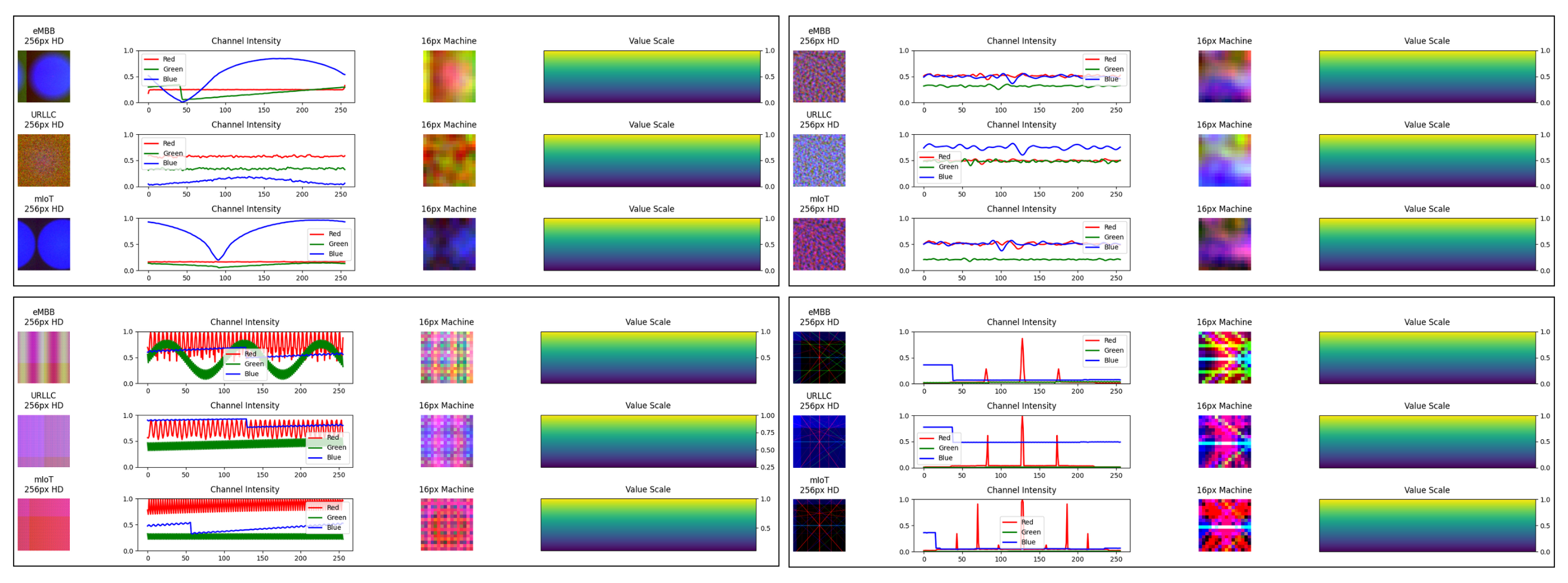
SlicVision-F2I is a novel multimodal dataset that transforms network slice Key Performance Indicators (KPIs) into multiple visual representation patterns, designed to bridge telecommunications and computer vision for next-generation network management systems.
SlicVision-F2I contains 30,000 samples of network slice KPIs converted into four distinct visual representation patterns. Each sample represents one of three primary 5G network slice types:
- eMBB (Enhanced Mobile Broadband): High-throughput applications
- URLLC (Ultra-Reliable Low-Latency Communications): Mission-critical services
- mIoT (Massive Internet of Things): Large-scale sensor networks
The dataset enables novel approaches to network management by providing multiple visual representations of identical underlying KPI data, facilitating multimodal learning and cross-pattern analysis.
- Multi-pattern representations: Four distinct visual encodings per sample
- Comprehensive KPI coverage: 10 key network performance metrics with realistic correlations
- Real-world characteristics:
- Simulated measurement noise (5-15%)
- Missing values (~5% random missingness)
- Natural class imbalance (eMBB:URLLC:mIoT = 2:1:7 ratio)
- Production-ready:
- Pre-normalized values (0-1 range)
- Missing value imputation (median-based)
- Consistent 16×16 RGB image format
- Anomaly Detection: Train vision-based models to identify slice performance degradation
- Slice Classification: Multi-class recognition of slice types from KPI patterns
- Quality Prediction: Regression models for QoE metrics from visual representations
- Multimodal Learning: Study cross-pattern relationships and ensemble methods
- Data Augmentation: Test augmentation strategies across different representations
- Explainable AI: Visual interpretability of network performance decisions
- Teaching Resource: Visual demonstrations of network performance concepts
- Benchmarking: Standard dataset for comparing network AI approaches
- Prototyping: Rapid development of visual network analytics tools
SlicVision-F2I/
├── numeric_data.csv            # Raw KPI measurements and slice labels
├── guided_patterns.npy         # Physics-inspired representations
├── perlin_patterns.npy         # Procedural noise-based patterns
├── wallpaper_patterns.npy      # Structural/geometric patterns
└── fractal_patterns.npy        # Recursive branching patterns
| Field | Description | Normalized Range | Physical Range |
|---|---|---|---|
| slice_type | Slice category | - | {eMBB, URLLC, mIoT} |
| delay | End-to-end latency | [0,1] | 0-100ms |
| jitter | Latency variation | [0,1] | 0-50ms |
| loss | Packet loss rate | [0,1] | 0-10% |
| throughput | Data rate | [0,1] | 0-300Mbps |
| retransmissions | Retry rate | [0,1] | 0-10% |
| packet_discard_rate | Drop rate | [0,1] | 0-10% |
| rssi | Signal strength | [0,1] | -100dBm to -30dBm |
| snr | Signal quality | [0,1] | 0-40dB |
| cpu_util | Processor usage | [0,1] | 0-100% |
| mem_util | Memory usage | [0,1] | 0-100% |
| label | Class encoding | {0,1,2} | - |
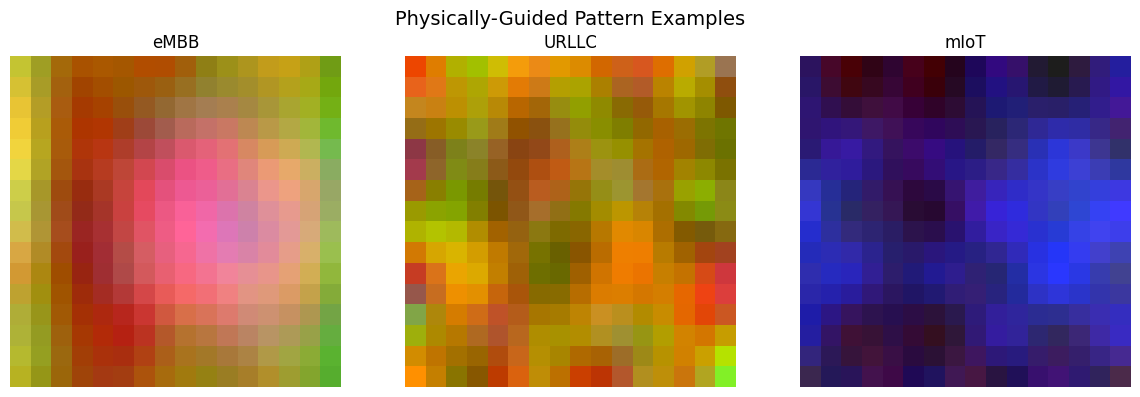
Design Philosophy: Embeds physical network relationships into spatial patterns
Key Characteristics:
- Gaussian blobs represent concentrated performance metrics
- Wave patterns show periodic behaviors
- Color channels encode related KPI groups:
- 🔴 Red: Latency metrics (delay/jitter/loss)
- 🟢 Green: Throughput metrics
- 🔵 Blue: System health (RSSI/SNR/resource usage)
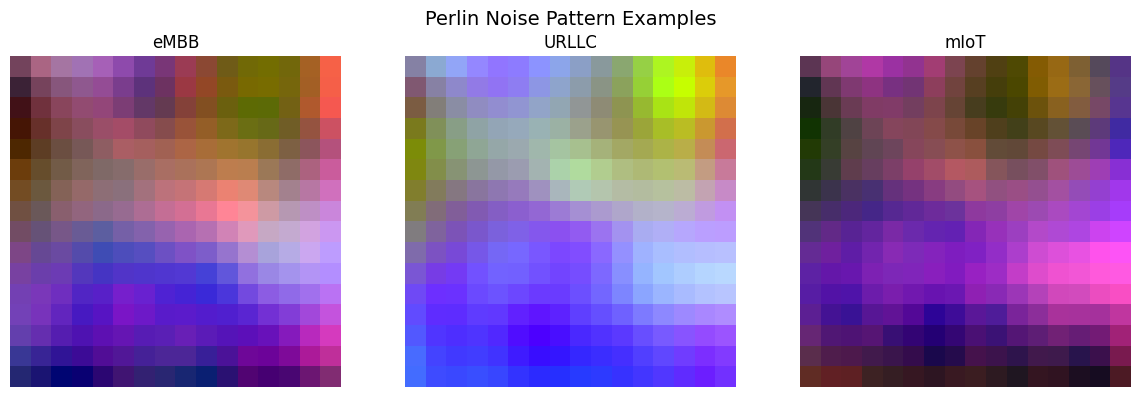
Design Philosophy: Organic patterns reflecting natural network variability
Key Characteristics:
- Noise parameters dynamically adjust to KPI values
- Each channel has unique generation parameters:
- Red: Octaves scaled by loss rate
- Green: Persistence set by throughput
- Blue: Lacunarity adjusted by SNR
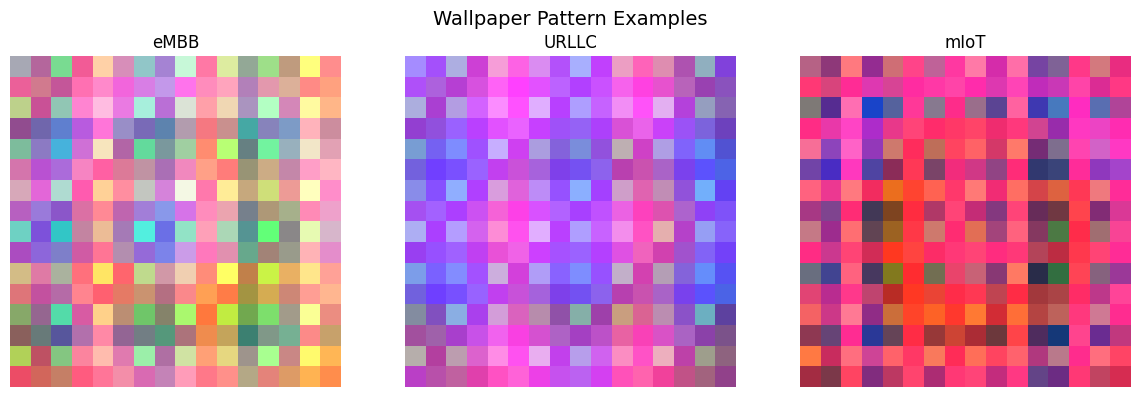
Design Philosophy: Structural representations of network periodicities
Key Characteristics:
- Combines multiple geometric primitives:
- Stripes → Throughput levels
- Grids → Packet loss patterns
- Radial gradients → Signal strength
- Parameters adapt to slice type characteristics
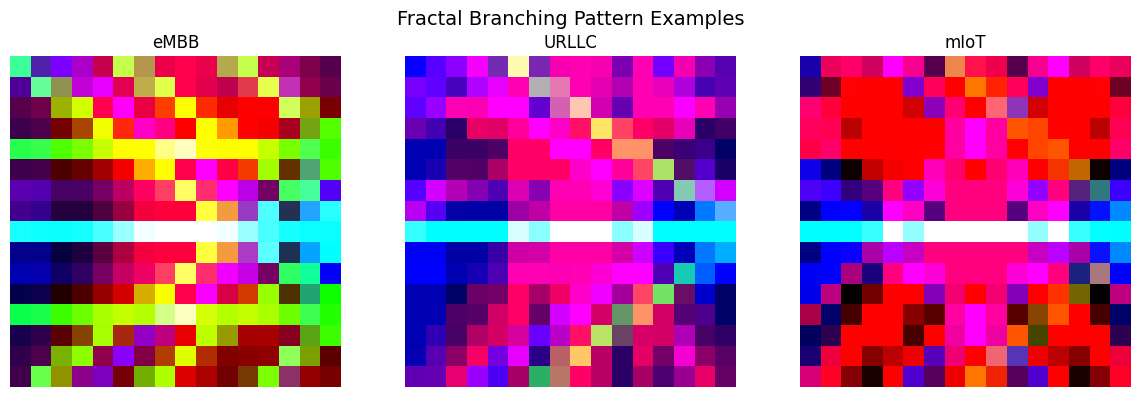
Design Philosophy: Tree structures modeling network paths
Key Characteristics:
- Branching complexity scales with traffic volume
- Leaf density reflects packet success rates
- Trunk stability indicates connection reliability
- Color gradients show resource utilization
| Category | Metric | Value |
|---|---|---|
| Samples | Total | 30,000 |
| eMBB | 6,000 (20%) | |
| URLLC | 3,000 (10%) | |
| mIoT | 21,000 (70%) | |
| Patterns | Resolution | 16×16px |
| Color Channels | 3 (RGB) | |
| Size on Disk | ~550MB | |
| Quality | Missing Values | 4.8% |
| Noise Level | 5-15% | |
| Normalization | Min-Max [0,1] |
This dataset-testing folder contains the core analysis scripts for evaluating the SlicVision-F2I dataset using both traditional machine learning and deep learning approaches.
dataset-testing/
├── traditional_ml_analysis.py  # Classical ML analysis script
├── cnn_analysis.py            # CNN-based evaluation script
└── requirements.txt           # Python dependencies
traditional_ml_analysis.py - Evaluates the raw KPI data using classical machine learning algorithms.
- Tests three classifier types:
- Random Forest
- Support Vector Machine (SVM)
- XGBoost
- Generates:
- Feature importance plots
- Correlation matrices
- Classification report
python traditional_ml_analysis.pycnn_analysis.py - Evaluates all four visual pattern types using convolutional neural networks.
- Tests four pattern representations:
- Guided patterns
- Perlin noise patterns
- Wallpaper patterns
- Fractal patterns
- Generates:
- Training history plots
- Model accuracy comparisons
- Classification reports
python cnn_analysis.pyInstall dependencies with:
pip install -r requirements.txtrequirements.txt contents:
numpy
pandas
scikit-learn
xgboost
tensorflow
matplotlib
seaborn
- First run traditional ML analysis:
python traditional_ml_analysis.py- Then run CNN evaluation:
python cnn_analysis.pyTo extend this testing suite:
-
For traditional ML:
- Add new classifiers to
traditional_ml_analysis.py - Append evaluation metrics to existing JSON output
- Add new classifiers to
-
For CNN models:
- Create new architecture in
cnn_analysis.py - Follow the existing pattern comparison framework
- Create new architecture in
Common issues:
- Shape mismatches: Ensure numpy files match CSV metadata length
- Memory errors: Reduce batch size in CNN training
- NaN values: Confirm all KPIs are properly imputed in the CSV
@misc{rafi2025slicevision,
  author       = {Rafi, Abid Hasan and Johora, Mst. Fatematuj and Bhowmik, Pankaj},
  title        = {{SliceVision-F2I: Synthetic Visual Dataset for Network Slicing}},
  year         = {2025},
  publisher    = {Mendeley Data},
  version      = {V1},
  doi          = {10.17632/68xp3vszsz.1},
  url          = {https://doi.org/10.17632/68xp3vszsz.1}
}- Abid Hasan Rafi
Dataset creation, pattern design, KPI modeling - Mst. Fatematuj Johora
Dataset management, Data documentation - Pankaj Bhowmik
Dataset evaluation, Process supervision
Any sort of use, reproduction, or distribution of the content in this repository without proper citation or reference to the author is strictly prohibited. Please respect the intellectual property and give appropriate credit when using or referencing any part of this work.