Gemini Meet is an open-source platform for deploying autonomous AI agents into video calls (Google Meet, Zoom, Teams).
Unlike simple transcription bots, Gemini Meet agents are active participants: they can speak, use tools (via MCP), and reason in real-time using Google's Gemini models (or other providers).
The platform consists of two parts:
- The Dashboard: A web interface to manage agents, configure tools (MCP), and view live meeting details.
- The Agents: Ephemeral Docker containers spawned by the dashboard that actually join the meetings.
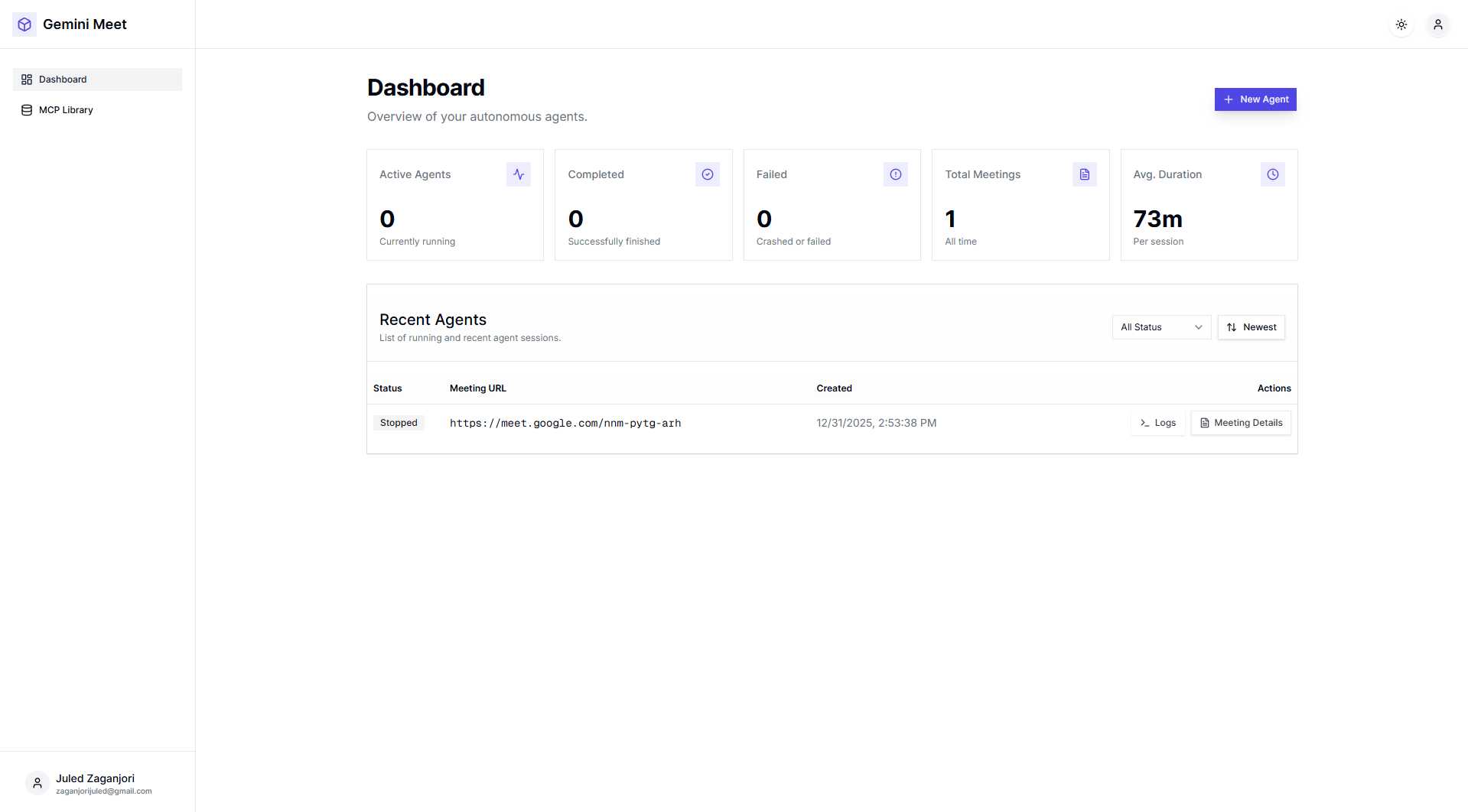
The recommended way to use Gemini Meet is through the Dashboard.
- Docker (Must be running)
- Node.js 18+ & npm
- PostgreSQL (Or use the docker-compose in
dashboard/directory) - Google Cloud Credentials (For Gemini)
The dashboard needs these images to spawn agents. You must build them first.
Make sure the .env file is present in the root directory.
cp .env.example .envFill in the required variables.
Then build the images:
# 1. Build the base image
docker build -f docker/Dockerfile -t ghcr.io/gemini-meet:latest .

# 2. Build the agent image (used by the dashboard)
cd dashboard
docker build -f Dockerfile.agent -t gemini-meet-with-node:latest .
cd ..Navigate to the dashboard directory and follow the setup there.
cd dashboard
cp .env.example .env
# Edit .env with your Google Cloud Credentials and Database URL
npm install
npm run init-db
npm run dev
Detailed Setup: For full database setup and production deployment instructions, see the Dashboard Documentation.
Open http://localhost:3000, click "New Agent", and paste your Google Meet or Zoom link.
Gemini Meet is designed for production with built-in Datadog integration. We track:
- Browser Health: Detect if the agent fails to join or if UI selectors break.
- Real-time Latency: Monitor STT drift and LLM response times.
- Tool Usage: Track which MCP tools your agents are using.
We provide pre-configured Datadog Monitors and Workflows in the datadog_exports/ directory ready for import.
For setup instructions and metric definitions, see TELEMETRY.md.
If you don't want the UI and just want to run a single agent container from the command line:
Create a .env file in the root directory:
# Google Cloud (Required for Gemini)
GOOGLE_CLOUD_PROJECT=your-project-id
GOOGLE_CLOUD_LOCATION=us-central1
GOOGLE_APPLICATION_CREDENTIALS=vertex_credentials.json

# Datadog Observability (Optional)
DD_SITE=datadoghq.com
DD_API_KEY=your-datadog-api-key
DD_APP_KEY=your-datadog-app-key
DD_LLMOBS_ENABLED=1
DD_LLMOBS_ML_APP=gemini-meet-agent
DD_TRACE_AGENTLESS=true

# Model Settings
GEMINI_MEET_MODEL_PROVIDER=google
GEMINI_MEET_MODEL_NAME=your-model-name # e.g. gemini-1.5-flash

# Optional: ElevenLabs TTS
ELEVENLABS_API_KEY=your-elevenlabs-keydocker run \
--env-file .env \
-v "$(pwd)/vertex_credentials.json:/app/vertex_credentials.json" \
ghcr.io/gemini-meet/gemini-meet:latest --client "https://meet.google.com/abc-defg-hij"uv run gemini_meet/main.py --client "https://meet.google.com/abc-defg-hij"- Google Gemini Integration: Native support for Google's latest Gemini models via Vertex AI for superior multimodal reasoning.
- Privacy & Local Execution: Fully capable of running locally with Ollama (LLM), Whisper (STT), and Kokoro (TTS) for complete data sovereignty.
- Technical Interview Assistant: Can solve coding problems and act as a pair programmer.
- Live Interaction: Responds in real-time by voice or chat.
- Cross-platform: Google Meet, Zoom, and Microsoft Teams.
- Flexible Model Support: While optimized for Gemini, supports other providers like OpenAI or Anthropic if needed.
- Modular Audio: Supports Whisper/Deepgram (STT) and Kokoro/ElevenLabs (TTS).
We recommend using the DevContainer for a consistent environment.
- Open in VS Code.
- Click "Reopen in Container".
- Run
uv run gemini_meet/main.pyto start the server locally.
You can use the CLI to start a single agent from the command line.
uv run gemini_meet/main.py --client "https://meet.google.com/abc-defg-hij"For a full list of command line options, run:
uv run gemini_meet/main.py --helpThis project is licensed under the MIT License.
This project is a fork of Joinly.