-
Notifications
You must be signed in to change notification settings - Fork 580
DESCRIBE query implemented, resolves #479 #1913
New issue
Have a question about this project? Sign up for a free GitHub account to open an issue and contact its maintainers and the community.
By clicking “Sign up for GitHub”, you agree to our terms of service and privacy statement. We’ll occasionally send you account related emails.
Already on GitHub? Sign in to your account
Closed
Closed
Changes from all commits
Commits
Show all changes
7 commits
Select commit
Hold shift + click to select a range
c336dd2
Added Describe Query
ms1901 b1ef7e9
Describe with multiple resources
ms1901 db6d3e3
Graph() added
ms1901 7cb7381
Merge branch 'RDFLib:master' into master
ms1901 2856f65
[pre-commit.ci] auto fixes from pre-commit.com hooks
pre-commit-ci[bot] 330aed8
Update README.md
ms1901 07ceef5
Update README.md
ms1901 File filter
Filter by extension
Conversations
Failed to load comments.
Loading
Jump to
Jump to file
Failed to load files.
Loading
Diff view
Diff view
There are no files selected for viewing
This file contains hidden or bidirectional Unicode text that may be interpreted or compiled differently than what appears below. To review, open the file in an editor that reveals hidden Unicode characters.
Learn more about bidirectional Unicode characters
This file contains hidden or bidirectional Unicode text that may be interpreted or compiled differently than what appears below. To review, open the file in an editor that reveals hidden Unicode characters.
Learn more about bidirectional Unicode characters
This file contains hidden or bidirectional Unicode text that may be interpreted or compiled differently than what appears below. To review, open the file in an editor that reveals hidden Unicode characters.
Learn more about bidirectional Unicode characters
This file contains hidden or bidirectional Unicode text that may be interpreted or compiled differently than what appears below. To review, open the file in an editor that reveals hidden Unicode characters.
Learn more about bidirectional Unicode characters
This file contains hidden or bidirectional Unicode text that may be interpreted or compiled differently than what appears below. To review, open the file in an editor that reveals hidden Unicode characters.
Learn more about bidirectional Unicode characters
Add this suggestion to a batch that can be applied as a single commit.
This suggestion is invalid because no changes were made to the code.
Suggestions cannot be applied while the pull request is closed.
Suggestions cannot be applied while viewing a subset of changes.
Only one suggestion per line can be applied in a batch.
Add this suggestion to a batch that can be applied as a single commit.
Applying suggestions on deleted lines is not supported.
You must change the existing code in this line in order to create a valid suggestion.
Outdated suggestions cannot be applied.
This suggestion has been applied or marked resolved.
Suggestions cannot be applied from pending reviews.
Suggestions cannot be applied on multi-line comments.
Suggestions cannot be applied while the pull request is queued to merge.
Suggestion cannot be applied right now. Please check back later.
There was a problem hiding this comment.
Choose a reason for hiding this comment
The reason will be displayed to describe this comment to others. Learn more.
It is unclear from the docstrings why this would exist in addition to
Graph.cbdas from a brief glance the docstrings look the same. I don't think we need two methods to get the CBD, we just need one that works.There was a problem hiding this comment.
Choose a reason for hiding this comment
The reason will be displayed to describe this comment to others. Learn more.
See:
Graph.cbd#1914Also you will have to include tests specifically for this function for this PR to be merged, but still I don't think it should exist, if
Graph.cbddoes not do what it says in the docstring it is a bug and should be fixed.There was a problem hiding this comment.
Choose a reason for hiding this comment
The reason will be displayed to describe this comment to others. Learn more.
Hey!
Thanks for your review.
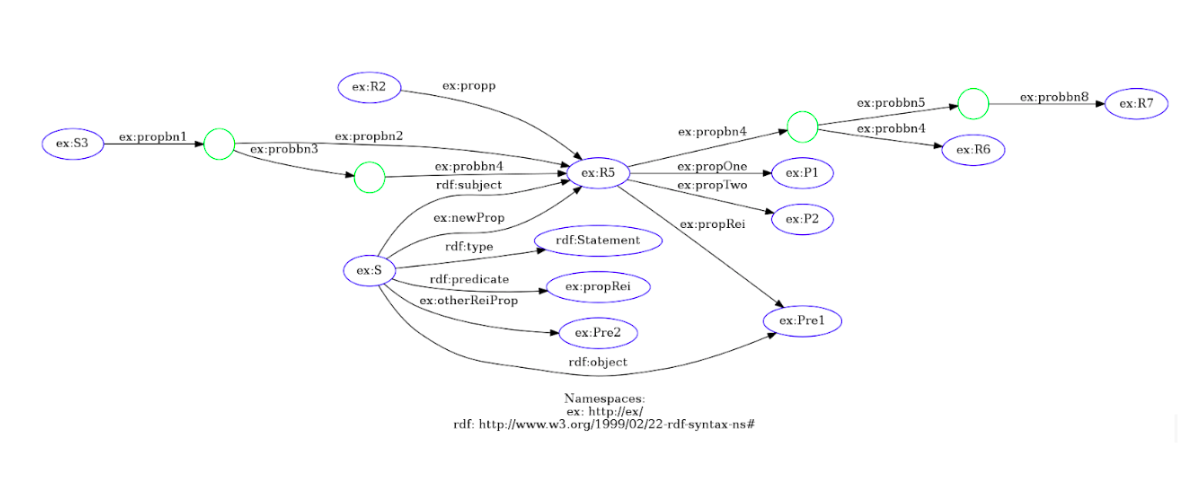
We have included the tests for this describe_cbd function in the test file test_graph_cbd.py as the testCbdDescribeReified() function. The test example which we have included will be able to cover all the cases for the definition of DESCRIBE query. The test example can be visualized as:-
There was a problem hiding this comment.
Choose a reason for hiding this comment
The reason will be displayed to describe this comment to others. Learn more.
The function describe_cbd is a variant of the original CBD implementation. I have modified the function to recursively consider all triples containing the query resource as an object and subject. The original function returns the CBD containing triples where the resource is a subject only. However, for implementing the
DESCRIBEquery, we need all triples containing the resource – both as an object and subject. We also ensure that the blank nodes are recursively resolved – this is in line with the definition ofDESCRIBEquery.Uh oh!
There was an error while loading. Please reload this page.
There was a problem hiding this comment.
Choose a reason for hiding this comment
The reason will be displayed to describe this comment to others. Learn more.
My appologies, in that case you will need tests for SPARQL
DESCRIBEas part of the PR.If it does something different then it should at least have a different docstring which it does not as far as I can tell, and then the next question is, why does it do something different? There is one definition of a Concise Bounded Description, and it is this: https://www.w3.org/Submission/CBD/#definition - if it does something different it should be further qualified, and as SPARQL
DESCRIBEdoes not mandate anything in regards to what should be returned I don't think qualifying it withdescribeis helpful.Can you clarify why? As per the SPARQL 1.1 spec:
https://www.w3.org/TR/2013/REC-sparql11-query-20130321/#describe
And goes on to say:
It does not state that DESCRIBE must return the CBD, but I do expect that if we decide to return the Concise Bounded Description that we return it as defined, in which case
Graph.cbdshould do it, and if it does not should be fixed to do it.There was a problem hiding this comment.
Choose a reason for hiding this comment
The reason will be displayed to describe this comment to others. Learn more.
DESCRIBEshould not return just the CBD, because as we mentioned belowThis is in line with the definition of the
DESCRIBEquery.Apologies for not providing a separate docstring, I can add that to make it well documented. A few things here and there can be improved wrt documentation, I can check that out.
Further,
I have also provided the link to a testing file that has such an example.
If that matches what you expect, we can add that file to the PR. For now, we have just attached the link.
There was a problem hiding this comment.
Choose a reason for hiding this comment
The reason will be displayed to describe this comment to others. Learn more.
But I don't understand why, where does this requirement come from, could you cite some specification that requires this behavior or indicates why you say it needs "all triples containing the resource – both as an object and subject."? If this is just what you as an individual would prefer I don't think it is sufficient justification.
It has to be in our test suite, if it is not then I don't know if it passes (as I won't run it on my computer) and we also can't know if there is a regression.
Uh oh!
There was an error while loading. Please reload this page.
There was a problem hiding this comment.
Choose a reason for hiding this comment
The reason will be displayed to describe this comment to others. Learn more.
To begin with, it will be best to just cite what specification dictates this algorithm/behaviour.
There was a problem hiding this comment.
Choose a reason for hiding this comment
The reason will be displayed to describe this comment to others. Learn more.
fwiw, the result of a "DESCRIBE" query is determined by the service and the definition is sufficiently vague as to prompt the W3 to set
descriptionin double quotes:The EBNF for SPARQL
DESCRIBEsuggests that an implementation that conforms to the spec is going to demand rather more than just defaulting to returning a cbd: