Making wildlife conservation safer with ground-based arboreal camera servicing
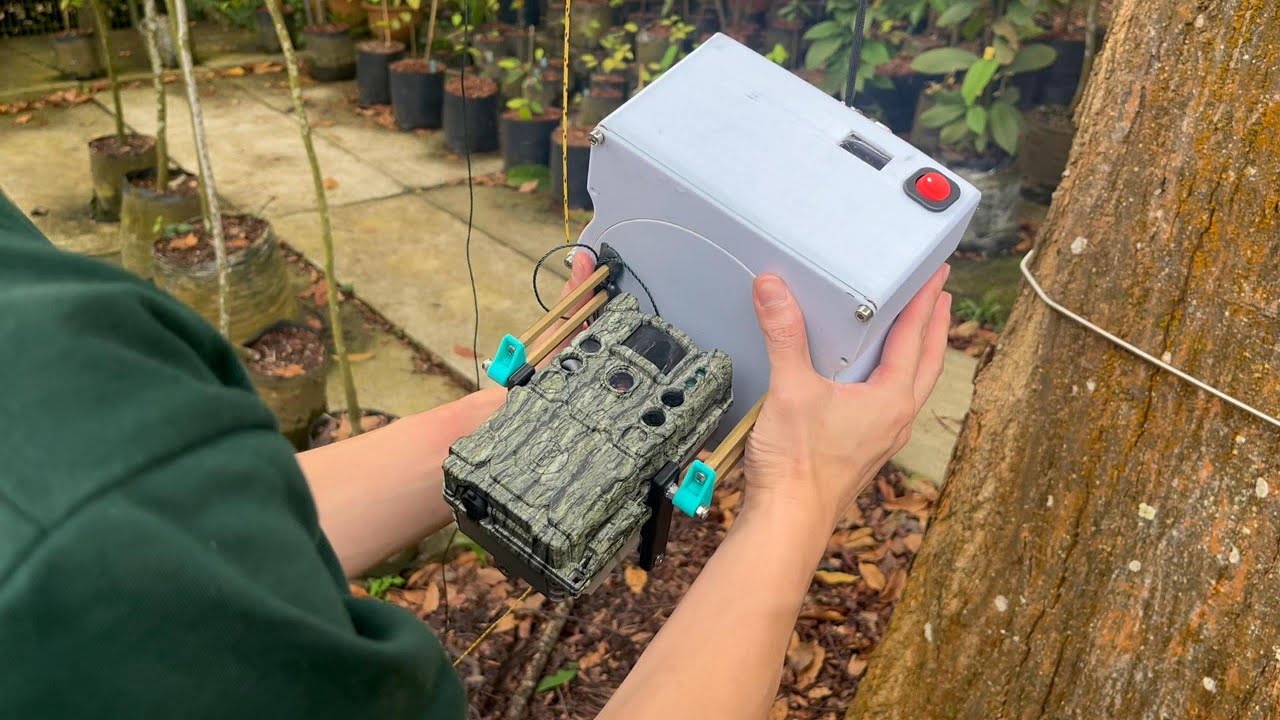
EcoRig is a ground-serviceable rigging system for arboreal camera traps that eliminates the need for repeated tree climbing. After a single installation, all maintenance — battery replacement, SD card retrieval, and camera angle adjustment — is performed entirely from the ground. Field-tested with the National Parks Board Singapore (NParks) at the Singapore Botanic Gardens, surviving two thunderstorms at 15m height.
Built as a Term 5 EPD - Engineering Design Innovation (30.007) Project at Singapore University of Technology and Design (SUTD), Group 16.
Impact: 93.75% reduction in tree climbs — from 8 per year to once every two years per camera trap.

Arboreal camera traps are essential for monitoring endangered canopy species. But maintaining them is hazardous and expensive:

- Trained arborists must climb up to 40m carrying loads up to 15kg, just to retrieve an SD card or replace batteries
- Certification costs exceed $2,000, and firms like Camphora Pte. Ltd. spend $800 to service just five traps
- Maintenance is required every 1–6 months, and delayed servicing causes camera downtime and data loss
- Existing partial solutions (e.g., CanopyCam) still require climbing for angle adjustment and strap loosening
EcoRig addresses all of these — with a rope-based rigging system selected via Pugh chart analysis over legged climbers, grippers, aerial platforms, and human SRT.
- Anchors the EcoRig permanently to the tree trunk
- Ratcheting mechanism allows slow quasi-static expansion as the tree grows (averaging around 12cm over 2 years), while resisting impulsive animal tugs via a bucktooth jam brake
- TPU-covered strap face for friction against bark (µ = 0.6)
- Strap tension designed within the window:
Tm < T < Tg(384N–2500N), keeping T = 400N - Tripod head integrated into buckle — pitch: −35° to +75°, roll: ±360°, yaw: +90°
- Camera module is raised and lowered from the ground via a 3-pulley paracord system
- Magnetic docking latches the camera module securely at the top mount
- Pneumatic tube release actuated from the ground decouples the latch and lowers the camera
- Docking tolerates ±15° pitch and ±3° roll misalignment
- Validated: 0 derailments over 50 cycles; no sheath damage after 100 cycles + 8 days sun/rain
- Worm gear (1:160) drives the pan–tilt mechanism — non-backdrivable, preventing wildlife tampering
- Planetary gearset (1:171.5) developed and evaluated as alternative (worm gear chosen for field robustness)
- Pan: ±90°, Tilt: ±38°
- Repeatability: ±0.7° over 10 repeats to the same setpoint
- Holds 0.42 kg·m (~4.1 N·m) without slip under tamper load
- Wi-Fi SoftAP mode — creates a local access point; any smartphone connects without additional hardware
- HTTP server hosted directly on ESP32-S3; live video streamed over same network
- Pan–tilt control via web app with real-time OV2640 5MP camera feed
- WiFi range: 46m LOS / 27m under canopy; command latency ≈ 210ms
- BMI160 6-axis IMU (gyro + accelerometer) replaces encoders for proprioception
- Kalman filter fuses gyro/accelerometer data for noise-robust angle estimation
- Finite State Machine (FSM) supervises the calibration algorithm
Self-discovers pan–tilt mechanical limits without encoders or limit switches:
- Stall detection — motors sweep until BMI160 gyro angular velocity drops below 3°/s, indicating a mechanical hard stop
- Back-off & re-test — system reverses 350 ms, then re-advances to confirm the exact limit position
- Map usable range — discovered limits saved to flash (NVS via
Preferences); asymmetry auto-compensated (e.g., tilt +28°/−22° → center adjusted); limits reload on next boot
- Labyrinth seal — forces fluids and insects through a tortuous path before reaching electronics; no degradable gaskets
- Validated IP35 (spray nozzle test, no ingress)
- Electronics survived two thunderstorms during NParks field test
| Component | Specification |
|---|---|
| Microcontroller | ESP32-S3 |
| Camera | OV2640 5MP |
| IMU | BMI160 (3-axis gyro + 3-axis accelerometer) |
| Display | SSD1306 OLED (local diagnostics) |
| I²C Mux | TCA9545A (resolves address conflicts between OLED and IMU) |
| Motor Driver | L293DD H-bridge |
| Motors | RS370 DC motors (pan & tilt) |
| Battery | 12V 3000mAh LiPo |
| Power Regulation | DC–DC step-down converter → 5V for ESP32 |
| Peak current draw | ≤3.5A @ 12V (validated in field) |
| Battery life achieved | 21 days (target: 120 days) |
| PCB | Custom — consolidates motor drivers, power distribution, signal routing |
Planetary gearset validated for monkey-tamper resistance:
| Load | Bending Stress | Status |
|---|---|---|
| 3.65 kg | ≈ 3.65 MPa | ✅ Safe |
| 5.17 kg | ≈ 5.17 MPa | ✅ Safe |
| 7.94 kg | ≈ 7.94 MPa |
Gear geometry: 15 teeth, module 1.03mm, face width 7.5mm, 20° full-depth spur, Lewis factor Y = 0.28.
- Upper limit (tree growth):
Tg = Pg · r · w→ 2500 N - Lower limit (monkey + system weight):
Tm = (Ms + M)g / (2µ sin b)→ 384 N - Design tension: T = 400 N
- Spring constants derived: ks = 4.3 N/mm, kc = 9.3 N/mm
| Requirement | Target | Result |
|---|---|---|
| Servicing time | < 20 min | 11:56 ✅ |
| Installation/retrieval | < 30 min | 12:31 / 8:24 ✅ |
| Carry-in weight | < 15 kg | ≤ 4.5 kg ✅ |
| Pan–tilt repeatability | < 1° | ±0.7° ✅ |
| Non-backdrive hold | > 0.35 kg·m | 0.42 kg·m ✅ |
| WiFi latency | < 250 ms | 210 ms ✅ |
| WiFi range (canopy) | > 30 m | 27 m |
| Strap expansion | +17mm @ 260N | 1.5mm @ 520N ✅ |
| Tug resistance | 8 kg @ 5 m/s | No undock ✅ |
| Static sag | < 1° after 30 days | 0.8° after 8 days ✅ |
- Installed at 15m height on a Hopea odorata tree at Singapore Botanic Gardens
- Left in situ for 6 days (retrieved 11 August 2025)
- Survived two thunderstorms with no electronics ingress
- NParks researchers verbally assessed the system as "convenient, safe, feasible, and potentially effective"

4-part assembly, each group < 1.6 kg. No tools required — magnetic latches throughout. Full install or retrieval in ~15 minutes.
Assembly groups:
├── Bag 1: Strap + tripod head mount
├── Bag 2: Camera module (housing + pan-tilt + electronics)
├── Rigging: Paracord + pulley system
└── Control: Smartphone via WiFi
- Battery life (21 days vs 120-day target) — root cause: continuous H-bridge leakage current. Fix: radio duty-cycling, deep sleep scheduling, hardware power-gating
- Corrosion — stainless steel hardware to replace mild steel
- Docking force — magnet upgrade needed (9.3 kg achieved vs 15 kg target)
- Macaque "freak" tampering — chewing through straps/cords not yet addressed
- Long-term deployment — 2-year full cycle not yet experimentally validated
EcoRig won Best Product Demonstration at the SUTD Term 5 Final Project Exhibition.

Christopher Tiong · Gavin Tan · Kwan Jun Jie · Loh Kun Hong · Looi Jun Cheng · Tan Min · Samuel Teoh · Su Keming

Special thanks to Poh Yee, Wan Ting, Marcus and Primeman from NParks Singapore.
Course: Engineering Design Innovation (30.007) — Term 5 Institution: Singapore University of Technology and Design (SUTD) Industry Partner: National Parks Board Singapore (NParks) Cohort: 2027